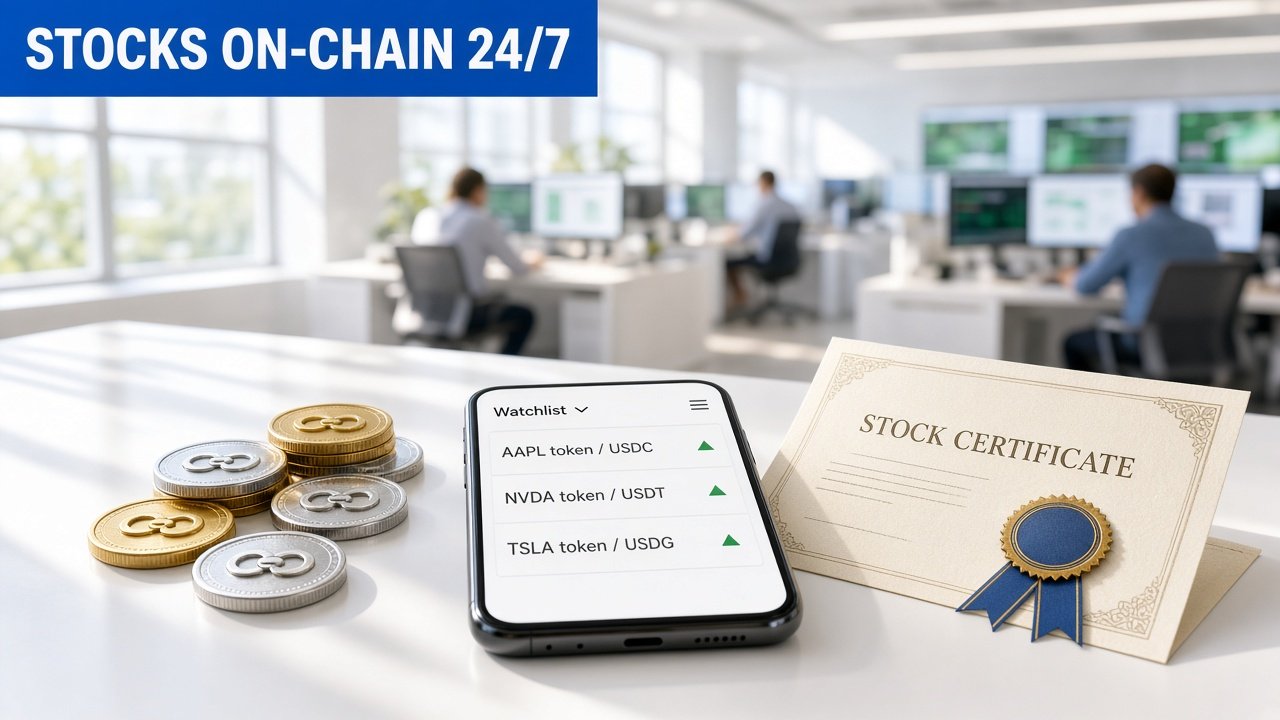
OKXICE, the 50-50 joint venture between crypto exchange OKX and Intercontinental Exchange, the parent of the New York Stock Exchange, published a public notice dated Sunday, Oct. 4, saying it intends to run a tokenized stock venue under the SEC’s new tokenized-securities exemption. The plan is round-the-clock trading of tokenized versions of U.S.-listed shares, settled on a blockchain and priced against dollar stablecoins.
The notice lists 63 stocks. They include Nvidia, Apple, Microsoft, Tesla, Amazon, JPMorgan Chase and Goldman Sachs, plus crypto-linked names such as Coinbase, Circle, Strategy, Robinhood, BitGo and Securitize. Each token would trade against one of three payment stablecoins: USDC, USDG or USDT. The venue says it will operate 24 hours a day, seven days a week.
The rails are specific. Trades would run through Uniswap v4 liquidity pools on XLayer, OKX’s layer-2 network, with an OKXICE smart-contract add-on that checks every wallet. Only wallets holding a non-transferable “soulbound” token can trade or add liquidity. That token is issued after identity checks, anti-money-laundering checks and sanctions screening run by OKX’s U.S. entity. The venue does not run an order book, does not hold customer assets, does not lend and does not sell new shares.
The trust question in any tokenized stock is simple: is there a real share behind the token? The notice says the tokens come from an unaffiliated third party, called only “the Tokenizer,” which holds the underlying shares one-for-one through an SEC-registered, FINRA-member broker-dealer. Tokens are minted only after the shares are bought and held. The notice says holders get the same rights as ordinary shareholders, including dividends, voting and a share of assets in a liquidation.
There are guardrails, and the notice spells them out. Trading in a token stops whenever the underlying stock is halted on its main exchange. If trading in a token breaks the exemption’s volume limits a second time, the venue must pause it for three months. OKXICE keeps admin keys that can pause pools, upgrade contracts and remove wallets. The notice also warns that token prices are set by the pools, not by the stock market, and may differ from the real share price, especially outside regular trading hours or when liquidity is thin.
Plain disclosure, worth reading twice: the venue is not registered with the SEC as an exchange, is not subject to Regulation NMS, and the SEC has not passed on the notice’s accuracy. Its use of the exemption remains subject to SEC oversight. That is how the exemption is built, not a red flag on its own.
Companies get a say. Under the exemption, a venue must notify an issuer and give it 30 days to object. Cerebras Systems has already filed an objection, and its stock is not on the list. Ledger Insights reports the 30-day wait puts the earliest possible start in early November. The notice itself gives no launch date.
OKXICE co-chair Andrew Cuomo called the filing “a landmark step toward a truly global, 24/7 Wall Street.” OKX CEO Star Xu said the future of markets is “real ownership, onchain,” and that “full shareholder rights are what make that possible.”
What happened: an NYSE-linked venture filed a public notice to trade tokenized U.S. stocks on-chain. What has not happened: trading. The next marks are issuer objections and the end of the 30-day window.
Sources: OKXICE public notice; Decrypt; Ledger Insights; The Block