Blog

  • Democrats Want the SEC Back in Charge of Crypto. Keep the Good Parts, Watch the Show.

    Democrats Want the SEC Back in Charge of Crypto. Keep the Good Parts, Watch the Show.

    Opinion. Easton writes Hardwire’s opinion column. Where this piece speculates, it says so.

    The votes in Ohio were barely counted before the new plan leaked.

    On Wednesday, journalist Eleanor Terrett reported that House Democrats are discussing a crypto “market structure” bill for the next Congress. It would grow out of Rep. Maxine Waters’ Crypto Investor and Consumer Bill of Rights, an amendment that never made it into the Clarity Act in 2025. According to three industry sources who spoke with Democratic staffers, ideas on the table include giving the SEC more of a role in supervising crypto markets and a smaller role for the CFTC, plus new ethics rules to restrict the crypto activities of President Trump and other federal officials. Republicans are calling it a “messaging bill.”

    Nobody has filed anything. There is no text and no schedule. But we know where it is pointed.

    Back to the SEC. The Clarity Act’s whole idea was to put most spot crypto trading under the CFTC and stop the SEC from regulating the industry one lawsuit at a time. Flip that around and you hand the keys back to the same agency that spent years telling the industry to “come in and register” without a door to walk through. Democrats will call it consumer protection. I’d call it the old landlord moving back in.

    To be fair, some of it is good. Waters’ 2025 amendment, according to the House Rules Committee record summarized by crypto.news, would have required exchanges to honor withdrawals within 24 hours, keep customer assets separate and safe in a bankruptcy, publish verifiable proof of reserves every month with an accountant’s sign-off, and tell customers within 48 hours of a breach. Anyone who sat locked out of an exchange this fall knows those aren’t crazy asks. Small holders want their coins back on time. That part should survive whoever writes the bill.

    Here’s my speculation, labeled as such. I think the ethics provisions are the real headline, and the market-structure part is the wrapping paper. A bill that pairs “investor rights” with “stop Trump’s crypto” is built for TV hearings and the 2028 campaign, not for getting 60 Senate votes. If I’m right, the real rules for the next two years won’t come from Congress at all. They’ll come from agency guidance and from whichever big banks and exchanges can afford the lawyers. Meanwhile Wall Street keeps tokenizing stocks and bonds under laws it already has. Funny how the rails for the big guys keep getting built while the fight over small holders stays stuck in committee.

    What I’d want to see. Keep the 24-hour withdrawal rule, the monthly proof of reserves and the breach notice, and write them so they apply to every big platform, not just the crypto-native ones. Put ethics rules on everyone in office, both parties and their families, not just the man in the White House. And tell us in plain English which agency is in charge of what, before the next exchange freezes.

    Washington changed hands on Tuesday. Whether ordinary holders get anything out of it depends on whether this becomes a law or just a show.

    Sources: Eleanor Terrett on X, crypto.news, FXStreet, Bitcoin Magazine, CoinDesk.
  • Five Global Banks Form a Tokenization Standards Body. Schroders and Morgan Stanley Put More Assets On-Chain.

    Five Global Banks Form a Tokenization Standards Body. Schroders and Morgan Stanley Put More Assets On-Chain.

    Washington spent Wednesday arguing about what the midterms mean for crypto. Some of the biggest names in traditional finance spent it building tokenized markets anyway.

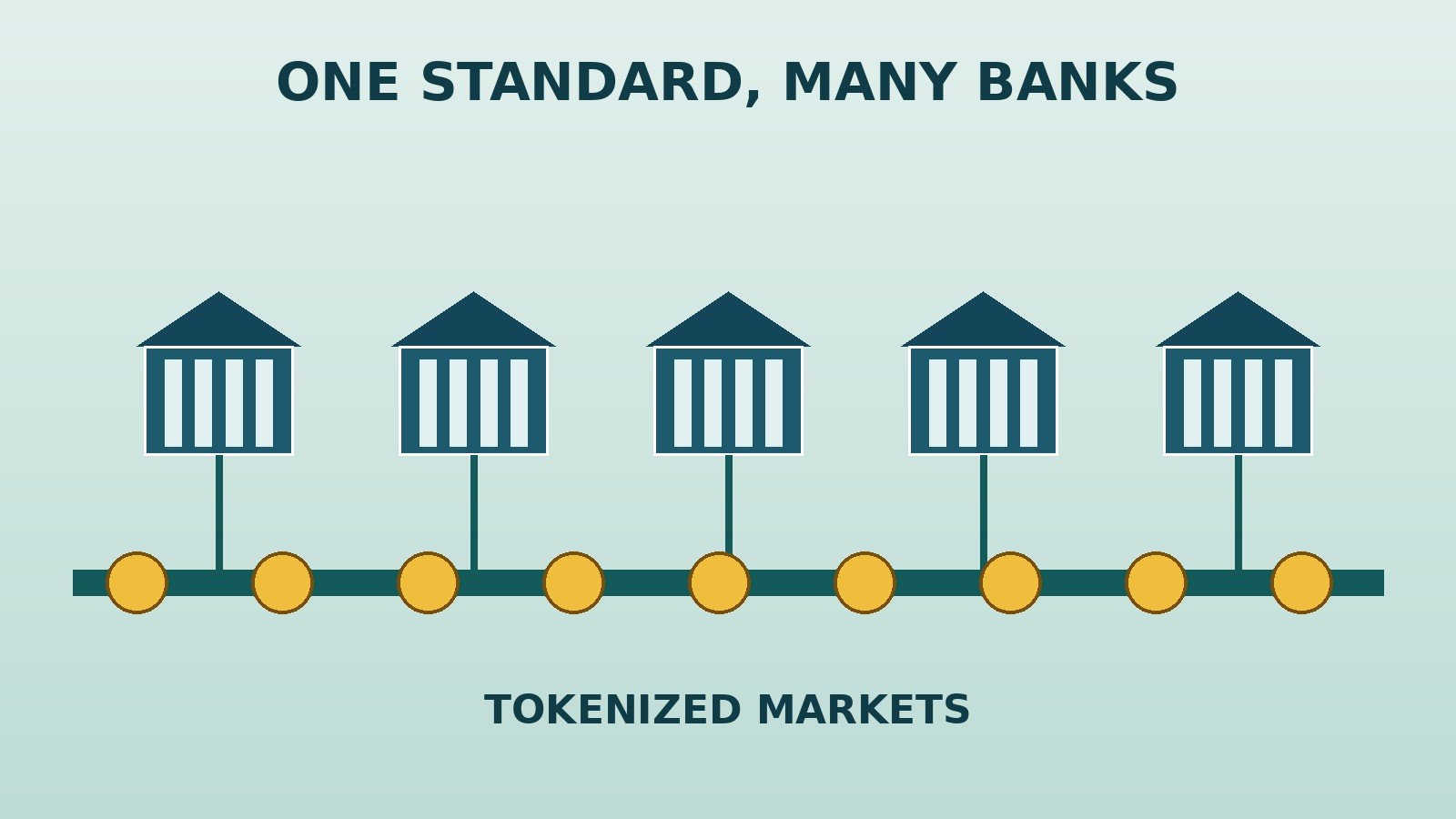
    Five banks set up a standards body. HSBC, Kinexys by J.P. Morgan, MUFG Bank, Societe Generale-FORGE and Standard Chartered said Wednesday they have formed the Global Layer One Organisation, or GL1 Org, a nonprofit based in Singapore. Its job is to write and promote common standards for tokenized financial markets, so that tokenized assets and digital money can move between different banks’ systems and across borders.

    GL1 Org takes over work started by the Monetary Authority of Singapore, the city-state’s central bank. That work has already produced two rulebooks: a Market Infrastructure toolkit, a set of controls for judging whether a blockchain platform is fit for regulated finance, and a Programmable Compliance toolkit, which describes how to build legal and policy rules directly into the software. “Tokenisation can help make financial markets faster, more efficient and more connected, but those benefits will only be realised if clients can trust the underlying infrastructure,” said Ruby Ho of HSBC. The group says it is open to other banks, regulators, market operators and fintech firms.

    Schroders moves past cash funds. Also on Wednesday, Schroders, a London asset manager that manages about $1.1 trillion, said it is working with tokenization firm Centrifuge to bring its emerging markets bond strategy onto the Solana blockchain. It is Schroders’ first deployment on Solana. Investors hold tokenized shares in a feeder fund that invests in Schroders’ existing bond fund, with share values tracking that fund’s net asset value.

    That is a step beyond what has dominated tokenization so far. Tokenized Treasuries and money market funds make up about $14 billion of the roughly $39 billion tokenized real-world asset market, according to RWA.xyz data cited by CoinDesk. Emerging markets debt carries different risks: the credit of governments and companies in developing countries, and currency swings.

    Morgan Stanley uses Wall Street’s new pipe. Morgan Stanley said Tuesday it is among the first banks to tokenize U.S. stocks and Treasuries through the tokenization service run by the Depository Trust & Clearing Corporation, which clears and settles most U.S. stock and bond trades. The service went live Oct. 28. The DTCC creates tokens that stand for securities it already holds, and says they keep the same ownership rights and investor protections as the originals. It covers Russell 1000 stocks, major index ETFs and Treasuries, runs on the Canton network and DTCC’s own private blockchain, and was cleared by an SEC no-action letter in December 2025. Twenty firms have signed up, including J.P. Morgan, Citi, Bank of America, Fidelity and Citadel Securities, CoinDesk reported.

    Why it matters. None of this needs the Clarity Act, the market-structure bill that stalled in the Senate in September. “The agencies have already made substantial progress without new legislation,” Peter Curley of Ondo Finance told CoinDesk. Stablecoins also have a law of their own: the GENIUS Act takes effect Jan. 18, NEAR Foundation’s Abhishek Vaidyanathan noted. The risk is durability. Lawyers told CoinDesk that agency guidance can be reversed by a future administration, and that rulemaking could slow if new commissioners arrive.

    What to watch: which banks and regulators join GL1 Org, whether Schroders publishes how much money the Solana share class draws, how quickly more banks start using the DTCC service, and whether the SEC finalizes its proposed rules for tokenized securities before the new Congress starts asking questions.

    Sources: GL1 Org announcement (via The Asian Banker), The Business Times, CoinDesk (Schroders), Morgan Stanley, CoinDesk (Morgan Stanley), CoinDesk (policy outlook).

  • Crypto Spent $63 Million to Stop Sherrod Brown. Ohio Sent Him Back Anyway.

    Crypto Spent $63 Million to Stop Sherrod Brown. Ohio Sent Him Back Anyway.

    Opinion. Easton writes Hardwire’s opinion column. Where this piece speculates, it says so.

    The crypto industry bought itself the most expensive lesson in Ohio.

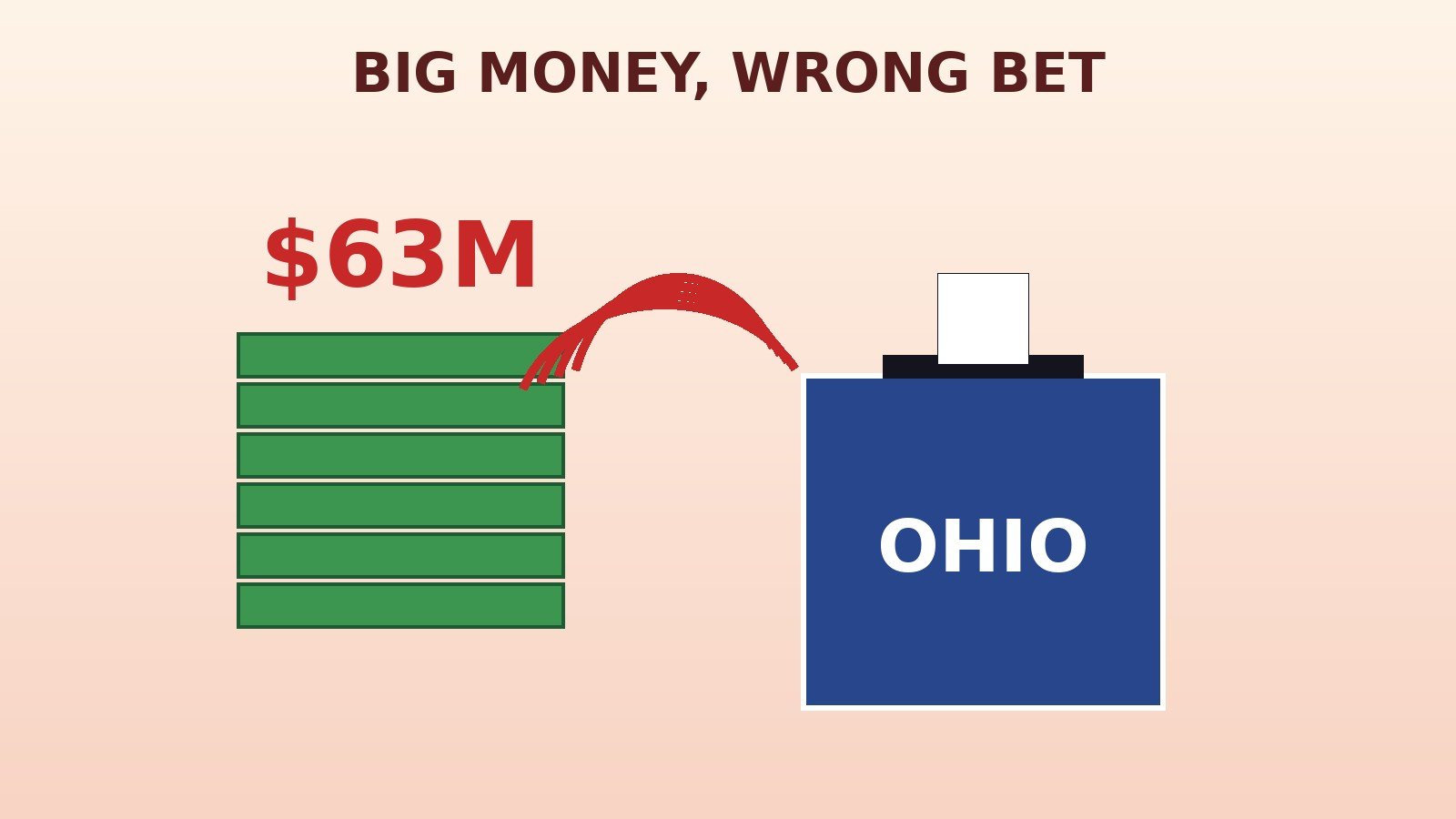
    Super PACs backed by crypto money, Fairshake and the Digital Freedom Fund, spent a combined $63 million trying to keep Sherrod Brown out of the Senate, according to CoinDesk. Brown, the former Banking Committee chairman the industry already spent to beat in 2024, won anyway on Tuesday, defeating Republican Sen. Jon Husted. The Associated Press says the Ohio race drew more than $500 million in total spending.

    That’s not the only scoreboard. Democrats took both the House and the Senate, according to the AP. Reuters says the crypto sector has spent more than $300 million backing crypto-friendly candidates of both parties, in roughly equal measure, across this cycle and the last one. Hedge both sides, and you lose anyway. Bitcoin dipped below $76,000 overnight before bouncing back to about $78,000.

    The bill that slipped away. The Clarity Act, the industry’s market-structure bill, passed the House 294-134 in July 2025. In September it failed a Senate procedural vote 49-50. If it isn’t passed before the new Congress meets on Jan. 3, it dies and has to start over.

    Sen. Ruben Gallego, an Arizona Democrat, told Bloomberg Law: “The industry and the Republicans screwed up. That was the best bill they were going to get.” TD Cowen’s Jaret Seiberg wrote on election day that he does not expect the Clarity Act to pass over the next two years, and that Democrats will likely investigate the president, “including his crypto entanglements.”

    Translation: next year’s rules get written by people the industry spent millions trying to beat, and the first order of business may be subpoenas, not standards.

    Here’s my speculation, labeled as such. Watch the lame duck. Sen. Angela Alsobrooks, a Maryland Democrat, has said it could still pass before January. When Washington has eight weeks and a deadline, deals get cut in back rooms. I’d bet the pressure now is to jam through whatever version the biggest exchanges and banks can live with, because they’re the ones writing the checks. Ordinary holders weren’t in the room in September. I doubt they’ll be in it in December.

    And the other side shouldn’t get a pass either. “Investigate first” is a fine slogan for a new majority. It is not consumer protection. If the next two years are hearings about the president’s family business while self-custody, tax rules and bank access sit in limbo, small holders lose twice.

    What I’d want to see. Any lame-duck Clarity text posted publicly days before a vote, not hours. Every PAC dollar spent this cycle tied to how those lawmakers vote in December. And a promise from both parties that the fight over the president’s crypto ventures won’t freeze the rules everyone else needs.

    The industry spent like it could buy a Congress. Ohio voters said no. Now let’s see if it tries to buy the lame duck instead.

    Sources: IBTimes (citing CoinDesk and AP), Reuters, Bloomberg Law, Bitcoin Magazine (TD Cowen note), CoinDesk.

  • Hong Kong Banks Now Settle Tokenized Deposits 24/7. A U.S. Bank Plans Loans Born on Arbitrum.

    Hong Kong Banks Now Settle Tokenized Deposits 24/7. A U.S. Bank Plans Loans Born on Arbitrum.

    Two banks on opposite sides of the Pacific moved tokenized money a step closer to everyday use this week, one with deposits that now settle around the clock and one with loans that would be born on a public blockchain.

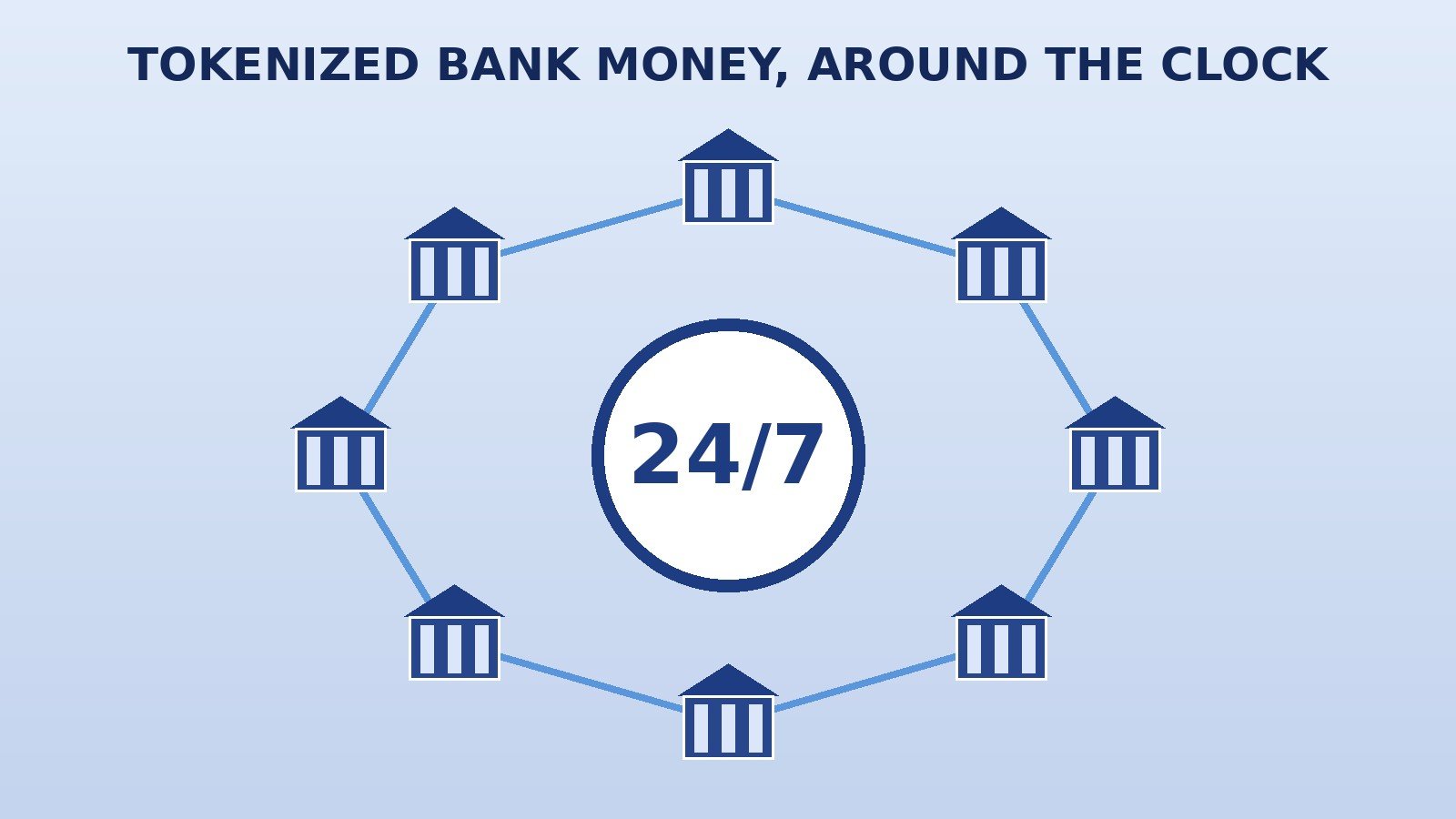
    Hong Kong goes 24/7. On Monday, the Hong Kong Monetary Authority said EnsembleTX, the live pilot phase of its Project Ensemble, now supports interbank settlement of tokenized deposit transactions in tokenized central bank money on a 24/7 basis. Until now, that settlement depended on the operating hours of Hong Kong’s regular interbank payment system. The pilot now has 12 participating banks, including HSBC, Standard Chartered, Bank of China (Hong Kong) and ICBC (Asia), plus 20 other firms the HKMA calls industry pioneers, such as Ant International, BlackRock and China Asset Management (Hong Kong).

    “In just two years, Project Ensemble has transitioned from experimentation and piloting to a new phase focused on promoting the commercialisation of tokenisation applications in Hong Kong,” HKMA Chief Executive Eddie Yue said. The HKMA also said it completed trial secondary-market trades of tokenized Exchange Fund Bills and plans to expand the trials to include regulated stablecoins.

    Standard Chartered is first to sell it. The same day, Standard Chartered launched a tokenized deposits service for corporate clients in Hong Kong, the first market in its group to offer it. The bank says eligible clients can move regular bank deposits in real time across participating banks through EnsembleTX, with interbank settlement in central bank money, including wholesale central bank digital currency, around the clock. It named China AMC, Finloop and PantherTrade as having already run live tokenized deposit transactions and settled tokenized money market funds. It is also working with Fireblocks to connect digital asset clients.

    A tokenized deposit is not a stablecoin. It is still money a regulated bank owes its customer, recorded and moved on the bank’s blockchain system. Only eligible clients can use it. CoinDesk reported that the bank did not disclose transaction values or how many institutions will have access at first. Standard Chartered says it plans to expand to more markets over time but has given no timeline.

    A U.S. bank plans tokenized loans from day one. In New Jersey, Cross River Bank said Tuesday it is working with Offchain, the developer of Arbitrum, to build tokenization into its lending platform. Loans made through the platform could be funded, owned, transferred and serviced on Arbitrum One from the moment they are created, instead of being moved onto a blockchain later. Borrowers would apply and repay through the same apps they use today, with Offchain’s ZeroDev wallet technology running underneath.

    Cross River says it stays the regulated bank and lender of record, and that tokenization does not change its underwriting, risk or compliance standards. What changes is how loans can be sold to investors, such as funds that agree in advance to buy a share of new loans as they are made. The two companies say they have finished a proof of concept and are targeting production in early 2027.

    Why it matters. Both projects keep the bank in the middle. Hong Kong is fixing the settlement side, so tokenized money can actually clear between banks after hours. Cross River is working on the asset side, so a loan has one shared record from day one. Neither is open to the public, and neither has published volume yet.

    What to watch: transaction volumes on EnsembleTX, which markets Standard Chartered adds next, when stablecoins join the HKMA’s trials, and whether Cross River’s first tokenized loans reach investors on schedule in 2027.

    Sources: HKMA, Standard Chartered, CoinDesk, Cross River.

  • Binance Traces $6.34 Billion Hack to a Fake Job Interview and an Internal AI Tool

    Binance Traces $6.34 Billion Hack to a Fake Job Interview and an Internal AI Tool

    Binance on Tuesday morning published its first account of how attackers took about $6.34 billion from its hot wallets on Oct. 29. The exchange calls the report initial and says independent security firms will review its findings.

    How it happened. Binance describes a multi-stage campaign. In June, a wallet DevOps engineer installed a tampered copy of the Homebrew package manager while looking for an AI coding tool. Binance caught it, replaced the device and rotated credentials, but says the engineer’s role and his teammates had been exposed. In September, a second engineer was approached on a legitimate job platform. After two fake interviews, he ran a code “assignment” on his work computer that hid malware Binance’s endpoint tools missed.

    On Oct. 20, the attacker used that machine and an internal AI tool to gain control over two wallet engineers, one of whom held a container deployment token. On Oct. 29, the attacker used those credentials to deploy a container and reach an internal wallet signing service. From there it could start transfers outside the normal withdrawal process.

    The drain. From 4:05 to 4:09 p.m. ET, five hot wallets sent 233.46 million XRP to the attacker. SOL, OP and 18,270 BTC followed. On Ethereum, the attacker used the signing service to set up EIP-7702 delegations over a hot wallet, and they kept working after withdrawals were paused. Because the wallet used multi-party computation, there was no single key to cancel them, and Binance had to build a revocation procedure. The last unauthorized transfer settled at 7:56 p.m. ET. The delegation was cleared at 8:10 p.m.

    Attribution and funds. Binance cites the FBI’s finding that North Korea is responsible. It says about $2.85 billion has been frozen or intercepted, and that it set aside more than 100% of the loss. It says 98% of affected tokens were replenished as of Oct. 31 and it is buying the less liquid remainder. Binance repeats that users will not bear the loss.

    Next steps. Binance says it has rebuilt the wallet system and the AI tool, replaced devices and revoked credentials. It plans an independent review and a security research fund.

    What it doesn’t answer. The report doesn’t explain why the signing service would sign transfers outside the withdrawal process, or how the AI tool gave the attacker control. It doesn’t say whether the June breach prompted a wider review. It gives no time zone for the Oct. 29 access window, and it has no chain-by-chain loss tally. It also doesn’t say how the 98% figure squares with the 95% Binance cited Sunday, or how frozen funds will be returned. It names no review firm and sets no date for a final report.

    Sources: Binance Blog, FBI, Reuters

  • Binance Says Deposits Beat Withdrawals. Its Own Chart Says Down $5.3 Billion.

    Binance Says Deposits Beat Withdrawals. Its Own Chart Says Down $5.3 Billion.

    Opinion. Easton writes Hardwire’s opinion column. Where this piece speculates, it says so.

    At 12:51 a.m. Eastern on Tuesday, Binance posted good news: “By 03:00 UTC, we are seeing hourly deposits exceed withdrawals, reflecting improving user activity and stabilizing flows.”

    It attached a chart. Read the chart.

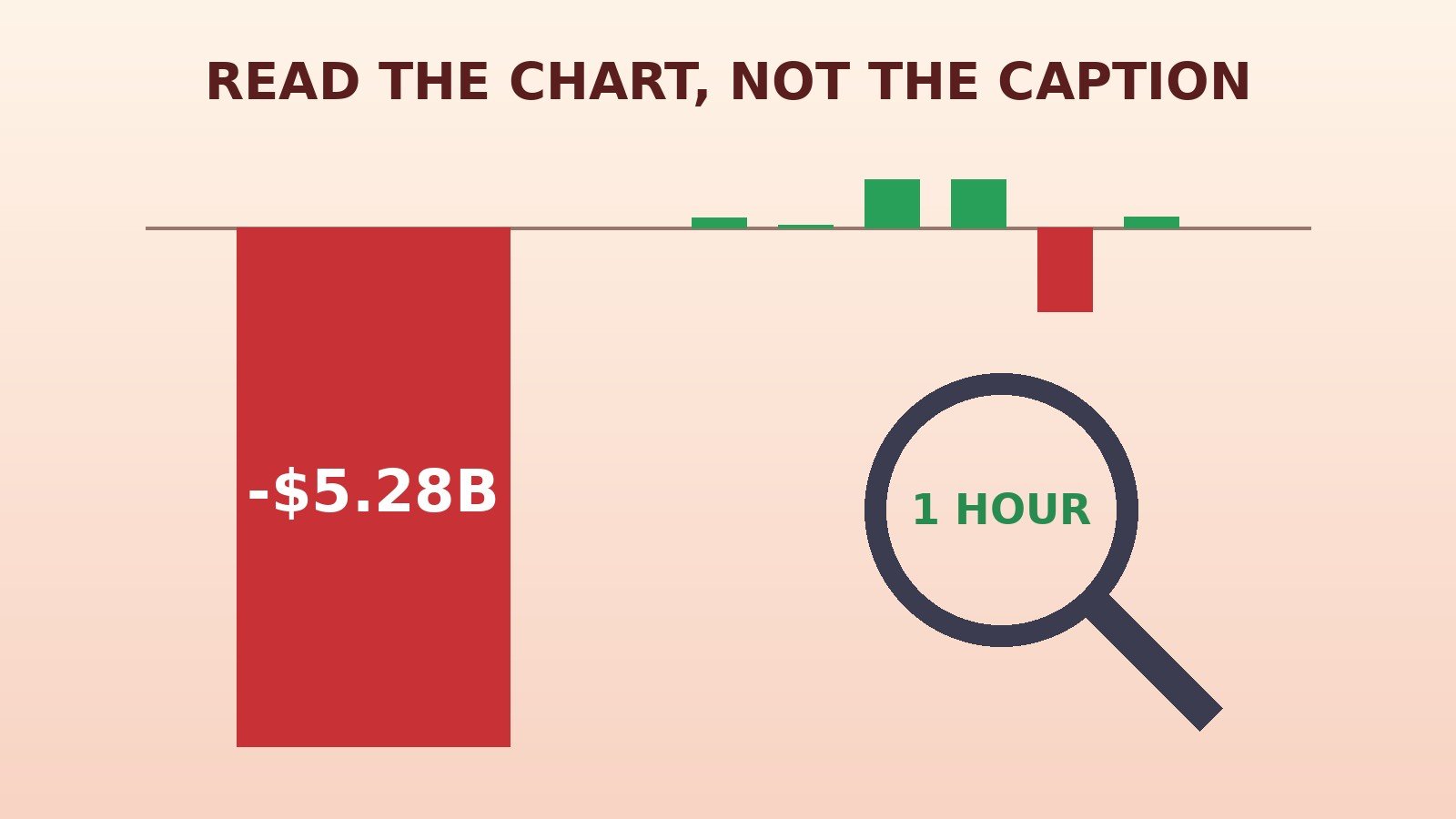
    What Binance’s own numbers say. The chart covers Sunday morning, when withdrawals reopened, through early Tuesday. In that window, it shows about $10.97 billion withdrawn and about $5.70 billion deposited. That’s a net outflow of roughly $5.28 billion. Monday, a Binance spokesperson told Reuters the figure was $4.72 billion. So the hole kept growing overnight.

    And the hours that “flipped”? A handful of hourly bars from Monday afternoon into Monday night, New York time, came in green: plus $9 million, plus $44 million twice, and plus $10 million in the last hour shown, the one Binance’s post points to. Mixed in with them are red hours, including one at minus $77 million. All of that sits against a $5.3 billion net outflow on the same chart.

    Is it true? Sure. Outflows really have slowed from the worst hour on Sunday morning, when the chart shows $936 million more going out than coming in. That’s worth something. But “deposits exceed withdrawals” is a headline. “Down $5.3 billion and the bleeding has slowed” is the story.

    The loyalty package. Same week, same pattern. Monday brought a thank-you campaign with fee vouchers and up to 10% APR. Monday morning, the VIP desk announced that VIP levels 1 through 9 are “protected” for 30 days, from Nov. 3 to Dec. 2, locked at the highest level each user hit between Oct. 21 and Oct. 30. Tuesday morning, the main account reposted it: “No drop, no stress.”

    My speculation, labeled. Put those together and it looks like a full-court press to keep big traders from moving their volume somewhere else while the dust settles. VIP status means lower fees. Promise you’ll keep it even if you trade less, and you remove one reason to leave quietly. That’s not a crime. It’s retention. But it’s worth noticing that the “stabilizing flows” message and the “please stay” perks arrived in the same 24 hours.

    To be fair: Binance says it is eating the roughly $6.3 billion loss itself, it published a reserve proof users can check, and it keeps reopening networks in phases. Tuesday it restored dozens more tokens on Ethereum and Solana. Most firms that lose that kind of money don’t open their doors this fast.

    But one good hour isn’t a turnaround. Here’s what would be: a cumulative net-flow figure that stops falling for days, not hours, Wednesday’s broader reserve snapshot, and a full post-incident report on how $6.3 billion walked out the door.

    Until then, enjoy the perks. Just read the chart, not the caption.

    Sources: Binance on X (withdrawal data update), Binance VIP on X, Binance on X (withdrawal update), Binance on X (Recovery Update #6), Reuters.

  • SEC Staff Spell Out When Token Voters Aren’t a ‘Central Party’

    SEC Staff Spell Out When Token Voters Aren’t a ‘Central Party’

    Staff at the Securities and Exchange Commission have added three new answers to their crypto FAQ, spelling out when token holders who vote on a network’s decisions count as the kind of “central party” that can keep a token in securities territory.

    The update, dated Nov. 2, comes from the SEC’s Division of Corporation Finance. It adds questions 1.4, 1.5 and 1.6 to the FAQ the division first published on Sept. 25 and revised on Sept. 28. The answers explain how shared governance fits the SEC’s March 17 interpretive release, which says digital commodities are not themselves securities and describes a “functional crypto system” as one with no central party overseeing participation or handing out rewards.

    Voting alone isn’t control. The release defines a central party as a person, entity or group with operational, economic or voting control of a crypto system. Answer 1.4 calls this a facts-and-circumstances question, but says people who take part in a network’s broad-based governance generally will not be treated as a “group” if they are not affiliated and have no agreement, arrangement or understanding, formal or informal, to act together outside the governance system itself. That includes coordinating through delegated votes. The staff says the same applies when governance sits inside a foundation or association and participation depends on holding the network’s native token. Even if voters did form a group, they would still need actual control to count as a central party.

    What oversight looks like. Answer 1.5 lists the powers that do mark a central party: unilateral authority to grant or limit access, change voting processes for upgrades or token distributions, decide who can validate transactions, modify the network’s code, reverse transactions, or revoke access. A system generally has no such overseer when every material part of its operation runs automatically on rules-based code, or when any remaining discretion is exercised only through broad-based governance.

    Working is not the same as decentralized. Answer 1.6 separates the two ideas. A functional system lets its native token do what it was programmed to do. A decentralized system runs without any person or group holding operational, economic or voting control. The staff says the degree of decentralization can vary.

    The limits. These are staff views, not a Commission rule. The FAQ says the answers have no legal force or effect, do not change the law and create no new obligations, and the Commission has neither approved nor disapproved them. The staff also limits the “group” answer to the digital-commodity question; it does not carry over to other parts of securities law, such as the definition of an exchange.

    For projects that run on token votes, including DAOs and foundation-led networks, the practical test is now clearer: who can actually change the rules, stop users, or undo transactions, alone or together.

    What to watch: whether the Commission itself adopts any of this, including in its Regulation Crypto Assets proposal from August, which the FAQ already cites, and how projects with foundations or heavy vote delegation describe their own control in filings.

    Sources: SEC, Cryptonews.

  • Binance’s Proof Is a Snapshot. Its Thank-You Gift Is a Retention Bonus.

    Binance’s Proof Is a Snapshot. Its Thank-You Gift Is a Retention Bonus.

    Opinion. Easton writes Hardwire’s opinion column. Where this piece speculates, it says so.

    Binance had two messages for its customers Monday morning, about 24 minutes apart.

    At 7:25 a.m. Eastern, it posted a “#ThankYouBinancians” campaign: eligible users can claim a 100 USDC trading-fee rebate voucher, share a 20 million USDC pool, and “earn up to 10% APR.” At 7:49 a.m., it posted Recovery Update #5, saying its reserve proof is done and customers “don’t have to take our word for it.”

    I’ll give credit where it’s due. Binance said it would cover the roughly $6.3 billion stolen last week, and it says it has covered about 95%. It let people check the math with their own computers. Withdrawals started reopening Sunday. That’s more than FTX ever offered.

    But a proof of reserves is a photo, not a live feed. And you should know what’s in the frame.

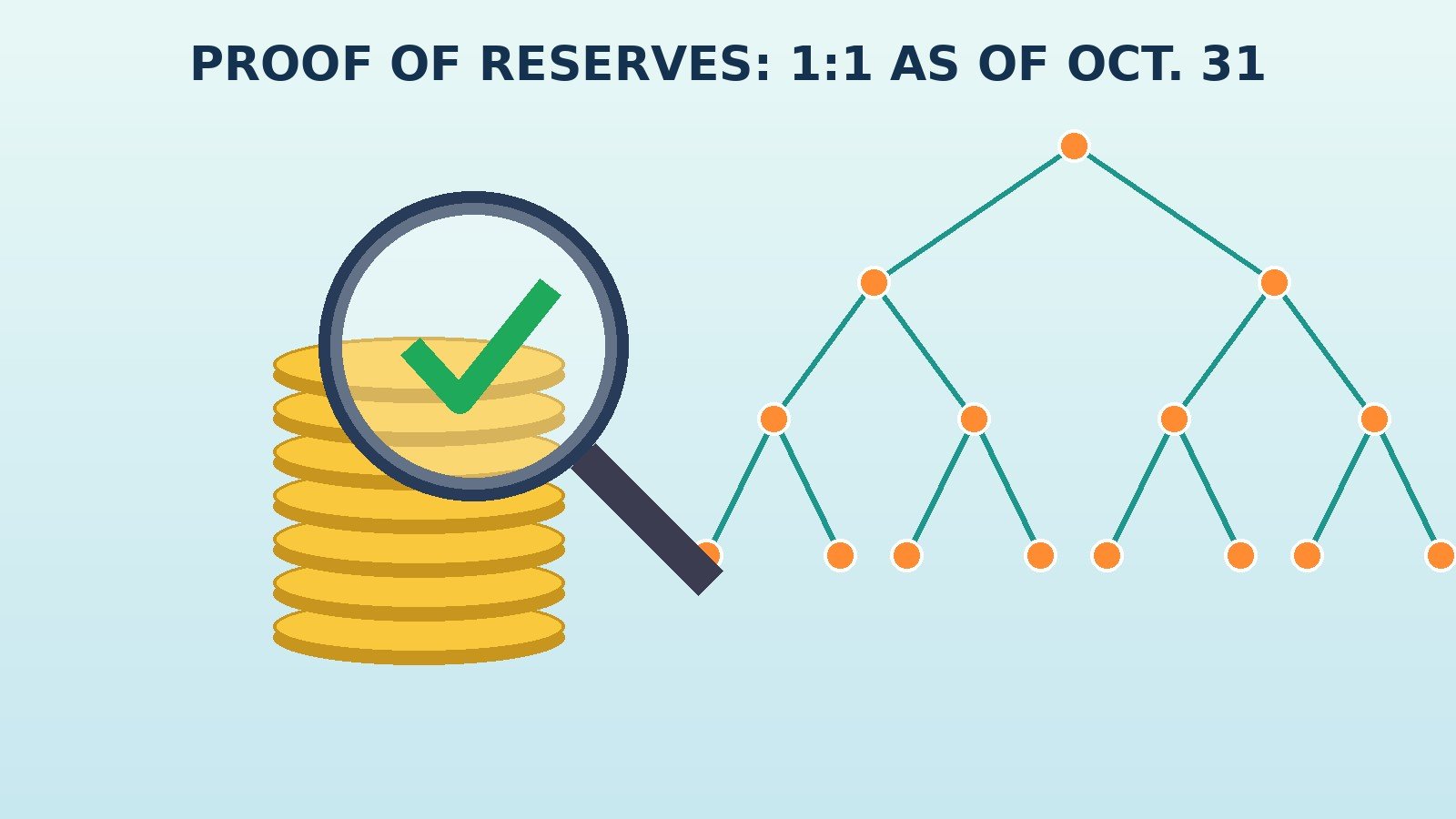
    What the photo shows. Binance’s proof says that at midnight UTC on Oct. 31, its holdings in ten tokens, including BTC, ETH, USDT, XRP and RLUSD, covered customer balances in those same tokens at least one-for-one. That’s useful. It’s also a moment Binance picked, taken after it had spent its own money refilling the hole.

    What’s outside the frame. It doesn’t show today. It doesn’t show the company’s whole balance sheet, only those ten tokens against what customers hold in them. It doesn’t name an outside auditor for this snapshot; Binance points to a 2023 audit of its verifier code. And the last 5% of the losses sits in less liquid tokens Binance hasn’t listed, which it says take longer to buy.

    Now the gift. Here’s my speculation, and it’s labeled as that: a fee voucher and a 10% APR offer, posted the same morning customers are deciding whether to stay, is a retention bonus dressed as a thank-you. Banks do this too. When trust wobbles, the rewards get sweeter. I’m not saying anything shady is going on. I’m saying a reward is designed to keep your money where it is, and you should treat it that way.

    Binance’s founder, Changpeng Zhao, wrote on X that “98% choose to stay!” Maybe so. A Binance spokesperson told Reuters net withdrawals since Sunday hit $4.72 billion, about 2.8% of assets. That’s not a run. It’s not nothing, either.

    Meanwhile, South Korea’s financial regulator called an emergency meeting Monday and told its exchanges to hold more coins offline, watch withdrawals around the clock and set aside extra reserves. Seoul didn’t wait for a press release to feel better.

    What I’d want next. A regular schedule of snapshots, not just ones after a crisis. A named outside firm that checks them. And the list of tokens in that missing 5%. Wednesday’s broader snapshot is the next chance.

    Run the check if you hold coins there. Take the voucher if you want it. Just don’t confuse a thank-you gift with a guarantee.

    Sources: Binance on X (Recovery Update #5), Binance on X (#ThankYouBinancians), Reuters, CNBC, Financial Services Commission (Korea).

  • Binance Opens Its Books to User Checks After the Hack. Here’s What the Proof Does and Doesn’t Show

    Binance Opens Its Books to User Checks After the Hack. Here’s What the Proof Does and Doesn’t Show

    Binance says customers can now check for themselves that their holdings in ten major tokens were fully backed as of Oct. 31.

    In its fifth recovery update, published on X Monday morning, the exchange said the zero-knowledge proof for its Oct. 31 proof-of-reserves snapshot is complete. Users holding BTC, ETH, USDT, BNB, SOL, USDC, XRP, USD1, RLUSD or ZEC can run Binance’s open-source verifier on their own computer to confirm that their balance is included and that reserves were at least 1:1 at that moment.

    What it shows, and what it doesn’t. A proof of reserves is a snapshot. It covers one point in time, midnight UTC on Oct. 31, and does not guarantee balances today or tomorrow. It tests assets against customer balances in those ten tokens, not the exchange’s full set of obligations. Binance did not name an independent auditor for this snapshot; it pointed to a 2023 third-party audit of its verifier code.

    Binance says it has now covered about 95% of the roughly $6.3 billion taken in last Thursday’s breach, using its own funds. The remaining 5% is in less liquid tokens outside the top ten, which the company says take longer to buy at the scale it needs. A second snapshot covering more tokens is planned for Wednesday, Nov. 4, with the proof expected to take about 40 to 50 hours to build.

    Withdrawals: the real test. Withdrawals reopened Sunday. Binance reported $4.65 billion out and $1.01 billion in during the first nine and a half hours, a net outflow of $3.64 billion, or 2.1% of its $171 billion in assets. A Binance spokesperson later told Reuters the net figure since Sunday had reached $4.72 billion, about 2.8% of assets. The exchange restored U.S. dollar withdrawals Monday and says the next phase of network reopenings is planned for Tuesday.

    The fallout is reaching regulators. South Korea’s Financial Services Commission called an emergency meeting Monday with the country’s major crypto exchanges, urging them to raise cold-wallet holdings, monitor deposits and withdrawals around the clock, report and share suspicious access attempts quickly, and set aside extra reserves.

    What to watch: Tuesday’s network reopenings, Wednesday’s broader snapshot, the list of tokens in the missing 5%, and whether Binance publishes a full post-incident report.

    Sources: Binance on X, Binance, Reuters, CNBC, Financial Services Commission (Korea).

  • Secret Service Says It Is Investigating Binance Theft, Moved Early to Freeze Funds

    Secret Service Says It Is Investigating Binance Theft, Moved Early to Freeze Funds

    The U.S. Secret Service said Sunday afternoon that it continues to investigate the theft of more than $6 billion in cryptocurrency from Binance Global.

    In a post on its official X account early Sunday afternoon ET, the agency said that within minutes of the incident on Thursday afternoon, its investigators worked with industry partners to identify and freeze a significant portion of the stolen funds. An accompanying graphic said the Secret Service and federal partners are working to recover the funds. The agency did not give a dollar figure for the amount it froze.

    Binance founder Changpeng Zhao thanked the Secret Service and “all the agencies and industry partners involved” in a post Sunday afternoon, saying the work “continues.”

    The statement adds a second federal agency to the public response. The FBI said Saturday evening that it attributes the attack to the North Korea-linked group known as TraderTraitor.

    Binance’s own figures are unchanged. The exchange puts the loss at about $6.3 billion, says it has set aside more than $6.34 billion, and says about $3 billion is frozen on-chain. It is not clear how much of that frozen total the Secret Service’s work accounts for.

    Withdrawals reopened in phases early Sunday on 15 networks. By late Sunday morning, Binance reported about $4.65 billion in withdrawals against about $1.01 billion in deposits. Remaining networks are still in testing. Binance says an updated proof-of-reserves report is expected Monday, and a post-incident report will follow its investigation.

    Blockchain analytics firm Chainalysis said Sunday that the attackers have begun a new phase of laundering, moving funds off the Tron network to fresh Ethereum and Bitcoin wallets.

    Prices were steady. At 3:52 PM ET, CoinGecko showed Bitcoin at $77,836, Ether at $2,261 and BNB at $707.95.

    Sources: U.S. Secret Service, Binance, FBI, Chainalysis, CoinGecko