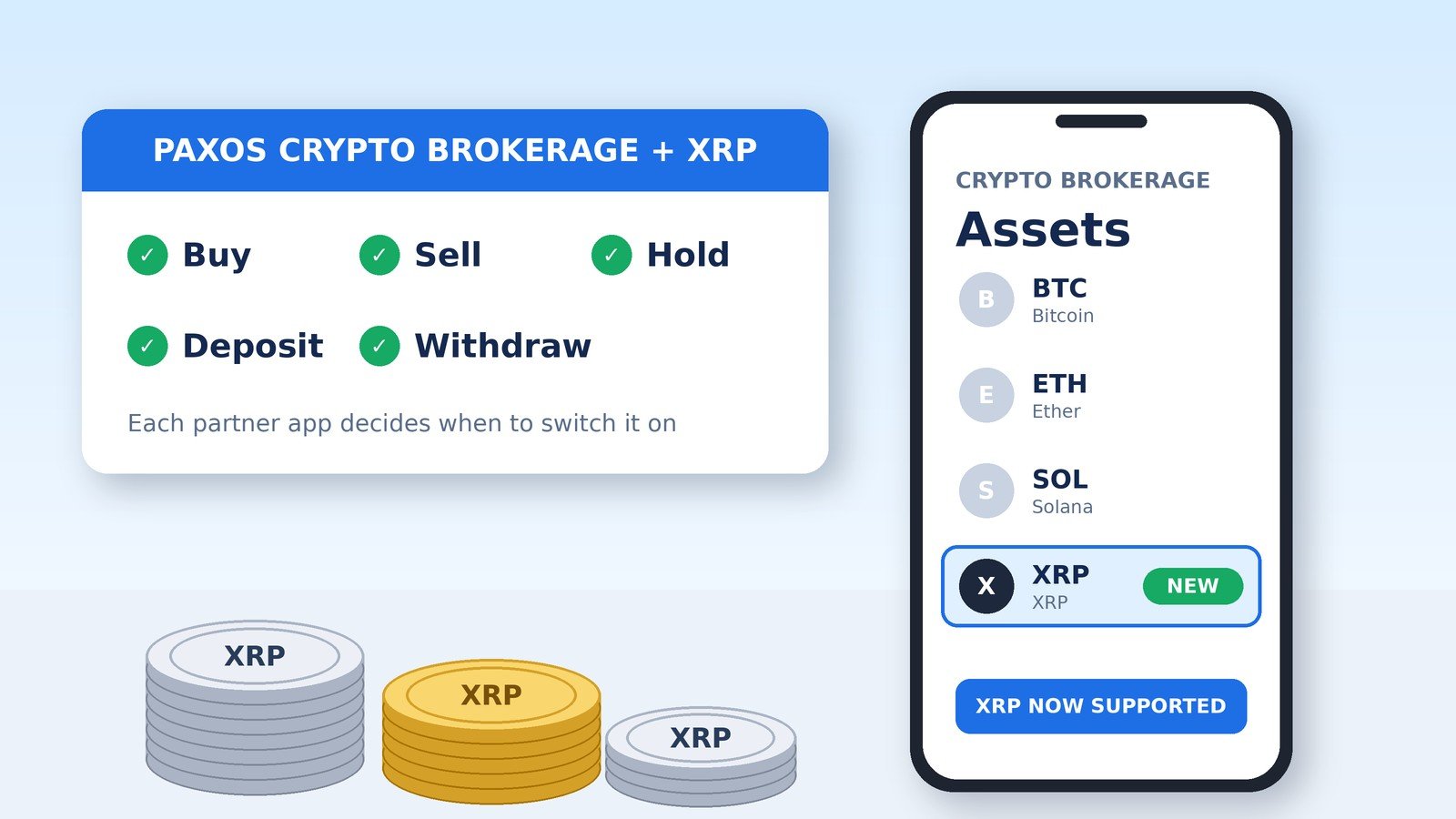
Paxos has added XRP to Paxos Crypto Brokerage, the white-label trading and custody service it runs for banks, brokerages and payment apps. “Paxos Crypto Brokerage now supports $XRP,” the company posted on X on Wednesday morning. “Partners can now offer XRP through the same regulated platform trusted by some of the biggest names in finance.”
The XRP Ledger Foundation, a non-profit that supports the network, filled in the client list. In its own post, it called Paxos Crypto Brokerage “the regulated back end used by PayPal, Venmo, Interactive Brokers, Charles Schwab, and Mercado Libre,” and said partners can offer XRP “for buy, sell, hold, deposit, and withdrawal.” Paxos replied: “The Paxos Crypto Brokerage lineup just got stronger.”
What changed, and what didn’t
What changed is the plumbing. A firm that already uses Paxos for crypto trading can now add XRP without building its own custody, liquidity connections or trade monitoring. Paxos says on its brokerage page that it “never trades against your clients,” benchmarks fills against independent price feeds, and puts every new asset through a review of “legal classification, liquidity, and regulatory history” before listing it. Paxos also says it is now federally chartered by the OCC and custodies assets on a fiduciary basis.
What has not changed, yet, is what customers see. None of the named platforms has announced an XRP launch for its own users. Each partner picks its own lineup. Schwab is a useful example: Paxos handles trade execution and sub-custody for Schwab’s crypto service, while Charles Schwab Premier Bank holds customer assets, crypto.news reported. Schwab’s August expansion named Solana, Avalanche and Chainlink. XRP was not on that list.
The addition fits a steady build-out. Paxos had more than doubled its brokerage list to 29 tokens by June and set a goal of covering much of the top 50 by year-end, Bitcoin.com News reported, citing head of brokerage product Asset Tarabayev.
Korea gets a Ripple partner too
The same day, South Korean brokerage Meritz Securities disclosed a strategic partnership with Ripple. The two will review how Ripple Custody and Ripple’s tokenization infrastructure could be used in Korea’s capital markets, The Herald Business reported. Meritz CEO Jang Won-jae and Ripple President Monica Long attended the signing at Meritz’s Yeouido headquarters, which took place on October 1, according to Seoul Economic Daily.
Meritz says it will start inside current securities rules and widen the work in stages as Korea’s digital asset regime develops. It is studying spot crypto ETFs, fractional and tokenized securities, trading platforms and won-denominated stablecoins. No product or launch date has been announced. “We look forward to exploring how digital asset infrastructure can support the continued development of Korea’s capital markets,” said Fiona Murray, Ripple’s head of Asia-Pacific.
The rails view
Both moves are distribution, not demand. Paxos opens a regulated door that large consumer apps already walk through. Meritz puts Ripple’s custody stack in front of a top Korean brokerage before the rules are final. The trust markers to watch are concrete: a named partner switching XRP on for its own customers, and a first Meritz product with a filing or a date.
The market did not wait for either. XRP traded near $1.40 on Thursday morning, down about 3% in 24 hours, per CoinGecko, after Wednesday’s Fed minutes showed most officials expect another rate hike by year-end, CNBC reported. U.S. spot XRP ETFs recorded zero net flow on Wednesday, while bitcoin ETFs lost $487 million, according to SoSoValue data compiled by CoinGabbar.
Sources: Paxos on X; XRP Ledger Foundation on X; Paxos; crypto.news; Bitcoin.com News; The Herald Business; Seoul Economic Daily; CNBC; CoinGabbar