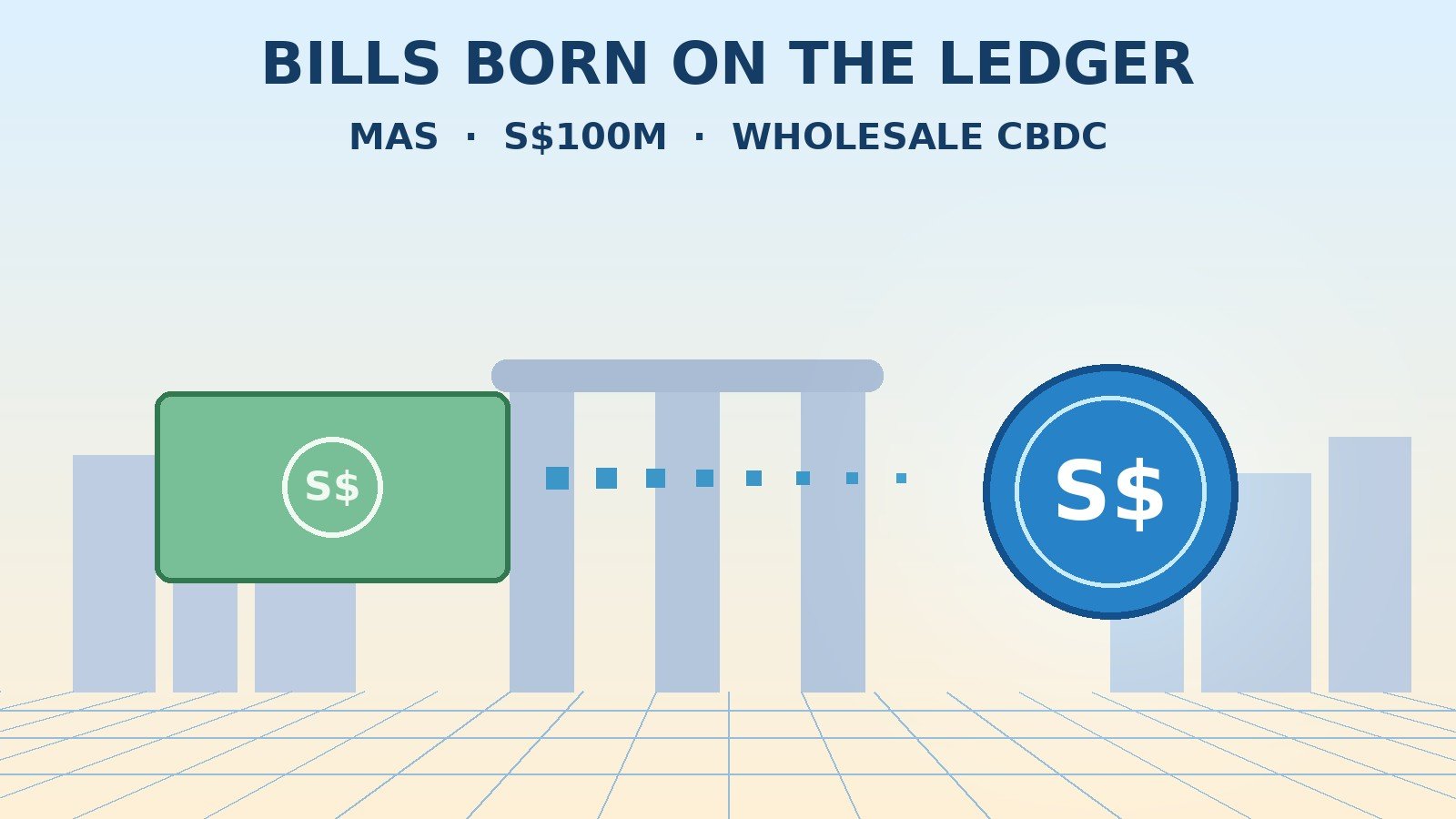
MAS issued S$100 million of four-week bills directly on its own ledger, paid for in wholesale CBDC. It is a small, live test, not a new market yet.
The Monetary Authority of Singapore (MAS) said Thursday that it issued S$100 million (about $77.5 million) of tokenized four-week MAS Bills on Nov. 6. The bills were created directly on the MAS-run Singapore Dollar Test Network and paid for in wholesale central bank digital currency, a form of digital cash that only banks hold.
Five primary dealers bid in the auction: DBS Bank, HSBC’s Singapore branch, OCBC, Standard Chartered and UOB. MAS said bids came in at more than twice the amount on offer. The bills mature on Dec. 4.
Why it matters
Most tokenized securities today are issued the usual way and then mirrored on a blockchain, which leaves two records that have to be matched. MAS says issuing the bills “natively” on its own ledger removes that reconciliation step. Because the bills and the cash sit on the same network, the security and the payment can settle together.
The bills also fill a gap. In 2025, banks used the same network for overnight interbank loans settled in wholesale CBDC. MAS says tokenized bills give lenders a trusted Singapore-dollar asset to pledge, opening the door to secured lending on the network.
“The live issuance allowed us to test a new method of issuance, and further enhance our in-house distributed ledger infrastructure,” MAS Managing Director Chia Der Jiun said. He added that tokenized bills can play “a complementary role to conventional MAS Bills” over time.
What it is not
This is not a retail product and not a public blockchain. Access is limited to approved banks, and S$100 million is a test-sized issue. MAS has not said how large future issues will be. The next real test comes when the bills mature in early December and redeem on the same ledger.
What’s next
MAS plans to scale up issuance, add more institutions and expand the bills’ use as collateral, with a wider round of live trials in 2027. The test network will be renamed SG Digital Ledger. Banks and market infrastructure firms can apply to join.
For readers watching tokenization, this is the slow, regulated version: a central bank, its own bills, its own money, and a handful of supervised banks.
Sources: Monetary Authority of Singapore, CoinDesk, The Block