
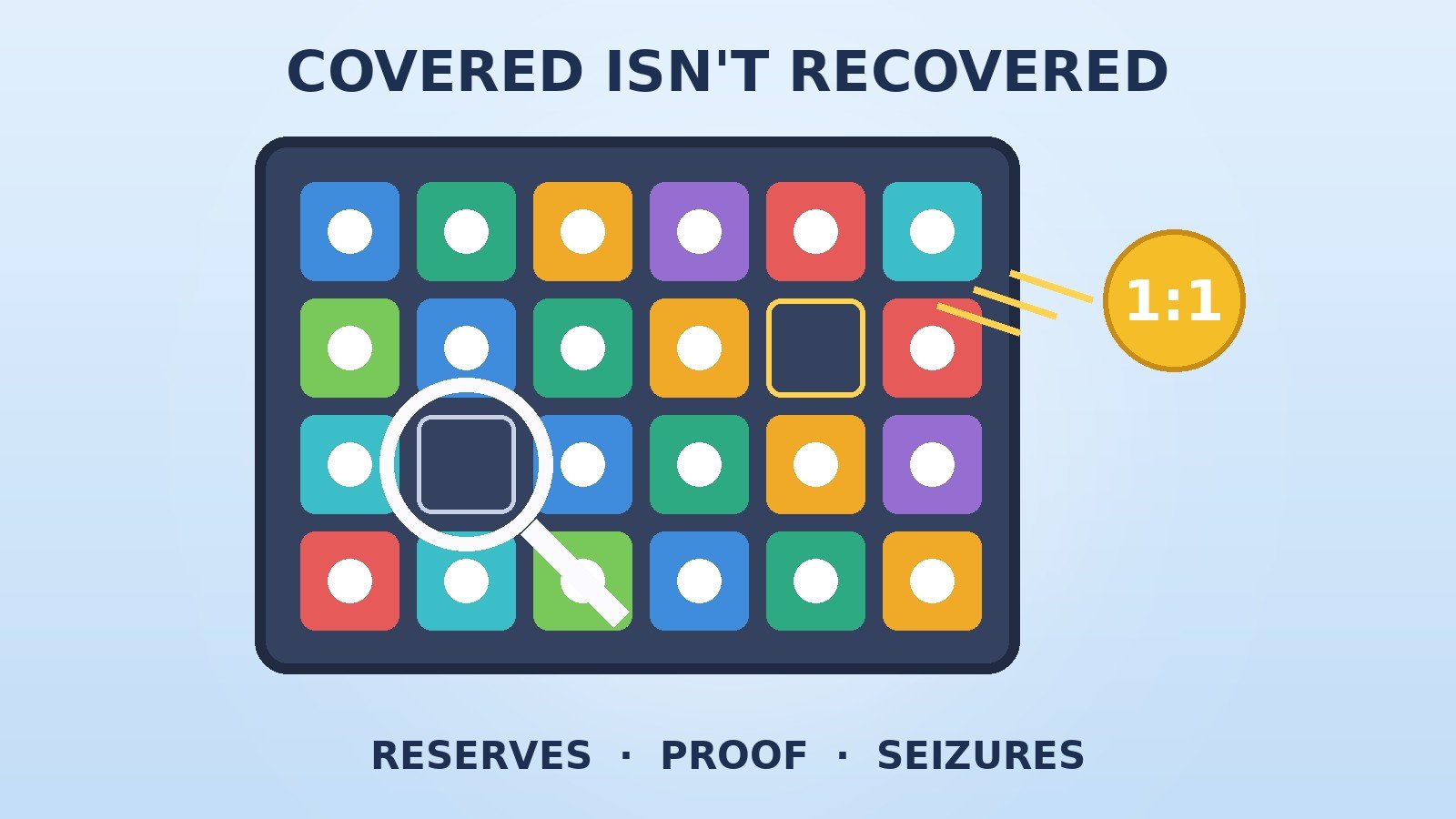
Binance said Thursday that it has finished replacing the customer assets hit in its Oct. 29 security incident. Hours later, the U.S. Justice Department said it had won court approval to seize or restrain more than $1.2 billion of the stolen crypto. The two announcements answer different questions. Binance’s covers what customers are owed. The department’s covers where the stolen coins went.
What Binance said
“Binance has completed coverage of assets impacted in the security incident and we have published a new Proof of Reserves snapshot,” the exchange posted on X at 11:49 a.m. ET Thursday. It said users will be able to check that their assets are backed “at a minimum of 1:1” only “once the zero-knowledge proof is generated.” Binance gave no date for that proof.
Co-CEO Richard Teng and co-founder Yi He repeated the message. Founder Changpeng Zhao quoted the post: “100% 1:1 backing. Funds are SAFU!”
Covered is not the same as recovered
Binance replaced the missing tokens with its own money. In its Oct. 31 security incident update, it said that money came from three places: part of its SAFU emergency fund, a portion of its futures insurance fund and its corporate treasury. Binance has not said on record how much came from each.
What the Justice Department said
The stolen coins are on a separate track. In a release Thursday evening, the department said members of the North Korean military, whom the FBI calls “TraderTraitor,” stole more than $6 billion in virtual assets from Binance on or about Oct. 29.
U.S. government and private-sector efforts have frozen more than $2.7 billion of that so far, the department said. It has court authorization to seize or restrain more than $1.2 billion of the frozen amount. Assistant Attorney General A. Tysen Duva of the Criminal Division said investigators and partners moved to “immediately halt about half of this historic breach.”
The department also said the hackers “continue to launder” the rest through cryptocurrency bridges, mixers and exchanges, and that efforts to trace, freeze, seize and forfeit the assets are ongoing. A seizure order is a step toward forfeiture, not money returned. The department did not say when or to whom any recovered funds would go.
The same release announced the seizure of cloud infrastructure behind a separate North Korean scheme the FBI calls “FaceStealer.” The department said that scheme used recorded webcam videos and deepfakes in fake video meetings and has stolen more than $400 million over 18 months.
What is still open
- The proof. Until the zero-knowledge proof is published, the 1:1 claim for the new snapshot is Binance’s statement, not something users can check themselves. After its Oct. 31 snapshot, the user-checkable proof followed about two days later. As of 8:20 a.m. ET Friday, Binance had not announced the new one.
- The final report. Binance called its Nov. 3 incident report “initial” and said independent security firms would review its findings. It has not published a final report or named a date for one.
- The SAFU fund. Binance has not published an updated SAFU balance after the draw.
- Some networks. Binance’s customer support account told users Friday that more assets and networks are being restored in phases as security checks finish.
For cautious readers, Thursday reduced one risk. Binance says customer balances are fully backed, and it says that claim will soon be checkable. Next, watch whether the proof lands, whether a final report follows, and how much of the frozen $2.7 billion reaches forfeiture.
Sources: Binance, Binance Proof of Reserves, Justice Department, Justice Department National Security Division, The Block, Richard Teng, Yi He, Changpeng Zhao, Hardwire (Nov. 2).