
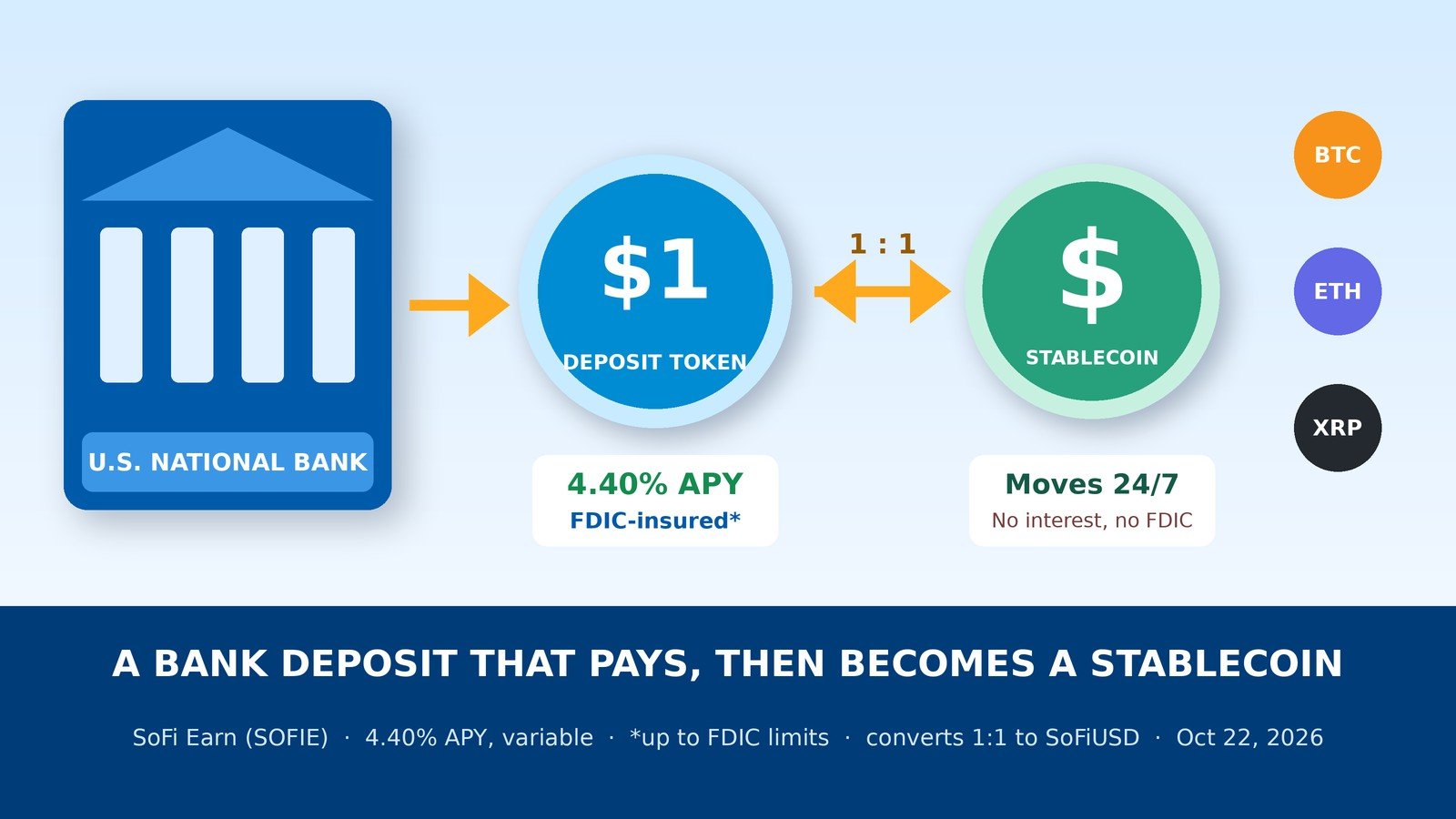
SoFi on Thursday launched SoFi Earn, a “tokenized deposit” for its crypto customers that pays interest and carries FDIC insurance. The token, called SOFIE, pays a 4.40% annual percentage yield. Each SOFIE stands for $1 held on deposit at SoFi Bank, the company said in its announcement.
SoFi calls it the first and only tokenized deposit offered to consumers by a U.S. national bank. The rollout to SoFi Crypto members runs through November.
How it works
Think of SOFIE as a parking spot for digital dollars. While the money sits in SOFIE, it earns interest and is covered by FDIC insurance up to the usual $250,000 limit per depositor, per bank, for each ownership category.
When a customer wants to use the money, they convert SOFIE 1:1 into SoFiUSD, the bank’s own stablecoin. SoFiUSD can then buy crypto in the SoFi app, or be sent to a supported outside wallet over blockchain rails at any hour, SoFi said. Customers can also withdraw SOFIE as cash into SoFi Checking and Savings, the company said on X.
The trade-off is in the fine print. Once the money becomes SoFiUSD, it stops earning that interest, and SoFiUSD is not an FDIC-insured deposit, The Block reported. SoFi’s own disclosure says SOFIE “is not a payment stablecoin.” The 4.40% rate is variable, can change at any time, and was current as of Oct. 20, according to SoFi.
Why a deposit, not a stablecoin
The design follows the rules. Under the GENIUS Act, stablecoin issuers may not pay holders interest. The OCC’s final rule under that law, issued Wednesday, keeps that ban for issuers and says rewards paid by others will be judged case by case. It takes effect Jan. 18, 2027.
A bank deposit is a different legal product. It can pay interest and be insured. By keeping the earning part as a deposit and the moving part as a stablecoin, SoFi offers both, just not in the same token at the same time.
SoFi makes the pitch directly. CEO Anthony Noto said too much money in the digital asset world “is sitting idle.” The company cited Federal Reserve research estimating that about $64 billion, or 21.2% of the stablecoin market, sits in rarely used, forgotten or inactive wallets.
The bigger picture
This is SoFi’s fifth crypto product in less than a year, the company said. It started consumer crypto trading in November 2025 and launched SoFiUSD in December 2025. In September, SoFi began settling card transactions with SoFiUSD on Mastercard’s network, The Block reported. SoFi says it has 15.8 million members.
Big banks have been testing deposit tokens mostly with business clients. JPMorgan’s JPM Coin, a deposit token for institutional clients, expanded to Ethereum on Monday. SoFi is aiming the same idea at everyday savers.
SoFi’s announcement did not say which blockchain SOFIE runs on, and it did not describe SOFIE itself moving to outside wallets. Those trips go through SoFiUSD.
The launch landed on a down morning for crypto. At about 8:15 a.m. ET Thursday, Bitcoin traded near $81,741, Ether near $2,401, XRP near $1.32 and Solana near $104, each down about 2% to 3% over 24 hours, according to CoinGecko. USDC held at about $1.00.
Sources: SoFi (Business Wire); The Block; SoFi on X; OCC; The Block (JPM Coin); CoinGecko