
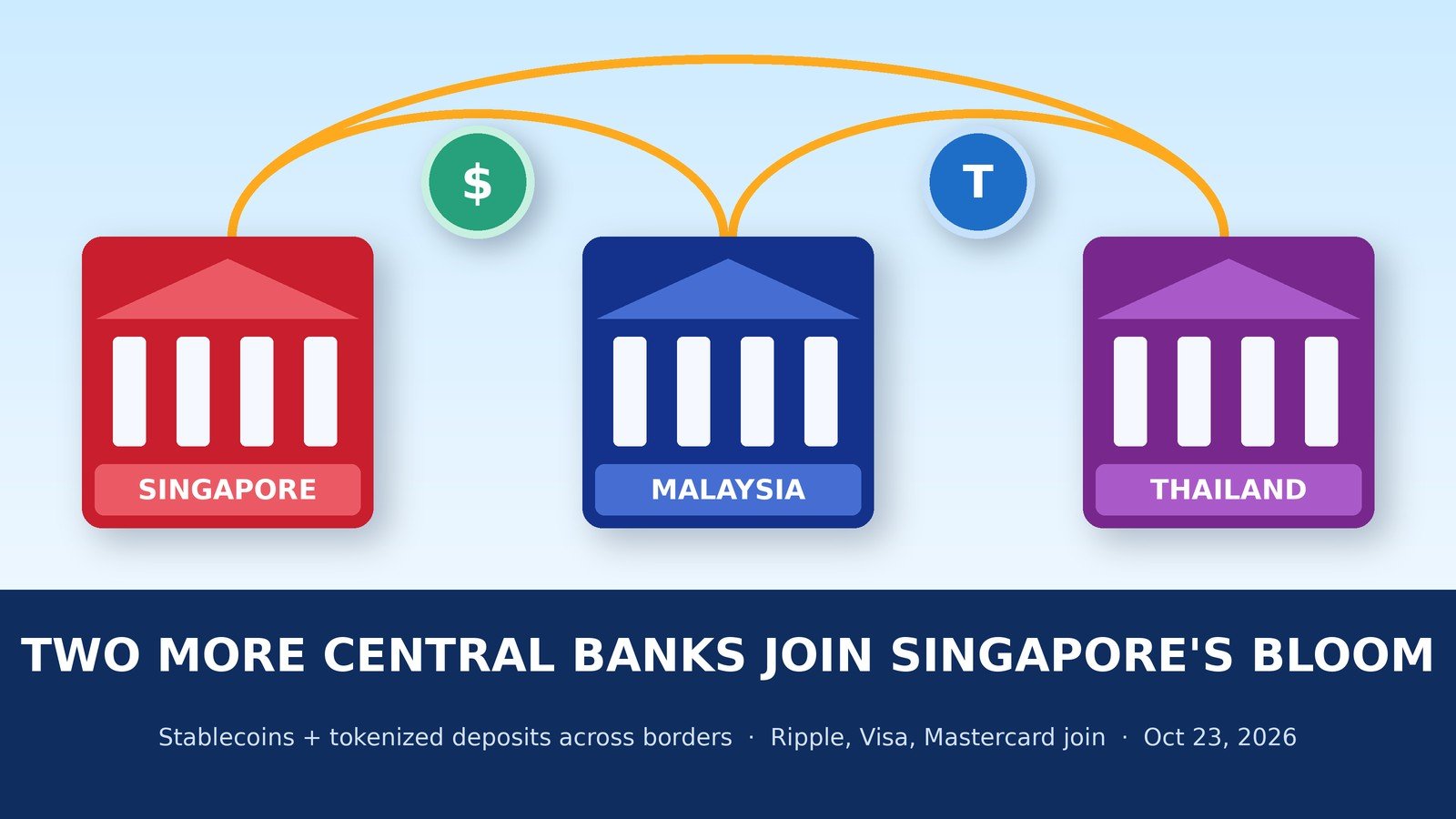
Singapore’s central bank says two of its neighbors are now inside its project to move money across borders with stablecoins and tokenized bank deposits.
The Monetary Authority of Singapore (MAS) announced on Oct. 23 that Bank Negara Malaysia and the Bank of Thailand have joined BLOOM as “policymaker members.” BLOOM stands for Borderless, Liquid, Open, Online, Multi-currency.
MAS also named nine new industry participants: Airwallex, Mastercard, Maybank, Monee, Nium, Ripple, ShopeePay, Visa and the World Bank Group. They join a list that already included Anchorage Digital, Ant International, Circle, Coinbase, DBS, J.P. Morgan, Kasikornbank, OCBC, Partior, Schroders, Standard Chartered, StraitsX, Stripe, Temasek, UOB and Xweave.
What BLOOM is trying to fix
Banks that want to pay each other in digital money across borders today often need a separate deal with each partner and each market. MAS says BLOOM aims to build shared frameworks so they don’t have to, which it says should cut costs and speed up launches.
The settlement assets in view are tokenized commercial bank money and stablecoins “that meet regulatory expectations,” according to MAS. The project builds on Project Orchid, Singapore’s earlier work on a digital Singapore dollar.
MAS listed three work areas:
- Acceptance and settlement: how banks accept different forms of digital money in cross-border deals, how counterparties contract, and how trades finally settle.
- Interoperability: how separate digital money systems can work across networks and borders.
- Programmable controls: safeguards such as identity checks, sanctions screening and transaction controls built into the payment itself.
What the central banks said
“The future of finance will involve multiple forms of digital money operating across different institutions and markets,” said Leong Sing Chiong, MAS deputy managing director for markets and development.
Bank Negara Malaysia Deputy Governor Aznan bin Abdul Aziz said frictionless cross-border payments using multiple digital monies are “now closer to a tangible reality than a far-fetched fantasy.”
Bank of Thailand Deputy Governor Daranee Saeju said the work would help inform “forward-looking regulatory approaches for tokenised money, particularly in cross-border payments and wholesale settlement,” while keeping oversight “prudent, proportionate, and responsive to evolving risks.”
What it is not
This is a coordination project, not a product launch. The MAS release does not name a go-live date, a single token or a single blockchain. Central bank membership means the three regulators will shape the rules as the frameworks are written. It does not mean any of them has approved a specific stablecoin for cross-border use.
For XRP Ledger watchers, Ripple’s name on the list is the hook. The Block reported that Ripple has said its BLOOM work involves testing trade payments with its RLUSD stablecoin on the XRP Ledger. MAS’s release does not single out any network.
MAS did not publish expected volumes or a timeline for live cross-border transactions.
Sources: Monetary Authority of Singapore (media release and BLOOM page, Oct. 23, 2026); The Block; The Business Times.