Index provider MSCI is set to publish the final list for its November index review after the U.S. close on Wednesday, and Strategy, the largest corporate holder of bitcoin, expects to be on the wrong side of it.
In October, MSCI said it would treat “non-operating companies” as ineligible for its Global Investable Market Indexes, the family behind benchmarks such as MSCI World and MSCI USA. The rule is not crypto-specific. A company that fails a core test for substantial operating assets is then checked against five financial ratios; failing four or more makes it ineligible. Current members are removed only if they fail in each of their two most recent annual filings. MSCI said the final list would come with the November review announcement on Nov. 11, and changes take effect at the close on Monday, Nov. 30.
Strategy flagged the likely outcome itself. In its quarterly report filed Nov. 2, the company said it expects its class A common stock to be excluded, and warned that exclusion could hurt the stock’s price and liquidity and its ability to raise capital. MSCI’s list of potentially affected companies also includes Japan’s Metaplanet.
What it means, in plain terms:
- Funds that track MSCI indexes would sell Strategy shares at the Nov. 30 close. JPMorgan analysts have estimated those sales at about $2.8 billion, a figure first published a year ago and likely smaller now after the stock’s decline.
- No rule forces Strategy or Metaplanet to sell any bitcoin.
- The indirect link is funding. Strategy buys bitcoin mostly by selling new shares, so fewer automatic buyers of the stock could mean a slower pace of purchases.
What is not known yet: whether MSCI’s final list matches its preliminary one, and whether other index providers adopt similar rules. MSCI said it may also consider a company’s most recent interim filing.
Markets were quiet ahead of the decision. Bitcoin traded near $73,900 shortly after 8 a.m. ET, down about 0.4% over 24 hours, according to CoinGecko. U.S. spot bitcoin ETFs lost a net $95 million on Tuesday, with BlackRock’s IBIT accounting for $78.2 million of that, according to Farside Investors.
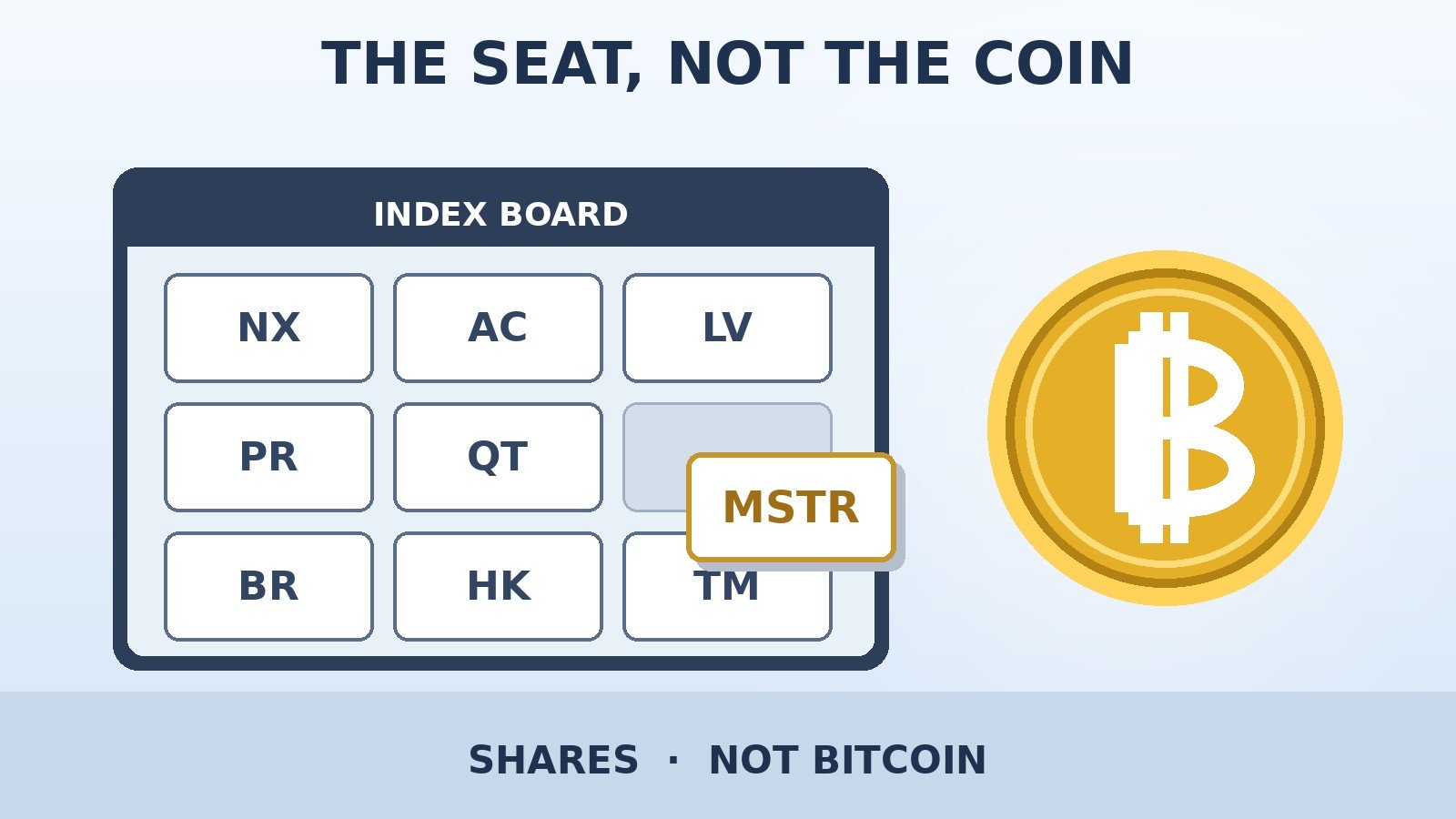
For cautious readers, the takeaway is narrow: this is a stock-index decision about one company’s shares. It changes who must own MSTR, not who must own bitcoin.
Sources: MSCI, Strategy (SEC filing), CoinGecko, Farside Investors.