
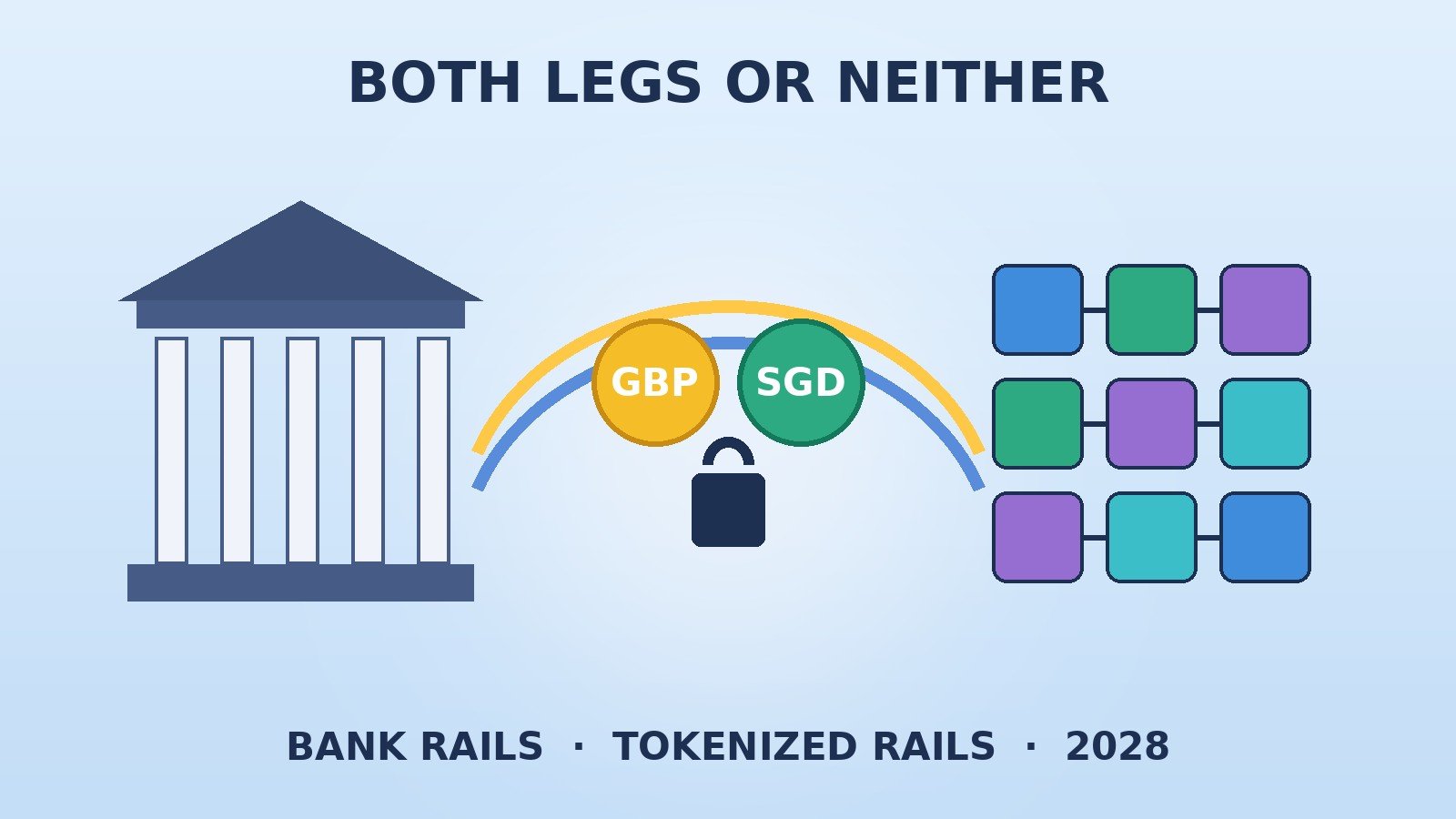
Three central banks said Friday they had settled foreign-exchange trades across payment systems built on completely different technology, including a blockchain-style ledger, without making any of them switch to a common design. The Bank of England, the Monetary Authority of Singapore and the Bank of Thailand published the results of Project Meridian FX APAC on Nov. 13. The Bank of England said the work will feed into a live service it has committed to launch in 2028.
What they tested
The trial linked three central bank test environments. Some ran on conventional Real-Time Gross Settlement, the account-based systems banks use today. Others ran on distributed ledger technology (DLT), the shared-ledger approach behind tokenized money. A prototype “synchronisation operator,” built by the Singapore-based firm Partior, sat in the middle.
The operator’s job is to make both sides of a currency trade settle together or not at all. This is called payment-versus-payment, or PvP. It removes the risk that one bank pays out pounds and never receives the baht. The trial also tested multilateral netting, which offsets many trades against each other so banks need less cash on hand to settle them.
The problem is large. Citing the Bank for International Settlements’ 2025 triennial survey, the Monetary Authority of Singapore said more than $1.4 trillion a day, about 10% of average daily FX settlement in April 2025, was still fully exposed to settlement risk.
What they found
The central banks said synchronised settlement worked across systems “with materially different architectures and capabilities.” The Bank of England’s summary said that suggests cross-border links “do not necessarily require central banks to converge on a single infrastructure design.”
It was easier on some systems than others. The process ran most cleanly where a settlement system let an outside operator earmark, or lock, funds in place and then trigger settlement. Where that wasn’t possible, the project used workarounds. The banks said those workarounds added complexity and could expand the operator’s responsibilities.
Ledger Insights reported the details. The Bank of England’s test system supported earmarking directly. Thailand’s DLT environment used an internal escrow, though custody never passed to the operator. Singapore’s wholesale test ledger did not support earmarking for the operator, so Partior ran a dedicated escrow account and temporarily held the funds. That reverses the model the central banks want, in which the operator coordinates trades but never holds anyone’s money.
The trial also ran failure cases: insufficient funds, wrong account numbers and temporary outages. The banks called the results “encouraging” but said important real-world conditions still need testing. The trial did not use live banks, real trading or production systems.
What regulators still have to settle
The policy report said the right oversight depends on what the operator actually does. According to The Block, it flagged open questions on operational resilience, settlement finality, governance, liability and cross-border data sharing. It also warned that extra functions, such as holding funds or calculating net positions, could change the operator’s regulatory duties.
“Project Meridian FX APAC provides practical evidence of how synchronised settlement could help reduce risk and improve efficiency in cross-border FX transactions,” said Tom Mutton, the Bank of England’s executive director for payments, innovation and fintech. Kenneth Gay, the Monetary Authority of Singapore’s chief fintech officer, said cross-border settlement “increasingly takes place across systems built on different technologies and operating models.”
The Reserve Bank of Australia and the Philippines’ central bank took part as observers. The work builds on an earlier Meridian FX project led by the BIS Innovation Hub in London with the Bank of England, the Bank of France, the Bundesbank, the Bank of Italy and the European Central Bank.
Why it matters
Banks are putting deposits, funds and stablecoins on new ledgers. Without links like this, those ledgers risk becoming islands. Meridian shows central banks are building the bridge themselves, in central bank money. It also shows where the trust question sits: whether the operator in the middle can coordinate trades without ever taking custody. Next, watch the Bank of England’s 2028 build and whether more central banks and commercial banks join the next round.
Sources: Bank of England, Bank of England (executive summary), Monetary Authority of Singapore, Ledger Insights, The Block.