Category: Markets

  • Special Report: Ledger Confirms Reseller Device Implant; XRPN Debuts on Nasdaq Monday

    Special Report: Ledger Confirms Reseller Device Implant; XRPN Debuts on Nasdaq Monday

    Special Report. Two custody and market-rails stories for the week ahead.

    1. Ledger confirms a hardware implant in a reseller-sold device

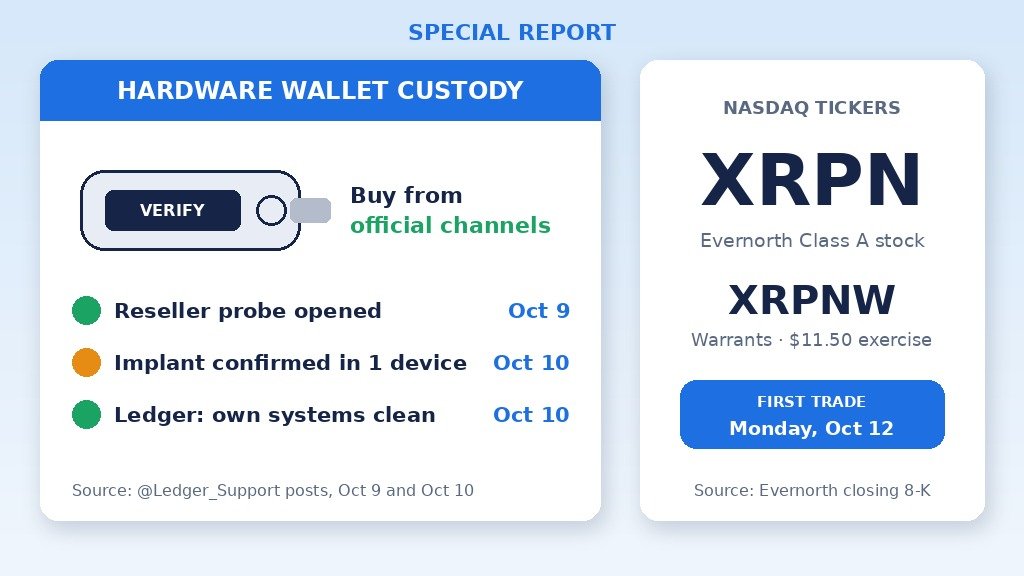
    Ledger said Saturday that one affected user’s device contained an unauthorized hardware implant. The update came from @Ledger_Support at 1:09 p.m. Eastern. Ledger said it is reaching out to impacted users as its investigation continues.

    The probe started Friday. In an Oct. 9 statement, Ledger said it was investigating reported losses among users in Southeast Asia who bought devices from CryptoBilis, a reseller. Ledger asked CryptoBilis to pause all sales and shipments of Ledger devices. News reports describe CryptoBilis as an authorized reseller in Indonesia, Malaysia and the Philippines.

    Ledger said it has no indication that its security infrastructure, systems or services have been compromised, per @Ledger_Support replies on Saturday. Ledger has confirmed one implanted device. It has not said how many devices were affected or how the implant got there.

    Loss figures are not from Ledger. On-chain researchers tanuki42 and Specter published thief addresses with losses above $86 million. Blockchain data firm Bitquery, in a tally verified Oct. 11, counts $93.2 million taken from 315 wallets across six chains, mostly USDT on TRON. Bitquery says Tether froze $10.0 million. Ledger has not confirmed any of these totals.

    Independent research adds context but not proof. Tibane Labs examined two Nano X units with suspected implants that could read the recovery words shown during setup, ForkLog reported. Those units were not shown to come from CryptoBilis.

    What Ledger advises. If you bought from CryptoBilis in the last 90 days and have not set up the device, do not set it up. If you already set it up, consider moving assets to a new Ledger signer with a new recovery phrase. Never share your 24 words with anyone, including people claiming to be Ledger.

    Basic custody hygiene.

    • Buy hardware wallets only from the maker’s official store or resellers it lists by name.
    • Run the device’s built-in authenticity check through the official Ledger Wallet app before loading funds.
    • Be wary of a device that arrives with a recovery phrase already printed or set up.
    • Generate your own seed on the device, and keep it offline.

    The key point is the supply chain. A hardware wallet is only as trusted as the path it took to your hands.

    2. XRPN debuts on Nasdaq Monday

    Evernorth’s closing 8-K, filed Oct. 9 at 4:25 p.m. Eastern, names Monday, Oct. 12 for Nasdaq trading. Class A shares trade as XRPN. Warrants trade as XRPNW. As of Sunday morning, Oct. 11, EDGAR shows no newer Evernorth filing.

    The filed facts:

    • The Armada merger closed Oct. 9.
    • About 80.3% of shares with redemption rights cashed out, about $195.39 million in total.
    • The XRP lots filed at closing add up to about 389 million XRP. Evernorth projected about 473 million on Oct. 1.
    • Each XRPNW warrant lets the holder buy one Class A share at $11.50.

    What to watch on day one. First prints for XRPN and XRPNW. Trading volume against a float thinned by heavy redemptions. Any first holdings update or press release from Evernorth. Any fresh SEC filing, such as a Form 4 or a resale prospectus.

    The trust angle holds. Evernorth’s XRP now sits inside a Nasdaq-listed company that reports to the SEC. Monday shows how the market prices that wrapper. Background: Westen’s Evernorth close piece.

    This is reporting, not investment advice. Hardwire Crypto makes no price calls.

  • Evernorth Closes Armada Merger; XRPN Approved for Nasdaq

    Evernorth Closes Armada Merger; XRPN Approved for Nasdaq

    Evernorth Holdings has closed its merger with Armada Acquisition Corp. II. A Form 8-K accepted at 4:25 p.m. ET on Friday says the business combination was consummated on October 9, 2026.

    That moves the deal from expected to done. Earlier this week, Evernorth said it expected to close on or about Oct. 9, citing an administrative delay. It closed on that date.

    The paper trail

    Friday’s filings came in order. At 9:16 a.m. ET, Evernorth filed a Form 8-A to register its Class A common stock and its warrants on the Nasdaq Stock Market. Each warrant lets the holder buy one share at $11.50.

    At 2:09 p.m. ET, Nasdaq filed its certification approving the listing. A prospectus supplement at 4:10 p.m. said the stock and warrants were approved for listing on the Nasdaq Global Market. The warrants will trade as XRPNW.

    The closing 8-K followed at 4:25 p.m. It also records one housekeeping step tied to the close. On Oct. 9, Evernorth took over Armada’s warrant agreement through an assignment and assumption agreement with Armada and the warrant agent, Continental Stock Transfer & Trust. The exercise period did not change.

    Redemptions and cash at close

    Armada shareholders redeemed heavily. Holders of 18,463,753 Class A shares, about 80.3% of the shares with redemption rights, cashed out at about $10.58 a share. The aggregate redemption amount was about $195.39 million.

    Against that outflow, Friday’s 8-K lists cash that came in with the close. Advance-funding subscribers put up about $214.05 million in cash (plus 600,000 XRP). Delayed-funding subscribers added $10.5 million in cash (plus 200,000 XRP).

    XRP that closed with the deal

    The same filing lists the large XRP moves tied to closing. Arrington XRP Capital Fund subscribed with about 211.3 million XRP. Ripple contributed about 126.8 million XRP under its contribution agreement. A Ripple-affiliated trust subscribed with 50 million XRP. Smaller subscriber XRP lots totaled another 800,000.

    Added together, those closing subscriptions and Ripple’s contribution come to about 389 million XRP. That is the filed package at close. It is not a later treasury report, and it is below the roughly 473 million XRP Evernorth had projected on Oct. 1.

    When XRPN trades

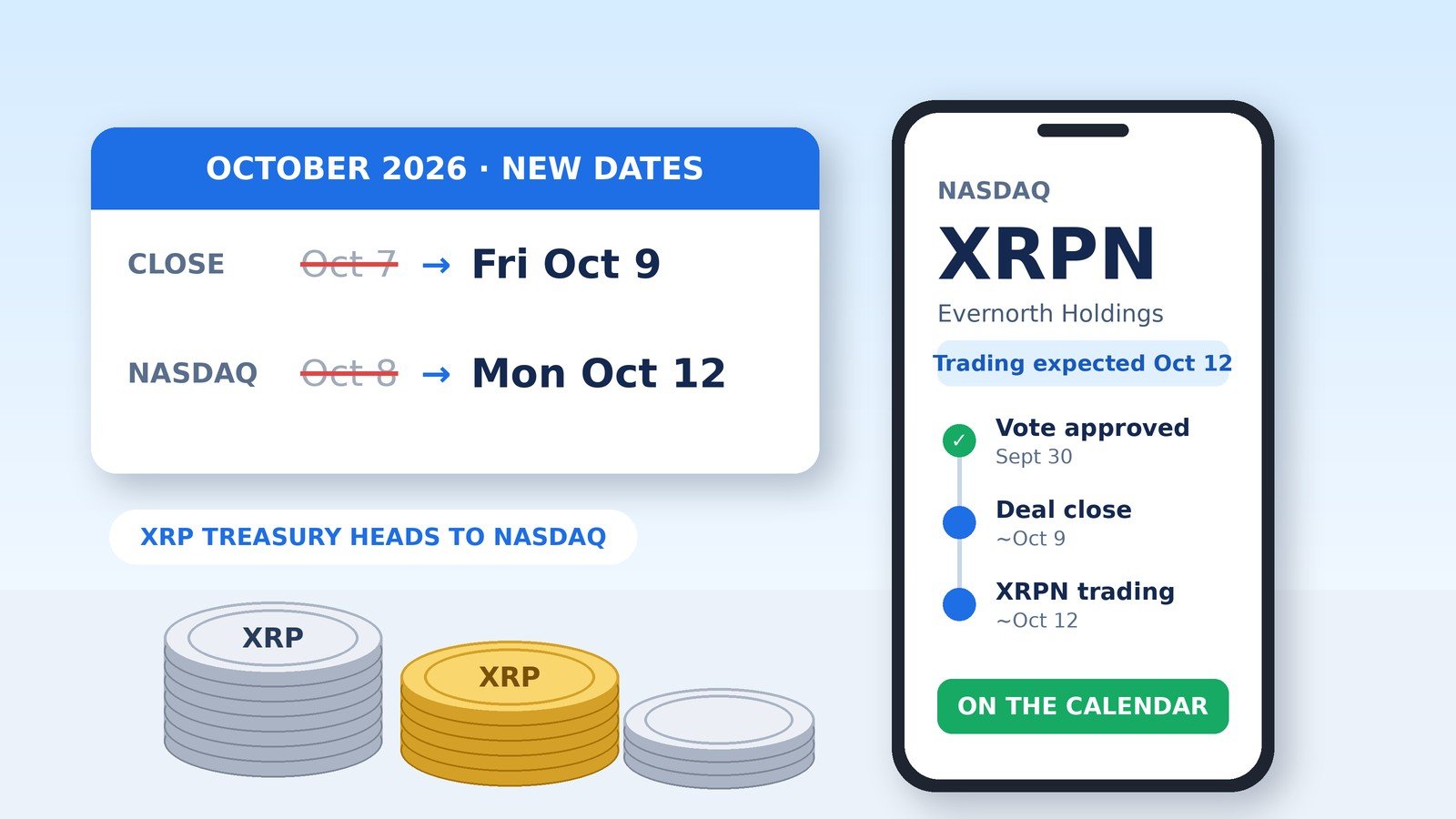
    The closing 8-K states that Pubco Class A common stock and Pubco warrants began trading on Nasdaq on October 12, 2026 under XRPN and XRPNW. That is Monday. An Oct. 6 8-K had said “on or about” that date. Friday’s closing filing names Oct. 12 without the hedge.

    As of the close, Evernorth reported 22,268,905 Class A shares, 32,211,992 Class C shares, and 11,739,645 warrants outstanding.

    For the XRP market, the point is the wrapper. Evernorth now holds its XRP inside a Nasdaq-listed company that files with the SEC. Investors will be able to track it through public reports, not just company posts.

  • Blockchain.com Seeks CFTC DCM and FCM Licenses for U.S. Prediction Markets

    Blockchain.com Seeks CFTC DCM and FCM Licenses for U.S. Prediction Markets

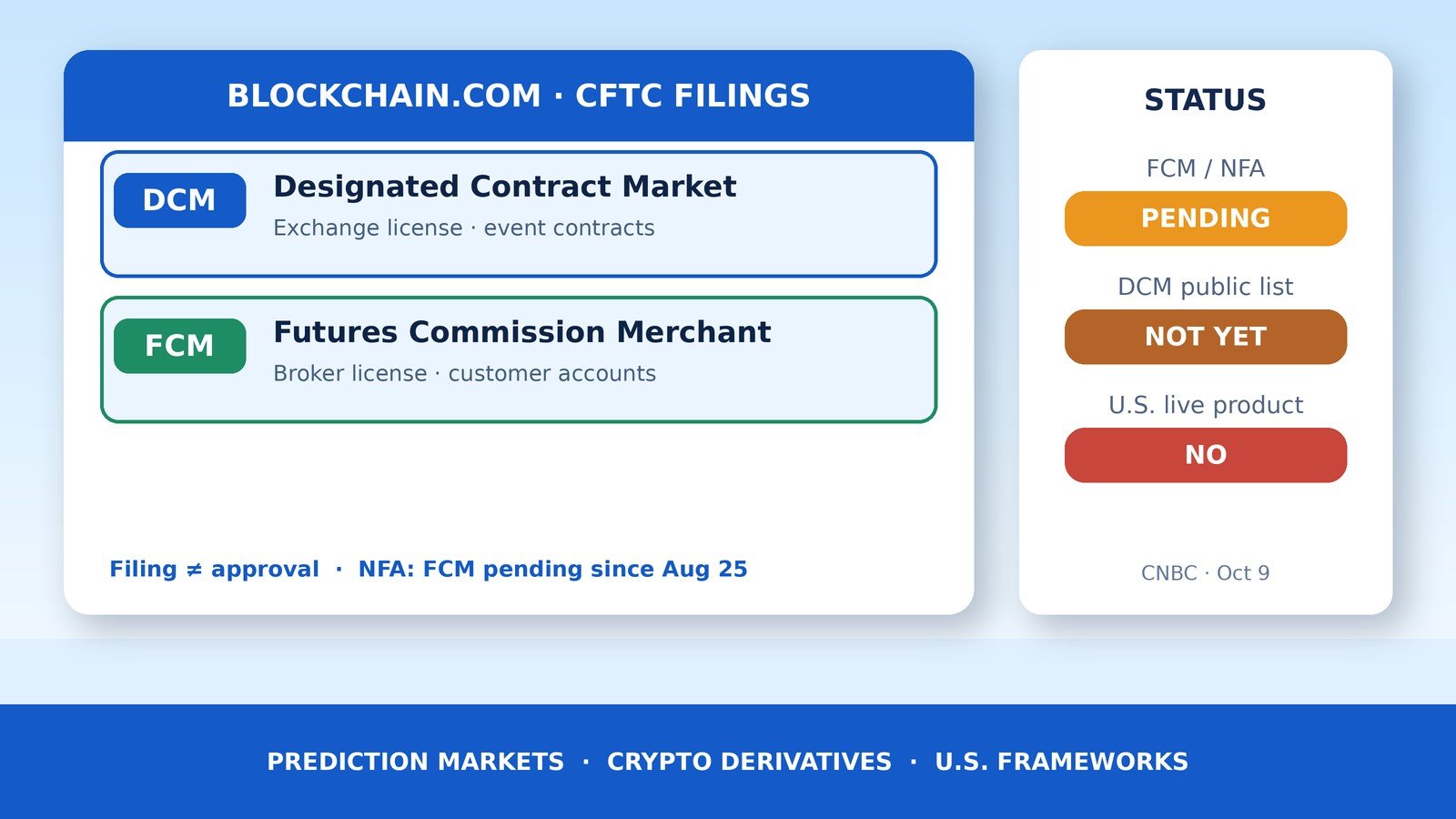
    Blockchain.com told CNBC on Friday that it has applied for Commodity Futures Trading Commission licenses to offer U.S. event contracts and cryptocurrency derivatives. The company is seeking designation as a designated contract market, the exchange license for futures and event contracts, and registration as a futures commission merchant, the broker classification that handles customer derivatives accounts.

    That is a filing story, not an approval story. The firm is not yet authorized to run those U.S. products under the licenses it says it seeks.

    What the company said

    CEO and co-founder Peter Smith told CNBC that users should be able to manage digital assets, trade derivatives, and take positions on real-world events in one place, without jumping between apps. He said the DCM and FCM applications build toward that future in the United States through the appropriate regulatory frameworks.

    Blockchain.com already offers prediction markets through a Polymarket partnership and perpetual futures powered by Hyperliquid to some international customers outside the United States, per CNBC. The dual filings would, if approved, move the firm from distributing partners’ products toward operating its own U.S. exchange and brokerage stack.

    What public records show so far

    Finance Magnates, citing National Futures Association records, reported that Blockchain.com Derivatives Inc. has had pending applications for FCM registration and NFA membership since Aug. 25. Those applications remain under review. The firm is not yet authorized to conduct FCM business.

    Finance Magnates also reported that the DCM application was not yet visible in public CFTC records as of Friday, and that no public filing disclosed products, market-access details, or a launch date. Treat the DCM claim as company-to-CNBC disclosure until it appears in the regulator’s public queue.

    The stampede context

    CNBC said Blockchain.com joins 11 other companies that have filed for DCM licenses this year. The CFTC has approved six new DCMs in 2026. More firms are chasing the prediction-market boom. Approvals and live U.S. product are still separate steps.

    Separately, Blockchain.com confidentially filed for an IPO with the Securities and Exchange Commission in May. Bloomberg previously reported ambitions around a roughly $4 billion to $6 billion valuation and about a $500 million raise. That is IPO optics context, not the lead of this filing.

    Rails and trust

    DCM plus FCM would be a model shift: from reseller of Polymarket and Hyperliquid rails to an in-house exchange-and-broker structure for eligible U.S. customers. Finance Magnates noted a similar path at Robinhood, which began by distributing external event contracts before moving toward its own market infrastructure. Blockchain.com has not disclosed whether it would build, buy, or outsource clearing.

    For Hardwire readers, the checklist is simple. Watch for the DCM name on the CFTC’s public applicants list. Watch whether the FCM application clears NFA review. Filing is not a license. A license is not a live U.S. product book.

    Sources: CNBC; Finance Magnates

  • XRPL Batch Day: What Actually Turns On This Morning

    XRPL Batch Day: What Actually Turns On This Morning

    Permission Delegation is no longer a forecast on the XRP Ledger. The PermissionDelegationV1_1 amendment enabled on mainnet Thursday at 5:29 p.m. ET, in ledger 107,524,865. The ledger’s own EnableAmendment record shows it, and XRPL Dashboard and CoinDesk reported the same activation.

    Friday’s clock is Batch. It is not live yet.

    What is scheduled this morning

    Two Batch amendments reach the end of their two-week windows Friday, if validator majorities hold. The ledger’s Amendments record shows fixBatchV1_2 gained its majority on Sept. 25 at 10:12 a.m. ET, and BatchV1_1 at 10:46 a.m. ET the same day.

    That puts fixBatchV1_2’s projected activation at about 10:12 a.m. ET Friday. The switch itself happens in an EnableAmendment pseudo-transaction on a following flag ledger, expected around 10:29 a.m. BatchV1_1 follows: projected at about 10:46 a.m., with its enable transaction expected near 11:03 a.m.

    These are projections, not guaranteed times. An amendment needs more than 80% of trusted validators for two straight weeks. With 35 validators on the current list, that means at least 29 yes votes. If support drops to 28 or below, the majority is lost and the two-week clock restarts. That happened to Permission Delegation in September.

    The vote margins

    XRPL Dashboard’s roll call early Friday showed fixBatchV1_2 at 35 of 35 trusted validators. BatchV1_1 sat at 30 of 35, one vote above the 29 needed. Counts differ by tracker, so treat these as one source’s read.

    What Batch does

    BatchV1_1 adds the Batch transaction. One account can submit up to eight inner transactions together. They can be set as all-or-nothing groups, so a two-sided settlement either completes in full or not at all. The standard is XLS-56.

    BatchV1_1 replaces the original Batch amendment. That version was disabled in xrpld 3.1.1 after developers found a critical bug, per XRPL.org. fixBatchV1_2 is the companion fix. It shipped in xrpld 3.4.1, an emergency release for security-sensitive issues. Servers on older software risk becoming “amendment blocked,” unable to keep up with the ledger, once it turns on.

    The PaymentBurn caveat stays

    Permission Delegation’s warning is unchanged. Until fixCleanup3_4_0 is enabled, XRPL.org recommends not delegating the PaymentBurn permission. Before that fix, a delegate holding it can also mint new trust-line tokens or MPTs in certain cases. Other permissions are unaffected.

    The fix is not close to done. The ledger logged a majority for fixCleanup3_4_0 early Friday, about 5:34 a.m. ET. If that held for two weeks, the earliest activation would be around Oct. 23. But Friday morning roll calls had it at or below the line: 28 of 35 on XRPL Dashboard, and 27 of 35 in CoinDesk’s report. Treat PaymentBurn as off-limits for now.

    Evernorth: expected is not closed

    Separately, Evernorth’s Oct. 6 Form 8-K still points to a closing “on or about” Oct. 9 and Nasdaq trading as XRPN “on or about” Oct. 12. As of Friday morning, EDGAR showed no closing 8-K. Expected is not closed.

    What to check

    Batch day is a protocol event. It is about capability and operator risk, not price. Before treating either Batch amendment as live, look for its EnableAmendment transaction on the ledger after the morning windows, not just the countdown.

    Sources: XRPL.org Known Amendments; XRP Ledger Amendments object and ledger 107,524,865; XRPL Dashboard; CoinDesk; SEC EDGAR

  • Paxos Adds XRP to the Brokerage Rails Used by PayPal, Venmo and Schwab

    Paxos Adds XRP to the Brokerage Rails Used by PayPal, Venmo and Schwab

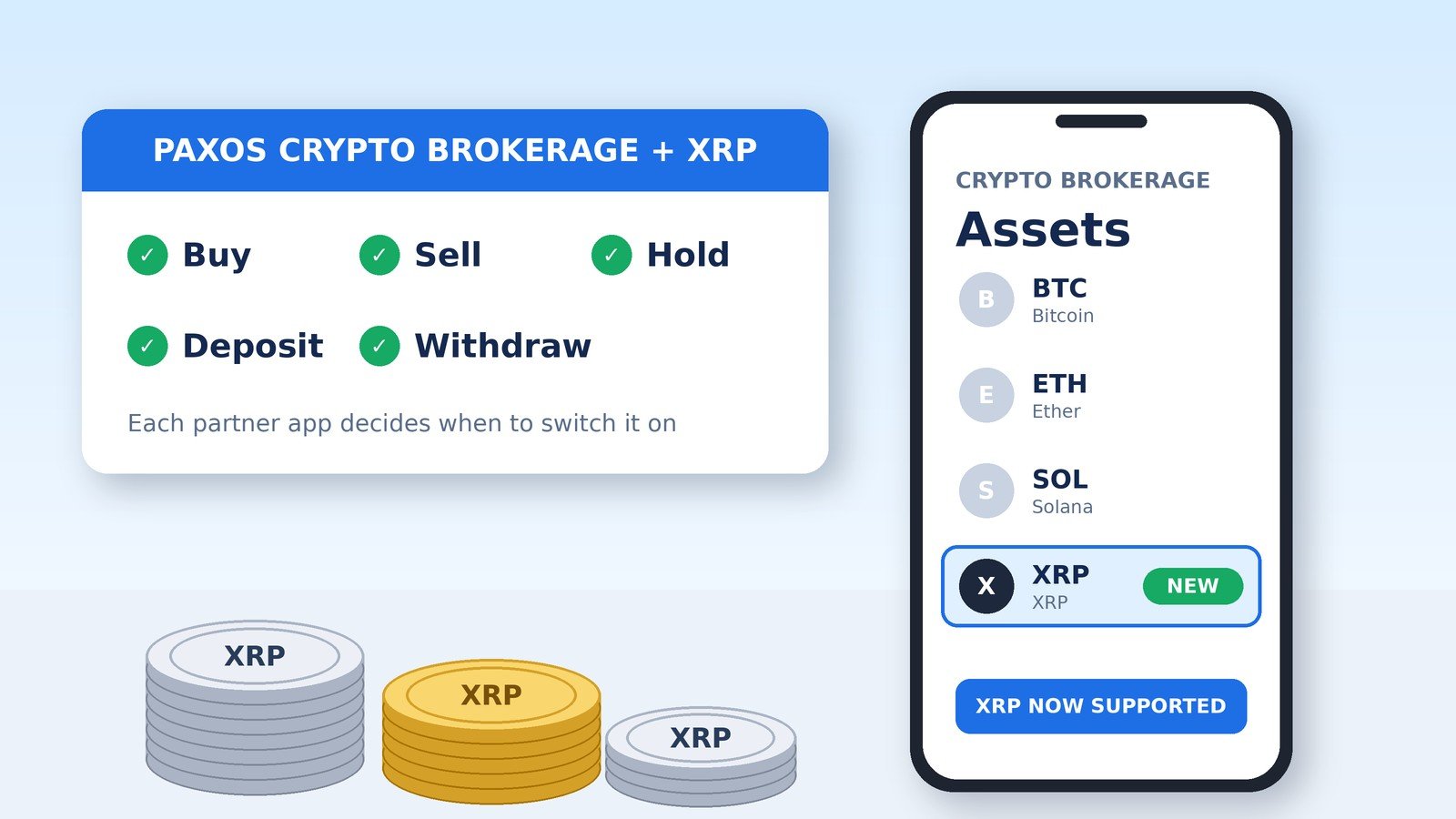
    Paxos has added XRP to Paxos Crypto Brokerage, the white-label trading and custody service it runs for banks, brokerages and payment apps. “Paxos Crypto Brokerage now supports $XRP,” the company posted on X on Wednesday morning. “Partners can now offer XRP through the same regulated platform trusted by some of the biggest names in finance.”

    The XRP Ledger Foundation, a non-profit that supports the network, filled in the client list. In its own post, it called Paxos Crypto Brokerage “the regulated back end used by PayPal, Venmo, Interactive Brokers, Charles Schwab, and Mercado Libre,” and said partners can offer XRP “for buy, sell, hold, deposit, and withdrawal.” Paxos replied: “The Paxos Crypto Brokerage lineup just got stronger.”

    What changed, and what didn’t

    What changed is the plumbing. A firm that already uses Paxos for crypto trading can now add XRP without building its own custody, liquidity connections or trade monitoring. Paxos says on its brokerage page that it “never trades against your clients,” benchmarks fills against independent price feeds, and puts every new asset through a review of “legal classification, liquidity, and regulatory history” before listing it. Paxos also says it is now federally chartered by the OCC and custodies assets on a fiduciary basis.

    What has not changed, yet, is what customers see. None of the named platforms has announced an XRP launch for its own users. Each partner picks its own lineup. Schwab is a useful example: Paxos handles trade execution and sub-custody for Schwab’s crypto service, while Charles Schwab Premier Bank holds customer assets, crypto.news reported. Schwab’s August expansion named Solana, Avalanche and Chainlink. XRP was not on that list.

    The addition fits a steady build-out. Paxos had more than doubled its brokerage list to 29 tokens by June and set a goal of covering much of the top 50 by year-end, Bitcoin.com News reported, citing head of brokerage product Asset Tarabayev.

    Korea gets a Ripple partner too

    The same day, South Korean brokerage Meritz Securities disclosed a strategic partnership with Ripple. The two will review how Ripple Custody and Ripple’s tokenization infrastructure could be used in Korea’s capital markets, The Herald Business reported. Meritz CEO Jang Won-jae and Ripple President Monica Long attended the signing at Meritz’s Yeouido headquarters, which took place on October 1, according to Seoul Economic Daily.

    Meritz says it will start inside current securities rules and widen the work in stages as Korea’s digital asset regime develops. It is studying spot crypto ETFs, fractional and tokenized securities, trading platforms and won-denominated stablecoins. No product or launch date has been announced. “We look forward to exploring how digital asset infrastructure can support the continued development of Korea’s capital markets,” said Fiona Murray, Ripple’s head of Asia-Pacific.

    The rails view

    Both moves are distribution, not demand. Paxos opens a regulated door that large consumer apps already walk through. Meritz puts Ripple’s custody stack in front of a top Korean brokerage before the rules are final. The trust markers to watch are concrete: a named partner switching XRP on for its own customers, and a first Meritz product with a filing or a date.

    The market did not wait for either. XRP traded near $1.40 on Thursday morning, down about 3% in 24 hours, per CoinGecko, after Wednesday’s Fed minutes showed most officials expect another rate hike by year-end, CNBC reported. U.S. spot XRP ETFs recorded zero net flow on Wednesday, while bitcoin ETFs lost $487 million, according to SoSoValue data compiled by CoinGabbar.

    Sources: Paxos on X; XRP Ledger Foundation on X; Paxos; crypto.news; Bitcoin.com News; The Herald Business; Seoul Economic Daily; CNBC; CoinGabbar

  • Evernorth Moves Expected Close to Oct. 9 and XRPN Nasdaq Debut to Oct. 12

    Evernorth Moves Expected Close to Oct. 9 and XRPN Nasdaq Debut to Oct. 12

    Evernorth Holdings has pushed back its timeline by two days for the deal and four days for the stock. In a Form 8-K filed Tuesday, the company said its business combination with Armada Acquisition Corp. II is now expected to close “on or about October 9, 2026.” Its Class A common stock is expected to begin trading on Nasdaq under the ticker XRPN “on or about October 12, 2026.”

    The old plan, set out in the company’s October 1 release, was a close today, October 7, and first trading on Thursday, October 8.

    What the company said

    The filing gives one reason: “an administrative delay that is not expected to affect the closing.” It does not say what the delay is. Both new dates remain “subject to satisfaction of customary closing conditions.” CEO Asheesh Birla signed the report.

    Evernorth posted the same message on its verified X account: “we now expect to close on Friday, October 9th, with XRPN expected to start trading on Nasdaq on Monday, October 12th, in each case subject to customary closing conditions and Nasdaq listing requirements.” The X wording names Nasdaq listing requirements directly. The 8-K covers that ground in its risk language. An October 7 Rule 425 filing shows Evernorth also lodged its October 6 communications with the SEC.

    Nothing else in the deal terms has been publicly changed. Armada’s shareholders approved the combination on September 30. Per Armada’s vote 8-K, the Business Combination Proposal passed 20,514,034 to 1,362,081. The October 1 release projected about $300 million in gross cash proceeds before expenses and about 473 million XRP on the balance sheet at closing. Those remain projections until a closing filing confirms them.

    A warrant fix along the way

    One more piece of plumbing moved this week. On Monday, Armada amended its warrant agreement with Continental Stock Transfer & Trust. The warrants trade on Nasdaq as XRPNW and carry an $11.50 exercise price. The change makes the agreement match what Armada’s May 2025 IPO prospectus already promised: the warrants become exercisable on the later of the completed business combination or 12 months after the IPO closed. Evernorth announced the amendment the same day.

    That is a conforming change, not a new economic term. It lines up the contract with the disclosure investors were given, before the shares and warrants become claims on an XRP treasury company.

    The rails view

    For trust, the useful part is how the change was delivered. The new dates came first in an SEC filing signed by the CEO, matched in substance on the company’s own X account, and were labeled “on or about.” The company did not quietly let October 7 pass. It refiled.

    What still has to happen is the same list as last week: the closing conditions, funding from private placement and in-kind contributors, final trust cash after redemptions, and Nasdaq clearance for the combined company’s stock. Until a closing 8-K and a listing notice arrive, October 9 and October 12 are company-expected dates, not completed events.

    The market backdrop is soft. XRP traded near $1.47 on Wednesday morning during a broad, leverage-driven sell-off, FXStreet reported. U.S. spot XRP ETFs still took in a net $3.1 million on Tuesday, Cointelegraph reported, citing SoSoValue data. Hardwire will report the closing filing when it lands.

    Sources: Evernorth Form 8-K (Oct 6); Evernorth on X; Evernorth Rule 425 filing (Oct 7); Armada Form 8-K, warrant amendment; Evernorth release on warrant amendment; Armada Form 8-K, vote results; PR Newswire; Cointelegraph; FXStreet

  • OKX and ICE file to trade 63 tokenized U.S. stocks around the clock

    OKX and ICE file to trade 63 tokenized U.S. stocks around the clock

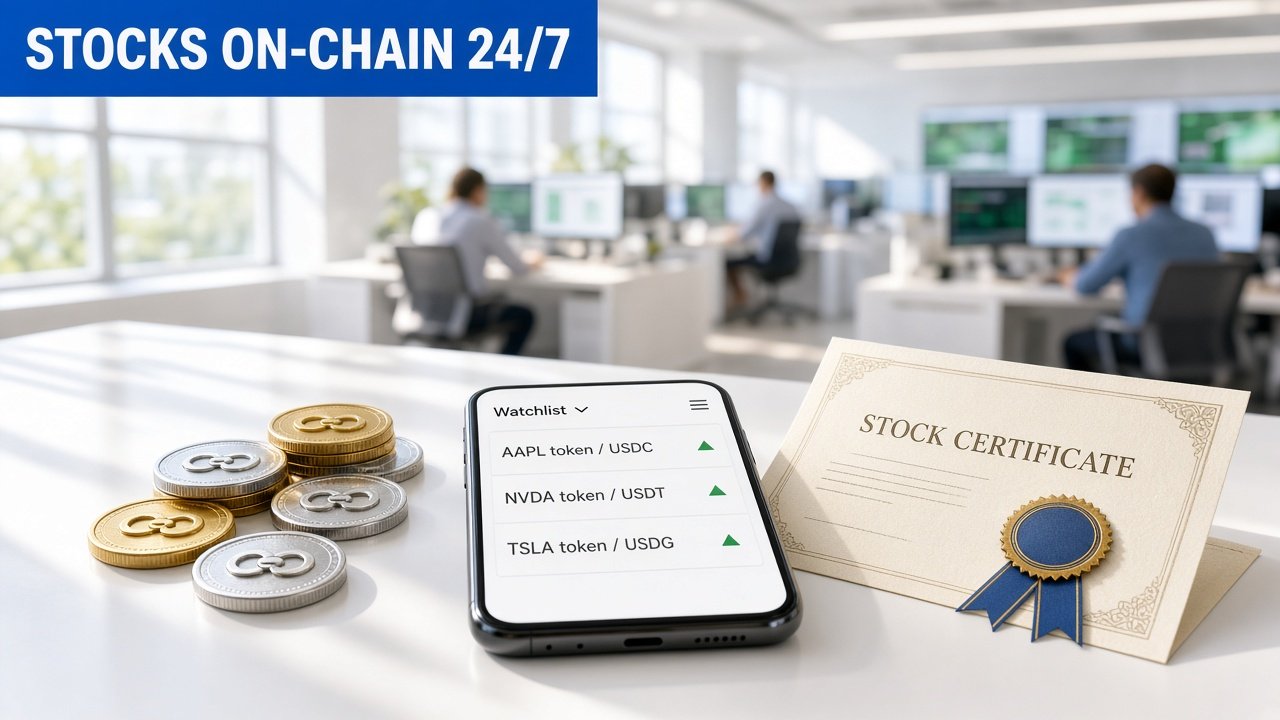
    OKXICE, the 50-50 joint venture between crypto exchange OKX and Intercontinental Exchange, the parent of the New York Stock Exchange, published a public notice dated Sunday, Oct. 4, saying it intends to run a tokenized stock venue under the SEC’s new tokenized-securities exemption. The plan is round-the-clock trading of tokenized versions of U.S.-listed shares, settled on a blockchain and priced against dollar stablecoins.

    The notice lists 63 stocks. They include Nvidia, Apple, Microsoft, Tesla, Amazon, JPMorgan Chase and Goldman Sachs, plus crypto-linked names such as Coinbase, Circle, Strategy, Robinhood, BitGo and Securitize. Each token would trade against one of three payment stablecoins: USDC, USDG or USDT. The venue says it will operate 24 hours a day, seven days a week.

    The rails are specific. Trades would run through Uniswap v4 liquidity pools on XLayer, OKX’s layer-2 network, with an OKXICE smart-contract add-on that checks every wallet. Only wallets holding a non-transferable “soulbound” token can trade or add liquidity. That token is issued after identity checks, anti-money-laundering checks and sanctions screening run by OKX’s U.S. entity. The venue does not run an order book, does not hold customer assets, does not lend and does not sell new shares.

    The trust question in any tokenized stock is simple: is there a real share behind the token? The notice says the tokens come from an unaffiliated third party, called only “the Tokenizer,” which holds the underlying shares one-for-one through an SEC-registered, FINRA-member broker-dealer. Tokens are minted only after the shares are bought and held. The notice says holders get the same rights as ordinary shareholders, including dividends, voting and a share of assets in a liquidation.

    There are guardrails, and the notice spells them out. Trading in a token stops whenever the underlying stock is halted on its main exchange. If trading in a token breaks the exemption’s volume limits a second time, the venue must pause it for three months. OKXICE keeps admin keys that can pause pools, upgrade contracts and remove wallets. The notice also warns that token prices are set by the pools, not by the stock market, and may differ from the real share price, especially outside regular trading hours or when liquidity is thin.

    Plain disclosure, worth reading twice: the venue is not registered with the SEC as an exchange, is not subject to Regulation NMS, and the SEC has not passed on the notice’s accuracy. Its use of the exemption remains subject to SEC oversight. That is how the exemption is built, not a red flag on its own.

    Companies get a say. Under the exemption, a venue must notify an issuer and give it 30 days to object. Cerebras Systems has already filed an objection, and its stock is not on the list. Ledger Insights reports the 30-day wait puts the earliest possible start in early November. The notice itself gives no launch date.

    OKXICE co-chair Andrew Cuomo called the filing “a landmark step toward a truly global, 24/7 Wall Street.” OKX CEO Star Xu said the future of markets is “real ownership, onchain,” and that “full shareholder rights are what make that possible.”

    What happened: an NYSE-linked venture filed a public notice to trade tokenized U.S. stocks on-chain. What has not happened: trading. The next marks are issuer objections and the end of the 30-day window.

    Sources: OKXICE public notice; Decrypt; Ledger Insights; The Block

  • Evernorth Flags Expected Oct. 7 Close, Nasdaq XRPN Trading Oct. 8

    Evernorth Flags Expected Oct. 7 Close, Nasdaq XRPN Trading Oct. 8

    Evernorth Holdings, Inc. and Armada Acquisition Corp. II (Nasdaq: XRPN) said in a company release this morning that the business combination is expected to close on October 7, 2026, with Class A common stock of the combined company expected to begin trading on Nasdaq under ticker XRPN on October 8, 2026 — subject to satisfaction or waiver of remaining closing conditions.

    The dated timeline follows Armada’s extraordinary general meeting on September 30, where shareholders approved the condition-precedent proposals for the combination. Armada’s Item 5.07 Form 8-K, filed October 1, records the vote: a quorum of 21,877,045 SPAC common shares (about 69% of shares entitled to vote); Business Combination Proposal 20,514,034 for, 1,362,081 against, 930 abstentions; Merger Proposal 20,514,597 for, 1,362,089 against, 359 abstentions; and Class B-only domestication approved unanimously, 7,880,000 for. Hardwire covered that tally earlier today. Shareholder approval is not closing, and closing is not automatic listing.

    Per the October 1 company PR (issued about 8:00 a.m. ET), the combination is expected to raise approximately $300 million in gross cash proceeds before transaction expenses — including about $225 million from related private placements, $30 million of incremental convertible note financing, and approximately $48 million of trust proceeds. Investors have also contributed XRP in kind. At closing, Evernorth is expected to hold approximately 473 million XRP if those contributions land as described. The release states that 100% of both advanced and delayed funders are participating. Named backers in the PR include Arrington Capital, SBI Group, Ripple, Pantera Capital, Kraken, and GSR, among others.

    After closing, the combined company would operate as Evernorth Holdings, Inc. Armada’s Class A ordinary shares already trade on Nasdaq as XRPN (units XRPNU; warrants XRPNW); the PR points to continued use of XRPN for the combined company’s Class A common stock once closing and listing steps clear. The Block’s same-day report (about 11:17 a.m. ET) restated the Oct. 7 close / Oct. 8 trading expectation and the ~$300 million cash and ~473 million XRP figures from the company materials.

    What still sits on the rails: remaining closing conditions in the Business Combination Agreement and related subscription and contribution agreements; whether private-placement and in-kind counterparties fund as committed; final trust cash after redemptions and expenses; and Nasdaq listing clearance for the combined company’s securities. Until a closing 8-K and listing notice land, Oct. 7 and Oct. 8 remain company-expected dates — not completed events.

    Key facts

    • EGM approvals: Sept. 30, 2026 (Item 5.07 8-K filed Oct. 1)
    • Expected close: Oct. 7, 2026 (company PR; subject to remaining conditions)
    • Expected Nasdaq Class A trading under XRPN: Oct. 8, 2026 (company PR)
    • Expected gross cash at close: ~$300M before expenses ($225M PIPE-related, $30M convertible note, ~$48M trust)
    • Expected XRP treasury at close: ~473M XRP (in-kind contributions included; contingent on close and funding)

    Sources: PR Newswire; The Block; SEC Form 8-K (Item 5.07); Hardwire morning vote piece.

  • Armada Shareholders Approve Evernorth Combination; Closing and XRPN Listing Still Ahead

    Armada Shareholders Approve Evernorth Combination; Closing and XRPN Listing Still Ahead

    Armada Acquisition Corp. II’s Item 5.07 Form 8-K, filed October 1, confirms that shareholders approved the condition-precedent proposals for its business combination with Evernorth Holdings Inc. at the September 30, 2026 extraordinary general meeting.

    A quorum of 21,877,045 SPAC common shares — about 69% of shares entitled to vote — was represented. The Business Combination Proposal passed 20,514,034 for, 1,362,081 against, and 930 abstentions. The Merger Proposal passed 20,514,597 for, 1,362,089 against, and 359 abstentions. Only Class B holders voted on domestication; that proposal cleared unanimously, 7,880,000 for and none against. Non-binding advisory document proposals also passed. The adjournment proposal was not presented because enough votes were already on the table.

    Approval clears the shareholder-vote condition in the Business Combination Agreement among Armada, Evernorth (Pubco), Pathfinder Digital Assets LLC, merger subsidiaries, and Ripple Labs Inc. It does not close the deal. Armada’s September 17 8-K still pegs expected closing in the fourth quarter of 2026, subject to customary conditions — including Nasdaq listing clearance for Pubco’s Class A common stock and warrants after notice of issuance, and funding and contribution conditions under the subscription and contribution agreements.

    Ticker hygiene matters. Armada’s Class A ordinary shares already trade on Nasdaq as XRPN (units XRPNU; warrants XRPNW). The combined company is also expected to trade under XRPN once closing and listing conditions are satisfied. Shareholder approval is not the same event as closing, and closing is not a same-day debut of a new public float.

    Evernorth describes itself as a digital-asset treasury that intends to hold and actively manage XRP and allocate capital across XRP-linked infrastructure under public-company disclosure. Company materials have pointed to an expected treasury of at least about 473.3 million XRP at closing — a figure that remains contingent on close and on counterparties funding contributions as committed. A separate $30 million convertible senior PIK note facility at Evernorth is also conditioned on closing concurrently with the combination.

    Public shareholders could vote for the deal and still redeem; the redemption deadline was September 28. Final cash left in the trust for the combined company will depend on redemptions, expenses, and whether private-placement parties fund — numbers that typically land in later closing disclosures, not in the vote 8-K.

    What to watch next: closing announcements, any redemption and trust-cash updates, and Nasdaq listing notice for the combined company’s securities. Until those land, the clean fact is that the inspector’s tally is now on EDGAR — and the rails from vote to listed treasury company still have conditions left to clear.

    Sources: SEC; SEC; PR Newswire

  • Brazil’s CSD BR Starts Mirroring Fund Records on the XRP Ledger

    Brazil’s CSD BR Starts Mirroring Fund Records on the XRP Ledger

    Brazil’s CSD BR has begun using the XRP Ledger as a second record for ownership of selected BTG Pactual investment fund shares, while its own systems remain the official source of record for registration, deposit, and settlement.

    In a Sept. 29 statement, Ripple said the first phase of its partnership with CSD BR will tokenize and mirror those fund shares on XRPL using the Multi-Purpose Token standard. Authorized participants can use the blockchain copy as a near-real-time query and audit layer. CSD BR said it holds more than 22 trillion reais in registered assets across its broader platform — a measure of the depository’s scale, not the size of the XRPL pilot.

    The architecture is deliberately cautious. CSD BR retains control over issuance and administration, including participant authorization, freezes, and clawbacks when required by regulators or courts. Access is permissioned to Brazilian corporate and banking clients subject to KYC and AML checks. Ripple and CSD BR said the model was built inside the current regulatory framework and does not, in this phase, change legal responsibilities for investors, issuers, or participants.

    That distinction matters. Assets registered with CSD BR are not being migrated onto XRPL as the legal books. The public ledger is a complementary mirror for reconciliation and transparency, not a transfer of the official register. CoinDesk reported the same structure: CSD BR’s database stays authoritative for custody and settlement.

    If mirroring holds up under live conditions, the partners said they may later test native issuance and trading among authorized participants, with Brazilian real-estate and agribusiness receivables (CRI and CRA) under consideration. Those steps are forward-looking and would need their own operational and regulatory scrutiny.

    For risk-averse readers, the story is not that Brazil “put trillions onchain.” It is that a central bank– and CVM-authorized market infrastructure chose a public ledger for a controlled, live audit layer — with clawbacks and identity gates intact — while keeping legal finality off the chain for now.

    Sources: Ripple; CoinDesk; Markets Media