Category: Markets

  • Standard Chartered Signs Deal to Own Its Crypto Custodian Outright. Here’s What Changes for Clients

    Standard Chartered Signs Deal to Own Its Crypto Custodian Outright. Here’s What Changes for Clients

    Standard Chartered said Wednesday it has signed definitive agreements to buy all of Zodia Custody, an institutional crypto custodian, and bring the business inside the bank.

    The buyer is Standard Chartered I H Limited. The target is Zodia Custody Limited, the parent of regulated operating companies in Singapore, Hong Kong, Australia, the United Arab Emirates and Luxembourg. The deal still needs regulatory approvals and customary closing conditions. The bank didn’t disclose a price or a completion date.

    After closing, Zodia’s custody business will be merged into the digital asset custody Standard Chartered already runs inside its Securities Services business. The bank says the aim is a single offering that covers both traditional and digital securities services for institutional clients.

    The deal also splits Zodia in two. Its software and professional-services arm moves to a new, independent company, Zodia Solutions, set up under SC Ventures, the bank’s venture unit. Listed backers include Northern Trust, NAB Ventures, SBI Ventures, Emirates NBD and Investcorp’s Zodia Investments. Standard Chartered will be one of its customers.

    For clients, the bank says it expects no disruption and that existing custody clients will “continue to be serviced as usual.” The bigger change comes later. Once the deal closes, those clients’ crypto will sit with a unit of a global bank listed in London and Hong Kong rather than with a separately owned company. Institutions that use Zodia may want to review the change-of-control terms in their agreements and confirm which company will supply the technology after closing.

    The deal has taken longer than planned. Zodia’s shareholders and noteholders accepted the bank’s non-binding offer in May, and definitive agreements were first targeted for the end of June with completion by the end of August, The Block reported. Zodia’s chief executive, Julian Sawyer, stepped down in September, and former chief revenue officer Richard Clark now runs the company.

    Standard Chartered is also building custody on its own. Earlier this month it said it plans to launch crypto custody in Singapore by the end of 2026, according to The Block.

    “Custody is increasingly becoming part of the global banking landscape,” Clark said in the bank’s release.

    What to watch next: approvals in each of the five jurisdictions, whether a price is ever disclosed, and whether clients see any change in fees or terms after closing.

    Sources: Standard Chartered; The Block
  • SoFi Launches a Bank ‘Deposit Token’ for Crypto Users: 4.40% Interest, FDIC Insurance, Swaps 1:1 Into Its Stablecoin

    SoFi Launches a Bank ‘Deposit Token’ for Crypto Users: 4.40% Interest, FDIC Insurance, Swaps 1:1 Into Its Stablecoin

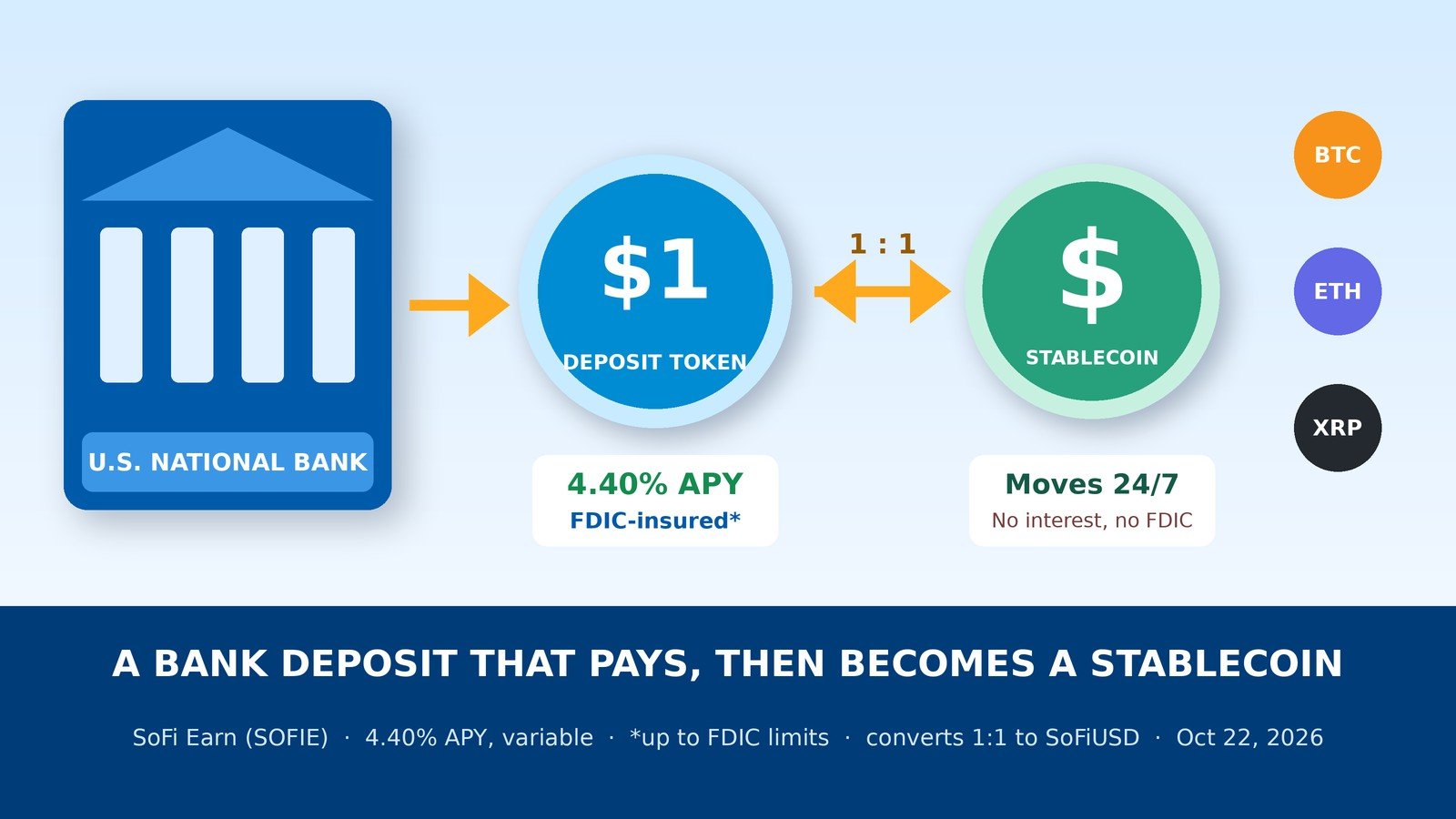
    SoFi on Thursday launched SoFi Earn, a “tokenized deposit” for its crypto customers that pays interest and carries FDIC insurance. The token, called SOFIE, pays a 4.40% annual percentage yield. Each SOFIE stands for $1 held on deposit at SoFi Bank, the company said in its announcement.

    SoFi calls it the first and only tokenized deposit offered to consumers by a U.S. national bank. The rollout to SoFi Crypto members runs through November.

    How it works

    Think of SOFIE as a parking spot for digital dollars. While the money sits in SOFIE, it earns interest and is covered by FDIC insurance up to the usual $250,000 limit per depositor, per bank, for each ownership category.

    When a customer wants to use the money, they convert SOFIE 1:1 into SoFiUSD, the bank’s own stablecoin. SoFiUSD can then buy crypto in the SoFi app, or be sent to a supported outside wallet over blockchain rails at any hour, SoFi said. Customers can also withdraw SOFIE as cash into SoFi Checking and Savings, the company said on X.

    The trade-off is in the fine print. Once the money becomes SoFiUSD, it stops earning that interest, and SoFiUSD is not an FDIC-insured deposit, The Block reported. SoFi’s own disclosure says SOFIE “is not a payment stablecoin.” The 4.40% rate is variable, can change at any time, and was current as of Oct. 20, according to SoFi.

    Why a deposit, not a stablecoin

    The design follows the rules. Under the GENIUS Act, stablecoin issuers may not pay holders interest. The OCC’s final rule under that law, issued Wednesday, keeps that ban for issuers and says rewards paid by others will be judged case by case. It takes effect Jan. 18, 2027.

    A bank deposit is a different legal product. It can pay interest and be insured. By keeping the earning part as a deposit and the moving part as a stablecoin, SoFi offers both, just not in the same token at the same time.

    SoFi makes the pitch directly. CEO Anthony Noto said too much money in the digital asset world “is sitting idle.” The company cited Federal Reserve research estimating that about $64 billion, or 21.2% of the stablecoin market, sits in rarely used, forgotten or inactive wallets.

    The bigger picture

    This is SoFi’s fifth crypto product in less than a year, the company said. It started consumer crypto trading in November 2025 and launched SoFiUSD in December 2025. In September, SoFi began settling card transactions with SoFiUSD on Mastercard’s network, The Block reported. SoFi says it has 15.8 million members.

    Big banks have been testing deposit tokens mostly with business clients. JPMorgan’s JPM Coin, a deposit token for institutional clients, expanded to Ethereum on Monday. SoFi is aiming the same idea at everyday savers.

    SoFi’s announcement did not say which blockchain SOFIE runs on, and it did not describe SOFIE itself moving to outside wallets. Those trips go through SoFiUSD.

    The launch landed on a down morning for crypto. At about 8:15 a.m. ET Thursday, Bitcoin traded near $81,741, Ether near $2,401, XRP near $1.32 and Solana near $104, each down about 2% to 3% over 24 hours, according to CoinGecko. USDC held at about $1.00.

    Sources: SoFi (Business Wire); The Block; SoFi on X; OCC; The Block (JPM Coin); CoinGecko

  • Germany’s Savings Banks Start Selling Crypto in Their App: Bitcoin, Ether, XRP, Solana and Polygon

    Germany’s Savings Banks Start Selling Crypto in Their App: Bitcoin, Ether, XRP, Solana and Polygon

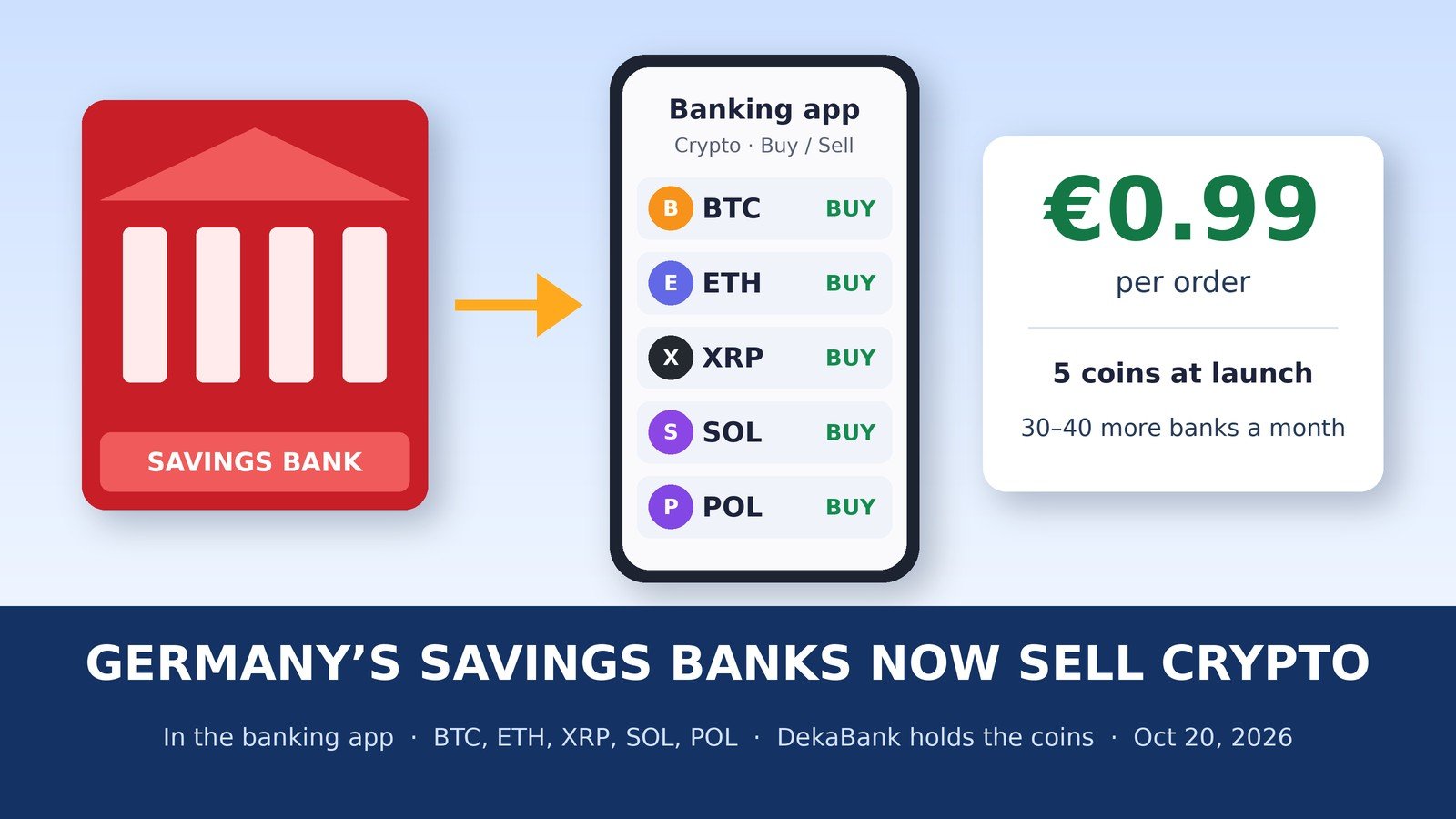
    Germany’s savings banks, the Sparkassen, have started selling crypto inside their everyday banking app. Since Monday, Oct. 19, customers at the first participating banks can buy, sell and hold Bitcoin, Ether, XRP, Solana and Polygon in the app “Sparkasse,” through a service called “Krypto – powered by Deka.”

    The rollout is gradual. Five savings banks went first: Frankfurter Sparkasse, Taunus Sparkasse, Sparkasse Karlsruhe, Sparkasse Rottal-Inn and Niederrheinische Sparkasse RheinLippe, according to the German banking newsletter Platow. The savings banks association, the DSGV, told dpa that 30 to 40 more banks should join each month. There is no single nationwide start date. Each savings bank decides for itself when to switch the service on.

    How it works

    DekaBank, the securities house of the Sparkassen, runs the trading, holds the coins and handles customer support. Customers open a separate crypto account at DekaBank inside the app. A securities account is not required. Each order costs €0.99, DekaBank said in its announcement.

    The fee is not the whole price. DekaBank quotes a price based on a market reference price plus its own spread, and its published documents do not put a number on that spread, CryptoCompass reported after reviewing the bank’s price list.

    Two details matter for anyone used to crypto exchanges. First, the coins sit in a shared “omnibus” wallet, and DekaBank holds the private keys in trust for customers, according to its product page. Second, coins can only be sent out to wallet addresses of certain licensed crypto service providers. Sending them to any other address, such as a personal hardware wallet, is excluded.

    The banks are not pushing it. The offer is for customers who decide on their own: no advice and no broad marketing, the DSGV said. Customers are warned about sharp price swings and the risk of total loss, and crypto holdings are not covered by Germany’s statutory deposit insurance.

    Why it matters

    The Sparkassen-Finanzgruppe says it serves around 50 million customers. Platow reported that more than 200 of the roughly 340 savings banks are considering the offer. Joachim Schmalzl, an executive board member at the DSGV, told dpa the group wants a large share of the interested banks connected in the first half of 2027. He said customer demand and a “reliable European legal framework,” meaning the EU’s MiCA crypto rules, drove the decision.

    For years the savings banks stayed away from crypto as too risky, while app banks such as N26, Trade Republic and Revolut offered it. Germany’s cooperative Volksbanken recently started offering crypto, too. Now the Sparkassen are in.

    The coin list is worth noticing. Next to Bitcoin and Ether, the first five include XRP, Solana and Polygon. At about 8:18 a.m. ET Tuesday, XRP traded near $1.30, Solana near $104 and Ether near $2,383, each down roughly 1% to 2% over 24 hours, according to CoinGecko.

    A practical note: the service only shows up in the app once your own Sparkasse has switched it on. If you don’t see it yet, your bank hasn’t joined.

    Sources: DekaBank; Deka Krypto product page; dpa-AFX (via finanzen.net); Golem; Platow; CryptoCompass; DSGV; CoinGecko

  • JPMorgan Takes Its JPM Coin Deposit Token to Ethereum. Here’s What It Is, and What It Isn’t

    JPMorgan Takes Its JPM Coin Deposit Token to Ethereum. Here’s What It Is, and What It Isn’t

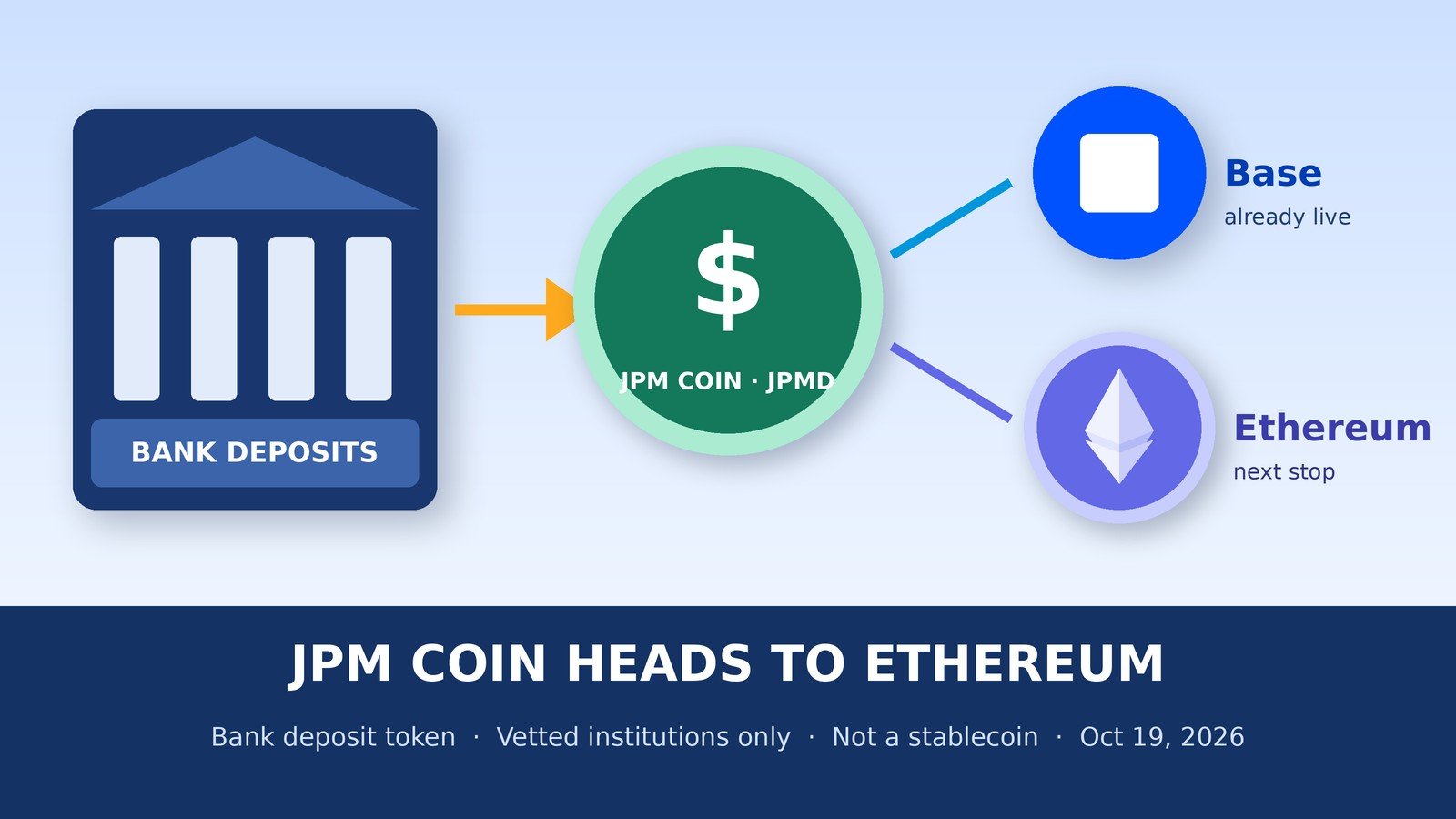
    JPMorgan is taking JPM Coin, its token for dollar deposits at the bank, onto Ethereum. Kinexys, the bank’s blockchain unit, said in a Monday statement shared with The Block that the token, known as JPMD, now supports peer-to-peer transfers across the Ethereum ecosystem, including Ethereum itself and Base, the Coinbase-built network where it launched.

    The token is for approved institutional clients only. It is not something retail users can buy, and it is not listed on exchanges.

    What JPM Coin is

    JPM Coin is a deposit token. Each one represents U.S. dollars sitting in an account at JPMorgan. The bank’s own FAQ says it is “not a cryptocurrency or a stablecoin,” and that clients’ funds “never leave the firm’s regulated banking infrastructure.” Clients move between cash and tokens through accounts at the bank, and only vetted counterparties can transact.

    That is the key difference from a stablecoin like USDC. A stablecoin is issued by a company that holds reserves. JPM Coin is a claim on a bank deposit at the largest U.S. bank, with JPMorgan controlling who can hold it.

    JPMorgan first tested the token on Base in mid-2025 and made it available to institutional clients there in November 2025.

    Why Ethereum, and what’s still unclear

    Kinexys said Ethereum’s “established depth of onchain liquidity and tokenized assets” made it the natural next network. Emma Landriault, global head of Kinexys Labs, told Bloomberg the bank wants to serve crypto firms making blockchain payments and financial firms that need a token to settle trades or back tokenized assets, according to CoinDesk’s summary of that interview.

    One detail is not settled in public yet. CoinDesk, citing Bloomberg, reported that Landriault did not say when JPM Coin would become available on Ethereum. As of Monday morning, JPMorgan’s JPM Coin web page still described the token as issued on Base. Clients should confirm timing and the official token details with the bank directly.

    The bigger picture

    JPMorgan said Kinexys has handled more than $4 trillion in transactions since launch and averages about $7 billion a day. That is still a small slice of the bank’s overall payments business. The bank has also launched tokenized money market funds on Ethereum, the first in December 2025 and a second in May 2026, and said in January it planned to take JPM Coin to the Canton Network as well.

    The move adds to a busy month for bank tokenization. Japan’s three megabanks reported a joint yen stablecoin test, and a U.S. bank, Cross River, added Ripple’s RLUSD to its core banking system. The pattern is the same: big banks are putting regulated money on public blockchains, while keeping control over who gets to use it.

    A safety note: JPM Coin is not sold to the public. Any token calling itself “JPM Coin” on a public trading app or decentralized exchange should be treated as suspect.

    Sources: The Block; CoinDesk; J.P. Morgan Kinexys; J.P. Morgan Payments; TokenPost

  • Japan’s Three Megabanks Say Their Joint Yen Stablecoin Worked in a Test. Live Use Is Aimed for FY2026

    Japan’s Three Megabanks Say Their Joint Yen Stablecoin Worked in a Test. Live Use Is Aimed for FY2026

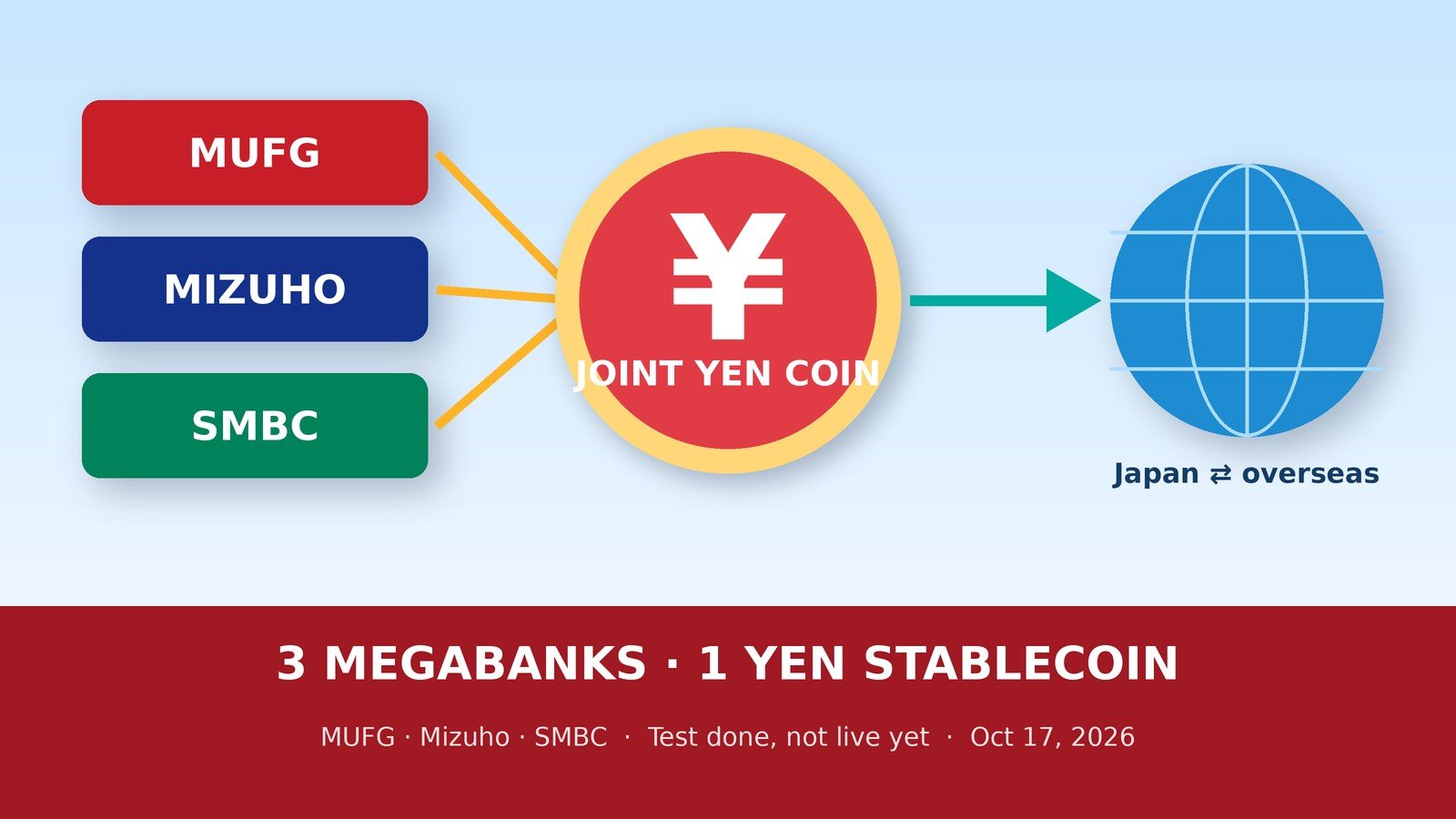
    Japan’s three largest banks say a jointly issued yen stablecoin worked in a test. MUFG Bank, Mizuho Bank and Sumitomo Mitsui Banking Corporation (SMBC) announced on Oct. 16 that they had issued, transferred and redeemed the coin in a proof-of-concept run from July 17 to July 23.

    The test used a cross-border payment scenario between Mitsubishi Corporation’s offices in Japan and overseas. Mitsubishi UFJ Trust and Banking acted as the agent trustee, and tech firm TISI built the wallet and blockchain connections. SMBC provided the blockchain platform used in the test, according to the banks.

    How the coin is built

    The coin was issued under Japan’s Payment Services Act as a trust-type stablecoin, with the three banks acting together as joint principal trustees. The money behind it sits in bank deposits. The banks said the design has no circulation cap, because they expect large-scale use.

    There is one big limit by design. The coin is meant to move only among users who have completed identity checks at the banks. That makes it a permissioned bank product, not an open token anyone can pick up on an exchange.

    The project ran with support from the Financial Services Agency’s FinTech PoC Hub, which approved the initiative in November 2025. The banks said the test also checked anti-money-laundering controls and how the operation works with several banks issuing one coin.

    What it is not yet

    This was a one-week test, not a launch. The banks did not disclose amounts moved in the test. They said the design “may be subject to change” and that they will keep working through issues with regulators in Japan and abroad before real-world use.

    The timeline points to the near term. In the same release, the banks pointed back to a June 10 announcement about launching live transactions of the three-bank coin in fiscal 2026. Japan’s fiscal 2026 ends in March 2027.

    The news landed the same week that Visa moved stablecoin prefunding for Visa Direct into commercial use and a U.S. bank, Cross River, added Ripple’s RLUSD to its core banking platform. The common thread: banks and payment networks are building stablecoin rails inside regulated systems, not around them.

    Sources: MUFG Bank; SMBC; Mizuho; Trade Finance Global; Visa

  • Cross River Puts Ripple’s RLUSD on Its Core Banking Platform for 24/7 Settlement

    Cross River Puts Ripple’s RLUSD on Its Core Banking Platform for 24/7 Settlement

    Cross River Bank is integrating Ripple USD (RLUSD), Ripple’s U.S. dollar-backed stablecoin, into its proprietary Core Operating System, with support for transactions on the XRP Ledger.

    The Fort Lee, N.J.-based bank, a New Jersey state-chartered FDIC member, announced the partnership on Oct. 15. RLUSD becomes an additional payment rail on Cross River’s platform, next to ACH transfers, wire transfers and real-time payments. Eligible fintech customers can reach it through a single API without standing up their own blockchain systems, the bank said.

    What the bank says it unlocks

    Adam Goller, Cross River’s head of fintech banking, said the bank is expanding on stablecoin capabilities already in development. The setup is meant to let fintechs convert between U.S. dollars and RLUSD, settle cross-border payments and treasury moves around the clock, and keep those rails on the same banking platform as traditional payment options.

    Markus Infanger, senior vice president for RippleX at Ripple, said Cross River is bringing RLUSD and the XRP Ledger’s settlement into a regulated banking platform so fintechs can move money in real time across borders without running a parallel system.

    The two companies also pitched the work as a settlement option for payment networks, giving issuers and acquirers more flexibility to settle intraday. The release cites typical XRP Ledger settlement of about three to five seconds, fees of a fraction of a cent, and more than $1.3 trillion settled on the ledger to date. Those are company figures and have not been independently verified.

    What’s narrow — and what this is not

    Availability is narrow. Cross River’s release states that services are currently only available in limited U.S. states. It did not name those states or give a timeline for a wider rollout.

    What this is not: a custody product, a retail deposit product, or a sign that every Cross River client can use RLUSD today. The release describes payment and settlement access for fintechs and payment networks through the bank’s existing core. Separately this week, DriveWealth said it plans to use RLUSD on the XRP Ledger for brokerage settlement starting in Europe, with no launch date, and Standard Chartered said institutional RLUSD custody is live at its Dubai branch. Those are different arrangements.

    The release did not name any fintech or payment network that is using the RLUSD rail yet.

    Sources: Cross River; Business Wire; Ripple

  • Evernorth Hires Ex-Coinbase Asset Management Co-CIO to Run XRP Treasury, Corrects Closing Share Count

    Evernorth Hires Ex-Coinbase Asset Management Co-CIO to Run XRP Treasury, Corrects Closing Share Count

    Evernorth Holdings Inc. has hired Hugo Jeandesboz as chief investment officer to lead its XRP treasury strategy, the company said in an Oct. 12 press release that it filed with the SEC on Tuesday.

    Jeandesboz joins from Coinbase Asset Management, where he was co-chief investment officer and led the firm’s Solutions investment strategies. According to the release, he was previously Coinbase’s lead derivatives trader, traded interest rate derivatives at HSBC in New York, and started his career at Société Générale. He reports to founder and Chief Executive Officer Asheesh Birla.

    The release says the role covers “treasury allocation, liquidity management and the active management of Evernorth’s own XRP holdings,” and makes him the company’s senior contact for trading counterparties and custodians. The filing does not disclose his compensation or a separate start date. The release says he “has joined.”

    The same Form 8-K corrects the company’s post-closing report. At the Oct. 9 closing of its merger with Armada Acquisition Corp. II, Evernorth issued 1,078,613 Class A shares to investors with delayed-funding subscription agreements, “not 663,510 shares as was indicated” in that earlier filing, “due to a clerical error,” the 8-K says. Those shares were priced at $10.00 each against the subscription amount, whether paid in cash or XRP. The correction also changes several other figures. Class A shares outstanding at closing are now 23,638,882, and Class C shares are 31,392,746. Former SPAC public shareholders held 20.5% of the Class A stock.

    XRPN closed Tuesday at $16.48, down 2.54% on its second day of trading as Evernorth, according to StockAnalysis. It traded between $15.70 and $17.86 on about 1.27 million shares.

    Company leadership is scheduled to ring the Nasdaq closing bell on Wednesday, Evernorth said in its Oct. 9 announcement.

    Sources: SEC Form 8-K; Evernorth press release (Ex. 99.1); StockAnalysis

  • Ledger Pulls Wallets From Shelves in Seven Asian Markets as Tampering Probe Widens

    Ledger Pulls Wallets From Shelves in Seven Asian Markets as Tampering Probe Widens

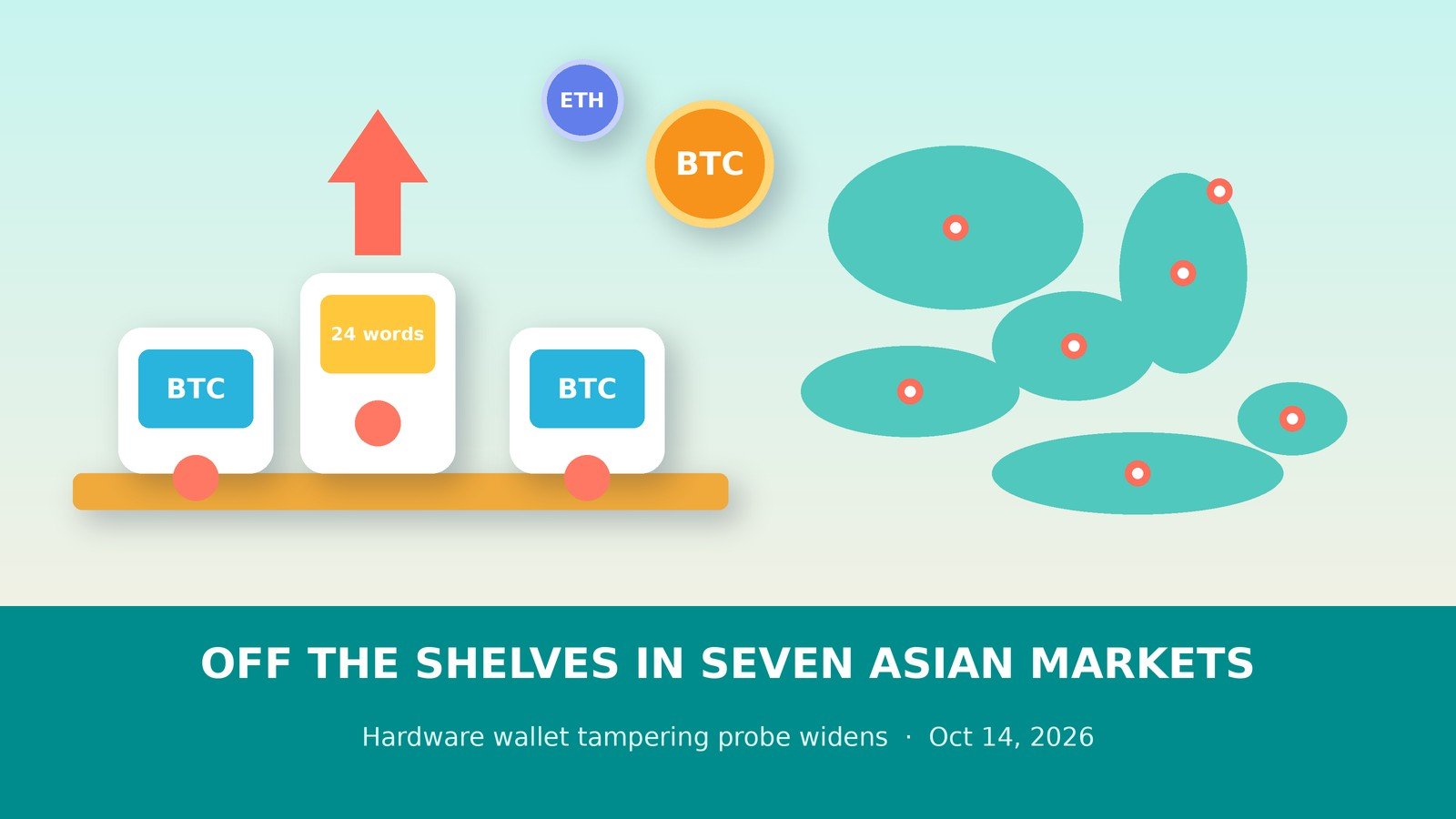
    Ledger has asked resellers and distributors in six Southeast Asian countries and Hong Kong to stop selling its hardware wallets and take them off shelves. The move widens a sales halt that began last week with a single reseller.

    In an update posted on X on Tuesday evening, the Paris-based company named Indonesia, Singapore, Thailand, the Philippines, Vietnam, Malaysia and Hong Kong. “The investigation is ongoing to determine who tampered with these devices and where in the distribution chain it happened,” Ledger said. The request builds on Ledger’s Oct. 9 call for CryptoBilis, a reseller in the region, to pause all sales and shipments.

    Earlier Tuesday, Ledger’s Donjon security team described how the tampering works. An added component sits inside the device’s case and reads the screen. When the wallet shows its 24-word recovery phrase during setup, the implant decodes the words and sends them out over a mobile network using a built-in eSIM. Ledger said the implant does not modify the Secure Element, the chip that guards private keys, or the device’s operating system, and does not alter transactions or signatures. The company said it has no indication that its own systems or its direct sales channel were compromised.

    Ledger says the confirmed losses so far are confined to Southeast Asia. “We have not verified a drain linked to a device bought elsewhere,” it said. In replies to users on Wednesday, the company said confirmed losses involve devices sold “through a limited number of resellers,” without naming them.

    Ledger has not confirmed a loss total or a victim count, and says figures circulating online come from third parties. Blockchain analytics firm Bitquery counts $102.0 million taken from 324 wallets across six blockchains, up from early estimates near $86 million. Bitquery says Tether froze $10.0 million in USDT and that about $84 million could still be traced on-chain as of Tuesday morning.

    The worry has reached store shelves elsewhere. In Singapore, The Straits Times reported that a tampered device had been sold at Metapod in Changi Airport and that another was reportedly bought at a Challenger outlet. In Europe, MediaMarktSaturn has pulled Ledger products after a customer in Germany reported an implant. Ledger said no funds were lost in that case. Rival Trezor said Tuesday it is cutting its own reseller network as a precaution, adding that “there is not a single piece of evidence” its devices have been compromised.

    Ledger’s advice has not changed. CryptoBilis buyers should not set up unused devices, and anyone already using one should move funds to a new device with a new recovery phrase. People who lost funds should contact law enforcement before opening the device.

    Sources: Ledger; Bitquery; The Straits Times; Cointelegraph; The Block

  • Standard Chartered Starts Holding Ripple’s RLUSD in Dubai. The LMAX Collateral Link Isn’t Live Yet

    Standard Chartered Starts Holding Ripple’s RLUSD in Dubai. The LMAX Collateral Link Isn’t Live Yet

    Standard Chartered has started offering institutional custody of Ripple USD (RLUSD), Ripple’s dollar-pegged stablecoin issued on the XRP Ledger. The bank announced the service on Oct. 12 and is running it through its branch in the Dubai International Financial Centre, which the Dubai Financial Services Authority (DFSA) regulates.

    The second half of the announcement is not live yet. Standard Chartered, Ripple and LMAX Group say they are working to make RLUSD “eligible collateral for agreed LMAX Group products and solutions across trading and collateral management.” The releases from all three companies say those “agreed future capabilities remain subject to final documentation, successful testing, applicable laws and regulations, internal approvals and jurisdictional readiness.” None of them gave a launch date.

    What is live today

    What changes now is who holds the stablecoin. Eligible clients can keep RLUSD in a bank’s custody unit inside a DFSA-supervised branch, instead of with an exchange or a crypto-native custodian. The releases did not say which clients qualify, what the service costs, or how much RLUSD the bank holds.

    What is still a plan

    The planned piece is about how that custody would connect to trading. Under Standard Chartered’s “collateral mirroring” model, the value of eligible collateral would be mirrored to LMAX “without requiring the underlying RLUSD to be transferred directly to the trading venue,” the bank said. In plain terms, the bank would keep the tokens and the venue would accept their value as margin. The companies say this is meant to cut transfer-related operational risk and counterparty exposure. Neither the bank nor LMAX has published the legal or operational terms.

    “Institutional clients want to participate in digital asset markets without compromising on how their assets are safeguarded or how risk is managed,” said Waqar Chaudry, Standard Chartered’s global head of digital assets for securities services.

    Luke Dorney, LMAX Group’s head of custody for digital assets, said the venue had agreed “to adopt Standard Chartered’s collateral mirroring model.” Jack McDonald, Ripple’s senior vice president for stablecoins, said customers want “the efficiency of a regulated stablecoin without giving up the custody standards they already trust.”

    Several regulators, no single sign-off yet

    The custody sits under the DFSA in Dubai. LMAX’s businesses are licensed separately: according to the company, its FX exchange is regulated by the UK’s FCA and Singapore’s MAS, and LMAX Digital by Gibraltar’s GFSC. Which LMAX entity would accept RLUSD collateral, and under which approvals, has not been disclosed.

    The firms already have commercial ties. Ripple provided LMAX with $150 million in financing in January as part of plans to embed RLUSD in its infrastructure, CoinDesk reported. CoinDesk also reported last week that Standard Chartered plans to offer crypto and stablecoin custody to institutional clients in Singapore. That is a separate plan, and the Dubai launch says nothing about when it will start.

    The bottom line: a regulated bank is now holding RLUSD in Dubai. Using that RLUSD as collateral at LMAX is still a plan.

    Sources: Standard Chartered; Ripple; LMAX Group; CoinDesk

  • XRP Ledger Discloses Decade-Old Bug That Could Have Minted New XRP

    XRP Ledger Discloses Decade-Old Bug That Could Have Minted New XRP

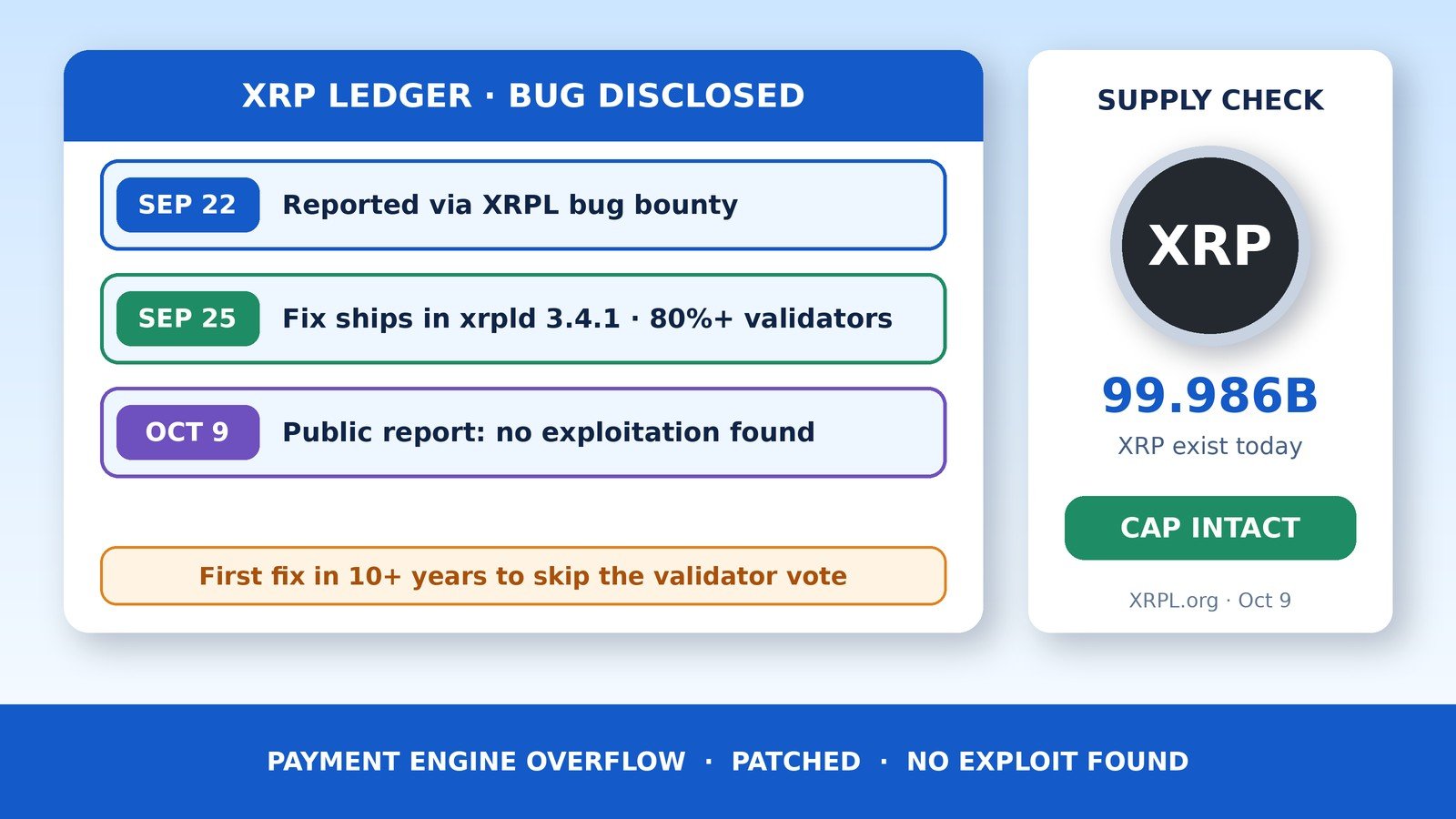
    The XRP Ledger’s core software carried a bug for roughly a decade that could have let an attacker create spendable XRP beyond the token’s fixed 100 billion supply, according to a vulnerability disclosure report published Oct. 9 on XRPL.org. The report says there is no evidence the flaw was exploited on any public network.

    What the bug did

    The problem sat in the ledger’s payment engine. When one payment consumed many offers from the built-in order book, the engine added up the XRP owed with 64-bit integer math and no overflow check. A large enough total wrapped around to a tiny number. Each offer owner was paid in full, while the buyer was charged only the wrapped amount.

    The ledger’s “no XRP created” safety check used the same arithmetic, so it missed the gap too. A separate per-account limit did not trip either, because the new XRP would have been spread across hundreds of accounts.

    It could not happen by accident, the report says. It took hundreds of offers priced in a way no real trader would use, then a payment built to consume them all at once. The cost to an attacker would have been a few hundred XRP in reserves plus fees.

    Who found it

    Researcher Cayden Liao and Veria AI reported the flaw through the XRPL bug bounty program on Sept. 22. RippleX reproduced it the same day and raised the severity to critical. Veria Labs says its proof of concept could have created about 18.4 trillion XRP in one transaction, and that it received the program’s maximum $250,000 bounty. Those are the firm’s own figures.

    The fix shipped in xrpld 3.4.1 on Sept. 25. More than 80% of default validators were running it that day, per the report. The supply check now uses a wider counter that cannot wrap.

    The governance question

    How it shipped is the bigger story for the network. Rule changes on the ledger normally go through amendments, which must hold more than 80% validator support for two weeks before switching on. This fix took effect on each server as soon as it upgraded. The report calls it the first deliberate exception in more than ten years.

    The report’s reasoning: the code is open source, so a normal amendment would have shown attackers where the bug was for weeks while it was still live on Mainnet. Validators received compiled software before the source code was public.

    That sequence drew criticism from Cyber Capital founder Justin Bons, who argued a public ledger briefly ran on closed code, ETHNews reported. The report says the call was made with the XRPL Foundation, RippleX and validators, and that skipping amendments stays reserved for the most severe bugs. The 3.4.1 source code has since been published.

    What it means now

    The same release carried a separate fix for the new Batch feature, which went live on Mainnet Oct. 9 through a normal amendment vote. Servers not running 3.4.1 or later are now amendment blocked. The report does not ask XRP holders to do anything.

    About 99.986 billion XRP exist today, slightly under 100 billion because fees are burned, CoinDesk reported, citing the foundation. XRP traded near $1.40 Monday morning, little changed on the day.

    This is reporting, not investment advice.

    Sources: XRPL.org, Veria Labs, CoinDesk, ETHNews, Kraken