Category: Opinion

  • The biggest bitcoin whale sipped. The smaller one gulped.

    The biggest bitcoin whale sipped. The smaller one gulped.

    Follow the wallets, not the talking heads. This weekend the bitcoin tape ran up to just shy of $86,950, came within about $500 of its late-September high near $87,400, and then slipped back under $86,000. Second stall in a week. While the chart crowd argued about the line, the real whales filed their receipts Monday morning. The receipts say something interesting.

    Start with the biggest corporate whale in the water. Strategy’s 8-K says it bought 334 BTC from Oct. 1 through Oct. 4, for $28.7 million, at an average of about $85,839. That takes it to 848,000 BTC. Same filing: Strategy spent $73.7 million over those same days buying back its STRC preferred stock, and $176.3 million on STRC buybacks counting Sept. 28 to 30. The buying streak is alive. The cash just went to two places, coin and capital stack, and the coin got the smaller slice this week.

    Now the smaller whale. Strive CEO Matt Cole posted that Strive bought 2,000 BTC for $169 million, at an average cost of $84,422, taking it to 29,462 BTC. He said 61.5% of the money came from SATA, its preferred stock, and warrants brought in $56.7 million. Read that again: a company holding about 3.5% as much bitcoin as Strategy bought roughly six times as many coins this week. The little fish is swimming hard, and it is doing it in the open with a filing behind it.

    Then the ghosts. On-chain tracker Lookonchain flagged two early holders who bought 1,346 BTC about 13 years ago, at an average near $178, and just moved a tiny test amount, 0.0005 BTC, worth about $43. Their stack is worth about $115 million now. Labeled speculation: a $43 test is what you send when you want to be sure the keys still work before you move real size. It could also be an estate, a lawyer or simple curiosity. A test is not a sale. But when 13-year-old coins clear their throat near a multi-month high, the smart move is to watch, not to guess.

    Over in XRP, the big wallets are doing nothing at all, and that is the tell. Analyst Ali Martinez wrote Sunday that XRP whales have “remained relatively sidelined over the past week, with no significant change” in holdings, while the price coils near $1.50. The calendar is loaded: Evernorth says it expects to close its Armada deal on Oct. 7, with XRPN trading on Nasdaq on Oct. 8, subject to remaining closing conditions. Labeled speculation: big holders sitting flat into a dated event usually means they want to see the first prints before they commit. Quiet hands are not empty hands.

    The populist read here is simple. The man on the street is told the Fed, the jobs report and the chart pattern decide everything. Meanwhile, the people with real size are telling you exactly what they did, in 8-Ks and signed posts, every Monday. Weekend liquidations, per CoinDesk, were light at $62.7 million, and shorts made up 68% of them. That is not a crowd in panic. That is a crowd leaning the wrong way and paying a small bill for it.

    My positioning question for the week is not “will bitcoin break $87,000.” It is: who is buying at $84,000 to $86,000, with what money, and who is just testing their keys? This week the answer came with names and numbers attached. Watch the filings. They do not tweet in all caps.

    Sources: Strategy 8-K; Matt Cole on X; Bloomingbit; Lookonchain; Tron Weekly; PR Newswire; CoinDesk; CoinDesk
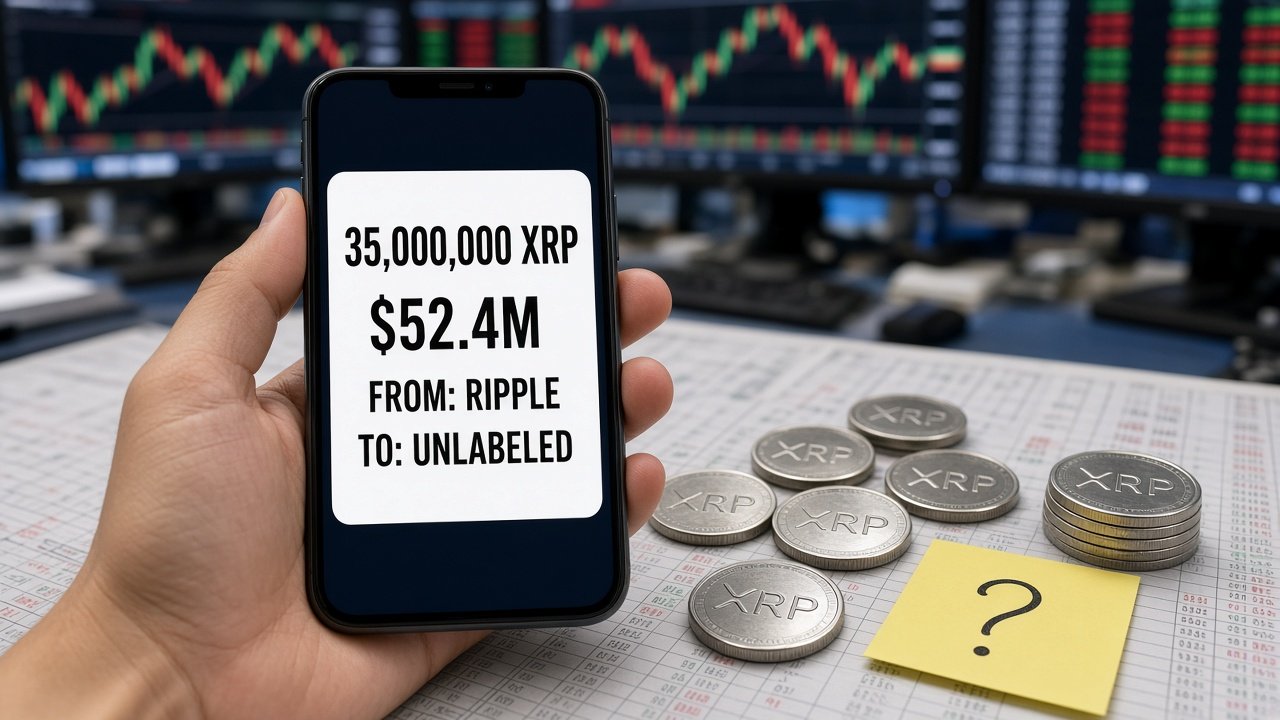

  • Ripple’s $52 million XRP send has a sender and no name

    Ripple’s $52 million XRP send has a sender and no name

    Opinion, up front. Late Thursday, New York time, a wallet Whale Alert tags as Ripple paid 35,000,000 XRP to an address with no public name. The alert clocked it at 00:21 UTC on Oct. 2, which is 8:21 p.m. Thursday in New York, and printed the value at $52,425,783. Sender rJqiMb94hyz41SBTNr2AyPNW8AzELa8nE. Receiver raRVLN1i5QFF6w8cwV3RovtTkjFj3qyNRf. Hash 667DC2B9F7A5018609862354CEAC5DF7BEB0AE68E7A36C90F9A822DBFDA5A8F4. That payment is the fact. The rest of this piece is a read.

    The timeline going around welds that payment to the monthly escrow unlock, as if they were one event. They are not. Whale Alert does show a 300,000,000 XRP unlock at a Ripple-labeled account at 00:00 UTC on Oct. 1, worth about $446.7 million at its print. U.Today, citing four Whale Alert posts that morning, put the full scheduled release at 1 billion XRP in four slices: 400 million, 300 million, 200 million, and 100 million. This desk opened the 300 million slice and the later 35 million payment. It did not open a transaction for the other three slices.

    Here is the number this piece will not use as fact. A stack of recaps says Ripple locked 700 million XRP back the same day, 400 million plus 300 million, leaving a net 300 million. A Whale Alert “story” page carries that 700 million claim in the headline. The body underneath only says unused XRP is typically returned. U.Today’s own unlock story, filed Thursday morning UTC, said the return was still ahead and that the next day would show it. XRPSCAN would not load here. Until a relock transaction is in hand, “700 million went straight back” is a rumor with good company, not a figure Hardwire should print as ledger fact.

    Speculation, labeled as speculation. A $52 million send off a company-tagged wallet, a day and a half after a scheduled unlock, looks like treasury routing, not a market dump. On this ledger a destination tag usually means a shared deposit address at an exchange or a custodian. Secondary write-ups say this payment had one, and that the receiver forwarded 6.5 million XRP within a few hours. This desk could not confirm the tag or those forwards on an explorer. Do not trade them. The read that survives without them is simpler: the industry handed retail a billion-token headline, and the line item with a sender label and no receiver label is 35 million XRP.

    Both camps are selling a story the payment does not tell. Unlock-fear accounts need you to think supply hit the book. Absorption accounts need you to think an ETF or a treasury desk quietly took the other side. Neither has been shown. Crypto Economy reported about $4.07 million of U.S. spot XRP ETF inflows on Oct. 1, almost all of it one Franklin fund. That figure is not checked here against issuer filings, and even if it is right it is not the same size as $52 million. A nameless receive is not proof of a sale. It is proof that nobody put a name on it.

    What would settle it is boring, and that is the point. A Ripple note. A named receiving desk. Or the claimed forwards sitting on a public explorer with the tag visible. Until then the honest question is the short one: routine treasury move, or a sale nobody labeled?

    Sources: Whale Alert; Whale Alert; U.Today; Whale Alert; Crypto Economy

  • Banks on a Seoul Stage Isn’t an XRP Ledger Deployment

    Banks on a Seoul Stage Isn’t an XRP Ledger Deployment

    Korea Blockchain Week’s XRP Seoul agenda for October 3 listed XRP Asia President Sabrina Tachdjian alongside Ripple’s Tatsuya Kohrogi. A separate panel put Woori Bank, Kbank, and JB Bank on the same stage to talk cross-border payments and tokenized deposits. The crowd read writes itself. The filing does not.

    TokenPost’s careful read of the program is the one that travels: the listing does not establish a commitment, pilot, or partnership. No XRP Ledger bank deployment was announced. Empty chairs on a conference stage are not plumbing. They are optics — warm light, nameplates, and a photo that outruns the contract.

    Hype framing sells “banks onstage = rails live.” That is conference theater dressed as institutional news. A panel title about tokenized deposits is not a go-live. It is a speaking slot. If your timeline needs a partnership press release, wait for one that names the ledger, the corridor, and the counterparty — not a KBW agenda line.

    Labeled speculation: Seoul stage time is attention capital, not settlement capital. Real XRPL institutional work — the kind Westen has already covered on Brazil CSD BR mirroring and similar rails stories — shows up in filings, operators, and live mirrors. Conference panels show up in camera angles. Confuse the two and you will buy the photo.

    XRP Asia itself was still early as of February reporting: no launch date, budget, or specific programs disclosed in the public record TokenPost cites. Ripple’s long-running ecosystem spend is real. That does not turn a Seoul panel into a Korean bank XRPL deployment. Stage ≠ switch.

    Keep the share-engine honest: applaud the conversation if you want. Do not mint a partnership from a speaker list. Optics vs plumbing — and only one of those clears a corridor.

    Sources: TokenPost

  • The ETF Door Just Voted Against Ether

    The ETF Door Just Voted Against Ether

    Thursday’s U.S. spot ETF tape split hard. Bitcoin products took in about $102.7 million. XRP funds added about $4.1 million. Ether funds lost about $55.4 million — a third straight outflow day, roughly $118 million over the streak. Solana funds shed about $5.9 million on a second consecutive red session. Flow figures via SoSoValue data as reported by Cointelegraph and market desks.

    Price did not recite the same memo. Into Friday morning, Bitcoin traded near the mid-$86,000s, Ether near $2,745, XRP near $1.54, and Solana near $122, with total crypto market cap around $2.95 trillion — CoinGecko tape cited across market updates. Ether can print green while its ETF door stays ajar the wrong way.

    Labeled speculation — whale / positioning read: treat the fund door as the institutional vote and the candle as the crowd’s mood. Three Ether outflow days after a strong Q3 haul is not “crypto dead.” It is selective. Allocators who wanted beta bought Bitcoin. A thinner XRP bid still showed up in the products. Ether and Solana products got the bill for the pause.

    Here’s the share-engine part they won’t put in the victory-lap threads: cumulative XRP ETF inflows sit near $1.8 billion while net assets sit near $1.7 billion — meaning the stack is worth less than the cash that went in, unlike the Ether and Solana products on a cumulative basis. Inflows are not the same as a mark-to-market win. And Ether rising slower than Bitcoin with ETH/BTC near 0.0318 is not “rotation into alts”; it’s the market refusing to crown a leader while the fund tape cools.

    Westen has the SEC custody rails story. Keep this desk honest: the overnight institutional tell was not a blanket bid — it was Bitcoin and a little XRP in, Ether and Solana out. Watch whether Ether and Solana funds flip back to inflows before you believe the next “altseason is back” headline.

    Sources: Bitcoin Insider; Cointelegraph; CoinGecko

  • They Cleared the Vote. The Listing Still Has Homework.

    They Cleared the Vote. The Listing Still Has Homework.

    Armada’s Item 5.07 is out. The Evernorth combination cleared the shareholder vote. Cue the victory-lap posts.

    Labeled speculation: celebrate the vote if you want — just don’t confuse the inspector’s tally with a listed XRP treasury company. Closing still sits in Q4 territory. Nasdaq listing clearance, contribution funding, and whatever cash left the trust after the September 28 redemption window still sit between “passed” and “trading as the combined co.” Same ticker letters on the SPAC today do not mean the post-close float is live.

    Here’s the part the share-engine accounts skip. Evernorth’s pitch is an actively managed XRP treasury — company materials have talked about roughly 473 million XRP expected at close, including Ripple-linked contributions. That stack is not a balance-sheet fact until closing conditions clear and the counterparties actually deliver. A $30 million convertible note is likewise conditioned on the combination closing. Vote yes ≠ tokens in the vault ≠ shares you can buy as XRPN-the-treasury-co.

    Whale-flow read, labeled as such: the people who needed the ballot to clear got what they needed. The people who redeemed got a different memo — cash out before the party. Until redemption totals and closing cash show up in primary disclosure, treat every “Nasdaq XRP treasury is here” headline as premature marketing dressed as a result.

    Westen has the vote math. Keep the celebration honest: the vote is real; the listing is still homework.

    Sources: SEC; PR Newswire

  • They Put Fund Shares on XRPL. They Didn’t Move the Legal Books.

    They Put Fund Shares on XRPL. They Didn’t Move the Legal Books.

    Opinion. Ripple and CSD BR announced on September 29 that Brazil’s central securities depository is using the XRP Ledger as an extra layer to record and audit financial assets — starting with selected BTG Pactual investment fund shares, tokenized under XRPL’s Multi-Purpose Token standard. That is a real infrastructure story. It is also a story the market will try to inflate into something it is not.

    What they are not telling you in the victory-lap headlines: CSD BR’s own systems remain the official source of record for registration, deposit, and settlement. The chain is a complementary query-and-audit layer so authorized participants can check consistency in near real time. Investors’ legal processes do not flip overnight. Participant responsibilities do not rewrite themselves because a token showed up on a public ledger. Ripple’s own release says the model sits inside the current regulatory framework — no change to legal duties, no new approvals required for this phase.

    CoinDesk and others will correctly note that CSD BR oversees on the order of BRL 22 trillion in registered assets — roughly $4 trillion. That is the size of the operator, not the size of what just landed on XRPL. Speculation, labeled: every cycle needs a round number. “$4T onchain” is the lazy cousin of this announcement. Hardwire’s rule: mirror ≠ migration. Selected fund shares get a blockchain twin. The depository still keeps the keys to issuance, freezes, and clawbacks when a regulator or court says so. Access for holding and transferring those tokens is permissioned to KYC’d corporate and banking clients in Brazil. Public ledger, gated ownership. That is the actual product.

    West’s contrast is the right one for anyone watching institutional rails. Public-chain mirrors inside a regulated CSD are a different bet than bank-led deposit tokens pushed through private coalitions and clearinghouse experiments elsewhere. One path says: keep the legal books where the supervisor already trusts them, bolt on a transparent reconciliation rail, prove it with live fund records, then talk native issuance (CRI, CRA, trading among authorized names). The other path keeps settlement inside club infrastructure and asks the public to take the bank’s word for the token. Different politics of trust. Different who-owns-the-books question.

    Republican/populist read: be suspicious of PR that sells decentralization while the clawback button stays with the regulated intermediary — and equally suspicious of legacy banks that want “innovation” without a public audit trail. Brazil just chose the first compromise. Take the live-ops milestone seriously. Do not confuse an audit mirror with legal finality, and do not let a $4 trillion AUM figure become a fake onchain AUM figure.

    Sources: Ripple; CoinDesk; CSD BR (via Ripple release)

  • Whales Are Bidding the Catalog — Congress Still Owns the Slogan

    Whales Are Bidding the Catalog — Congress Still Owns the Slogan

    West will own the ledger. On Sept. 23 The Hashgraph Group got IDTrust — Hedera-anchored self-sovereign identity for AI agents, devices, and humans — validated and listed on the IBM Cloud Catalog, with IBM Silver Partner status and a global Embedded Solution Agreement covering Cloud and AI. Same stretch of tape: HBAR printed a sharp roughly 20–27% 24-hour outperformance into Sept. 29 on secondary screens; bitcoin sat just above about $83,100 overnight under yield pressure near multi-year highs; Sept. 28 spot XRP ETF net inflow was a quiet about $3.96 million (Canary only, SoSoValue via CoinGabbar). Those are real procurement and flow prints. My lane is what attention does when an enterprise catalog door opens while Capitol still rents the “clarity” talking point.

    Because the move that grabbed the feed was not a Senate calendar update. A Hedera Governing Council member’s cloud marketplace is now selling Know-Your-Agent identity as SaaS. Populist-skeptic readers should notice the asymmetry: distribution rails for agent identity advancing through IBM procurement while Congress still owns the slogan. Whales and the attention tape appear to be bidding the catalog story — HBAR’s overnight outperformance is the loud secondary print — even as bitcoin digests ~$83K and a cooler Sept. 28 ETF day (BTC about $31.07 million, the smallest September daily cited).

    X weather (hard-check): the public tape is the THG–IBM IDTrust catalog listing, secondary HBAR outperformance into Sept. 29, macro pressure on bitcoin and yields ahead of PCE, and a quiet XRP ETF session. Clarity Act theater still circulates without a fresh primary floor schedule that reopens the bill this week. Rumor remains rumor. The IBM listing does not by itself prove causation for the HBAR move — cite the range, don’t invent the tick.

    Speculation — labeled, not advice, not a prediction you should size:

    When an enterprise cloud catalog opens a Hedera-anchored Know-Your-Agent door and the HBAR tape prints a sharp overnight outperformance while Congress still owns the “clarity” slogan, ask which clock the flow is actually watching. Labeled speculation: markets and whales are pricing distribution rails and agent-identity infrastructure — who sits in the IBM Cloud Catalog, who anchors credentials on Hedera, who shows up in enterprise procurement — not the next Capitol talking-point night. Victory-lap accounts will cash both the HBAR spike and any staff memo as permission. The quieter read is that catalog rails are being priced now, and the headline Congress still rents is useful cover while the SaaS listings get signed. Spicy, not ugly. Ask who benefits when the clarity slogan travels farther than the PR Newswire release.

    The boring test still wins: whether enterprises actually buy IDTrust through IBM commitments, whether subsequent sessions keep printing attention outside the bitcoin wrapper, and whether anyone can point to a scheduled Clarity floor vote instead of another recycled “clarity” post. Celebrate the catalog if you want. Just don’t confuse Senate ownership of the word with ownership of the rails.

    Sources:

    • PR Newswire

    • CryptoBriefing

    • CoinDesk

    • SoSoValue

    • CoinGabbar

    • Global Banking & Finance / market screens

  • The Banks Are Wiring 2027 — Congress Still Owns the Headline

    The Banks Are Wiring 2027 — Congress Still Owns the Headline

    West will own the ledger. On Sept. 24 The Clearing House — the payments utility that clears and settles more than $2 trillion a day for U.S. banks — selected Quant to power its On-Chain Money Initiative: interoperable clearing and settlement of tokenized deposits, with connectivity to RTP and CHIPS, access expected in the first half of 2027. Same week, U.S. spot bitcoin ETFs printed roughly $2.39–2.4 billion in net inflows (largest since Oct. 2025; YTD flipped positive), ether ETFs about $690 million, XRP ETFs about $76 million. Those are real infrastructure and product prints. My lane is what the timeline does when the same stretch still gets sold as “Congress is about to deliver clarity.”

    Because the institutional move that matters this week was not a Senate calendar update. The banks’ clearing house named a rails vendor for programmable deposit settlement aimed at 2027. Tokenized deposits keep deposit protections and oversight, per The Clearing House’s own framing — they are not waiting for another cloture rematch to start wiring the stack. Populist-skeptic readers should notice the asymmetry: settlement infrastructure advancing on a vendor timeline while the “clarity” headline stays parked on Capitol Hill.

    X weather (hard-check): the public tape is the Clearing House–Quant selection, a multi-billion weekly ETF creation print, and the usual Clarity Act theater still circulating without a fresh primary floor schedule that reopens the bill this week. Rumor remains rumor. XRPL’s BatchV1_1 slip to an earliest Oct. 9 (CoinDesk) is a separate rails delay — interesting for tokenized-asset UX, not a substitute for bank clearing design.

    Speculation — labeled, not advice, not a prediction you should size:

    When the payments utility behind America’s bank clearing picks the on-chain money vendor for 2027 while Congress still owns the “clarity” talking point, ask which clock the institutions are actually watching. Labeled speculation: the real positioning is on settlement infrastructure — who clears tokenized deposits, who connects to RTP and CHIPS, who shows up in H1 2027 — not on the next Senate theater night. Victory-lap accounts will cash both the ETF week and any staff memo as permission. The quieter read is that major-bank rails are being chosen now, and the headline Congress still rents is useful cover while the vendor contracts get signed. Spicy, not ugly. Ask who benefits when the clarity slogan travels farther than the Clearing House press release.

    The boring test still wins: whether participating institutions actually get network access in H1 2027, whether subsequent ETF sessions keep printing outside the bitcoin wrapper, and whether anyone can point to a scheduled Clarity floor vote instead of another recycled “clarity” post. Celebrate the rails announcement if you want. Just don’t confuse Senate ownership of the word with ownership of the stack.

    Sources:

    • The Clearing House

    • Quant

    • The Block

    • SoSoValue

    • crypto.news

    • CoinDesk

  • Staff “Clarity” Is Not a Statute — and Flows Won’t Write One Either

    Staff “Clarity” Is Not a Statute — and Flows Won’t Write One Either

    West will own the ledger. SoSoValue has U.S. spot XRP ETFs at $22.65 million net on Sept. 25, Bitwise leading at $18.39 million, Franklin’s XRPZ at $4.26 million, cumulative inflows near $1.79 billion. Spot bitcoin ETFs added roughly $134.5 million the same session — a seventh green day in the secondary readout. Those are real product prints. My lane is what the timeline does when the same weekend gets sold as “the SEC is finally bringing clarity.”

    Because Friday’s other headline was not a Senate cloture redo. Secondary desks (CoinGape, amplifying social posts) framed Sept. 25 SEC staff answers on token buybacks, staking receipts, network maintenance, and promotional claims as Washington delivering the Clarity Act by other means. Staff said certain buybacks on functional networks do not necessarily signal promised managerial work; certain staking receipts may look more like tools or commodities depending on issuance; routine upgrades and promotion of existing uses may fall outside investment-contract analysis. Useful process notes. They carry no legal force. They do not classify XRP. They do not reopen the Clarity Act after the Senate failed to advance it earlier this month (49–50 on the cloture miss still standing in the public record).

    X weather (hard-check): the public tape overnight is XRP ETF flows, another bitcoin ETF inflow session, and “SEC clarity” posts recycling staff FAQs. Watchlist handles did not surface a primary Senate calendar that schedules Clarity for a floor vote this weekend. Rumor remains rumor. The SEC’s separate Innovation Exemption for permissioned tokenized-NMS-stock AMMs — issued Sept. 17, five-year, conditional, OFAC-aware — is still temporary relief, not market-structure law. Stack those workarounds next to Friday’s creations and you get a tidy narrative. You do not get a statute.

    Speculation — labeled, not advice, not a prediction you should size:

    When agencies can publish staff Q&As the same week ETF creations print in XRP and bitcoin, the victory-lap accounts will cash both as permission. Populist-skeptic readers should notice the swap: product demand and staff process language standing in for the bill Congress still has not passed. That is useful for desks that already have wrappers. It is also a quiet admission that the Senate calendar is not the bottleneck the industry will wait on forever — and that “clarity” is being rebranded as whatever memo cleared the building on Friday. Ask which text has the force of law. Ask who benefits when FAQ theater travels farther than a failed cloture vote.

    The boring test still wins: subsequent XRP and bitcoin ETF sessions, whether anyone can point to a scheduled Clarity vote instead of another staff answer set, and whether temporary tokenized-stock relief ever graduates past a five-year stopgap. Celebrate the $22.65 million if you want. Just don’t confuse a flow print — or a staff FAQ — with what they’re not putting on the Senate floor.

    Sources:

    • SoSoValue

    • CoinGape

    • CoinNess

    • SEC.gov

    • Sullivan & Cromwell

  • The Portfolio Rails Are Being Built Past the Senate Calendar

    The Portfolio Rails Are Being Built Past the Senate Calendar

    West will own the product ledger. Ondo says it launched three Intelligent Portfolio tokens powered by BlackRock-developed strategies — BLKHIon, BLKDIGon, BLKGRWon — for eligible investors outside the United States, with onchain weights and rebalances. That is a real issuer statement from Thursday’s PR Newswire wire. My lane is the timeline the victory-lap posts skip.

    Because the same capital-markets brand that leads U.S. spot bitcoin ETF creations on Farside can also ship model-portfolio strategies through an onchain channel that does not wait on a Senate cloture vote. Clarity still failed to open debate on Sept. 15 (49–50). Agencies keep writing FAQs, no-action letters, and temporary relief. Secondary desks this week are already cashing a purported CFTC FAQ refresh on tokenized Regulation 1.25 assets and blockchain records as “clarity.” Staff FAQs are not statutes. Temporary SEC relief for permissioned tokenized-stock AMMs is not a market-structure law. And a non-U.S. portfolio-token launch is not Congress finishing its homework.

    X weather (hard-check): the public tape overnight is Ondo/BlackRock portfolio tokens, XRP ETF flow streaks on SoSoValue (~$20.0M / $18.0M / $14.9M across Sept. 22–24), and another green bitcoin ETF day on Farside (~$190.7M on Sept. 24). Watchlist handles did not surface a primary Senate calendar that schedules Clarity for a floor vote this week. Rumor remains rumor. If someone is selling “institutionalization” as a substitute for legislation, ask which jurisdiction the product actually clears in.

    Speculation — labeled, not advice, not a prediction you should size:

    When the biggest names in asset management can route diversified strategies to eligible investors abroad as transferable tokens while Washington still cannot open debate on who regulates what, you do not have a finished U.S. rulebook. You have a two-track system: regulated wrappers where Congress already allowed products, and offshore-of-the-calendar rails where the distribution map is drawn around U.S. retail. That is useful infrastructure for the people who can touch it. It is also a quiet admission that the Senate calendar is not the bottleneck the industry will wait on forever — which is exactly what populist-skeptic readers should notice before they cash every “BlackRock is here” headline as a domestic mandate.

    The boring test still wins: subsequent AUM and mint/redeem prints on the Ondo tokens, whether U.S. spot XRP and bitcoin ETF sessions stay green without being sold as law, and whether anyone can point to a scheduled Clarity vote instead of another staff FAQ. Celebrate the product if you want. Just don’t confuse a non-U.S. portfolio token with a statute — or with what they’re not putting on the Senate floor.

    Sources:

    • PR Newswire

    • Ondo Finance

    • Farside Investors

    • SoSoValue

    • TokenPost