Category: Opinion

  • France Wants to Tax You for Using the Stablecoins Europe Told You to Use

    France Wants to Tax You for Using the Stablecoins Europe Told You to Use

    Opinion. For years, Brussels told Europeans the same thing: use the regulated stablecoins. The licensed ones, the supervised ones, the ones that report to the tax man. Now a group of French lawmakers wants to charge you 31.4% for doing exactly that.

    First, what’s real

    On Oct. 7, the National Assembly’s finance committee adopted an amendment from Nicolas Sansu of the left-wing GDR group. It would end the tax pause on swapping crypto into e-money tokens, MiCA’s name for stablecoins pegged to one currency, like USDC. Starting Jan. 1, 2027, that swap would trigger France’s 31.4% flat tax on gains. Today, crypto-to-crypto swaps in France aren’t taxed until you cash out to euros or spend.

    Two days later, the committee rejected the whole revenue half of the budget, 31 to 3. Under French budget rules, the floor debate restarts from the government’s text, which doesn’t include the amendment. It is not law.

    But it isn’t dead either. On Oct. 10, Sansu refiled the same text for the full Assembly as amendment I-3898. It’s on the list to be debated. The vote on the revenue half of the budget is set for Tuesday, Oct. 20.

    Taxing the lane they built

    Do the simple math. Lock in a €40,000 gain by moving into a regulated stablecoin, and at 31.4% you’d owe €12,560, even though not a single euro reached your bank account.

    The amendment’s own explanation calls the current rule a “hole in the legislation” and says taxing the swap is just “a simple application of tax law that already exists” (our translation). Maybe. But look at the timing. On Oct. 8, the EU’s markets regulator, ESMA, told licensed crypto firms to stop offering services in stablecoins that don’t comply with MiCA, and gave supervisors three months to clean up what’s left. And on Wednesday, the European Banking Authority named USDC the EU’s first “significant” e-money token, putting its reserves under EU-level watch.

    So Europe is herding people into the regulated stablecoins, and Paris is drafting a toll at the door. Francois Volpoet, Chainalysis’s regional sales director for France, told CoinDesk the measure could push people toward DeFi, peer-to-peer trades and exchanges outside international tax reporting. He also noted it targets MiCA-compliant stablecoins and may leave other tokens outside its scope. Tax the compliant lane, and you shouldn’t be surprised when traffic moves to the dirt road.

    Speculation, labeled

    Speculation, labeled: this looks less like stablecoin policy and more like a treasury hunting for any gain it can call “realized.” The same committee also backed a rule making people declare self-custody wallets holding €100,000 or more, and an exit tax on large crypto holdings when people move abroad. Put it together and the message to French holders reads like this: stay, report everything, pay early, or pay on the way out.

    And here’s my guess about who actually pays. The whales, the funds and the big desks have lawyers, offshore entities and the option to move. The regular saver on a French app doesn’t. A tax like this doesn’t stop big money from moving. It just makes sure the little guy is the one who sends the check. That’s my read, not a fact. But it’s worth watching who lines up behind this on Oct. 20.

    One more thing nobody should wave away: Chainalysis counted 30 violent attacks on crypto holders in France in the first half of this year, according to CoinDesk. A government list of everyone with €100,000 in a wallet is a list somebody will want to steal.

    To be fair

    There’s pushback on the record. Deputy Daniel Grenon filed the opposite amendment for the floor, I-3738, which would keep swaps into e-money tokens tax-free. His stated reason: taxing them would hit French holders directly and make platforms based in France less attractive. The committee also voted to let investors carry crypto losses forward for 10 years. And French budgets don’t always survive the floor. Last year, the Assembly voted down the revenue half of the budget outright.

    So watch Oct. 20. If the swap tax gets back in and survives, Europe will have built a regulated stablecoin market and then charged people for using it. If it dies, credit the deputies who noticed that you don’t bring money onshore by taxing it at the door.

    This is opinion, not investment or tax advice.

    Sources: Assemblée nationale (amendment I-3898); Assemblée nationale (amendment I-CF1826); Assemblée nationale (amendment I-3738); CoinDesk; ESMA; European Banking Authority; NosParlementaires; Cryptoast
  • Wells Fargo Says Stablecoins Have No Clear U.S. Use. It’s Building One Anyway

    Wells Fargo Says Stablecoins Have No Clear U.S. Use. It’s Building One Anyway

    Opinion. On Tuesday, the CEO of one of America’s biggest banks told Wall Street analysts that stablecoins don’t have a clear use in this country. In the very next breath, he told them his bank is building one. Both things can be true. But it’s worth asking who that first sentence is for.

    What Wells Fargo actually said

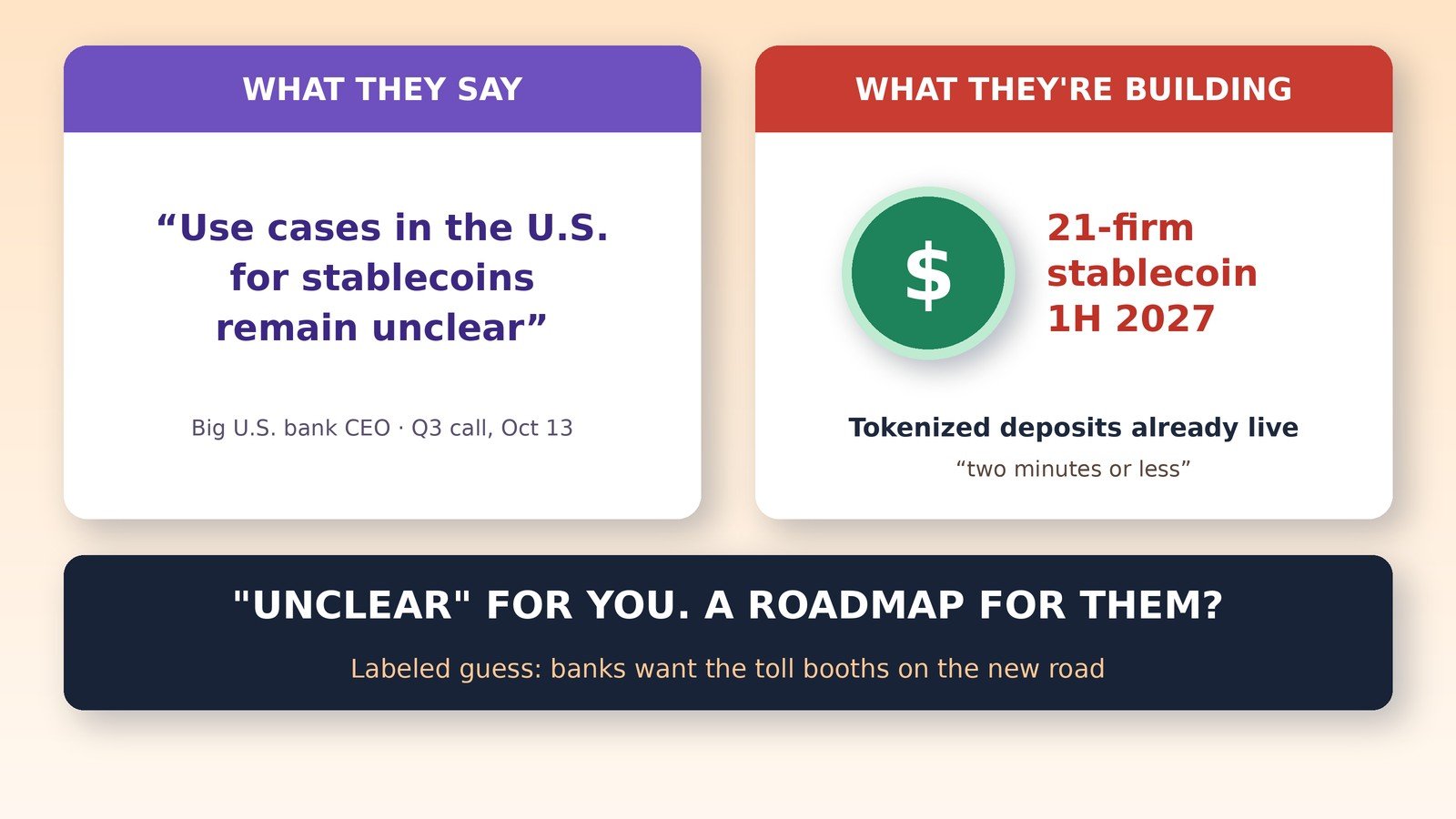
    Here’s Charlie Scharf on the bank’s third-quarter call: “Use cases in the U.S. for stablecoins remain unclear, but we’re building solutions to be prepared as opportunities potentially unfold.” Then: Wells Fargo, “along with 20 other international financial institutions,” is setting up a new company “to issue stablecoins beginning in the first half of 2027,” for wholesale, institutional and retail customers.

    And it isn’t just talk. Scharf said the bank launched tokenized deposits on its own blockchain last month for corporate and commercial clients. His CFO, Mike Santomassimo, said it’s “in production,” at “small volume so far,” and payments land “in two minutes or less” instead of a day or two.

    Meanwhile, across the Atlantic, Qivalis, a euro stablecoin company backed by 37 European banks, just got its license from the Dutch central bank on Wednesday.

    Read the fine print

    Look at how Scharf pitched the tokenized deposits: clients will move money around the clock “without changing how they bank with us.” That’s the tell. A tokenized deposit is still a bank deposit. The money stays on the bank’s books, and the bank keeps earning on it.

    An open stablecoin from an outside issuer is a different animal. Money that leaves a checking account for a token is money the bank no longer holds. So when a big bank says the use case is “unclear,” I hear a bank that isn’t in a hurry for you to find one before it does.

    My read, labeled as a guess

    Here’s the speculation, and it’s only that. I think the big banks figured out that they can’t stop stablecoins, so they’re doing the next best thing: build their own, on their own timeline, and make sure the toll booths on the new road have familiar logos on them. “Unclear” is a handy word when you’d like the upstarts to slow down while you catch up.

    To be fair, there’s a boring explanation too. Banks answer to regulators, and nobody wants to oversell a product that doesn’t exist yet. Wells Fargo’s dollar token is still a 2027 plan, and the company that would issue it is still being set up.

    But for regular people, the question isn’t whether banks get into stablecoins. They clearly are. It’s whether you end up with real choice, or just your same bank in a new costume. Watch who gets to issue, who gets to hold, and who gets paid for it.

    This is opinion, not investment advice.

    Sources: Wells Fargo Q3 2026 earnings call; crypto.news; Qivalis; CoinDesk

  • A Whale Bought $55 Million of Ether. ETF Holders Sold for 10 Straight Days

    A Whale Bought $55 Million of Ether. ETF Holders Sold for 10 Straight Days

    Opinion. On Monday one whale went all in on ether. On the same day, ETF holders kept walking out the door for the tenth straight session. Somebody is wrong. Right now, the tape says it’s the whale.

    The whale’s trade

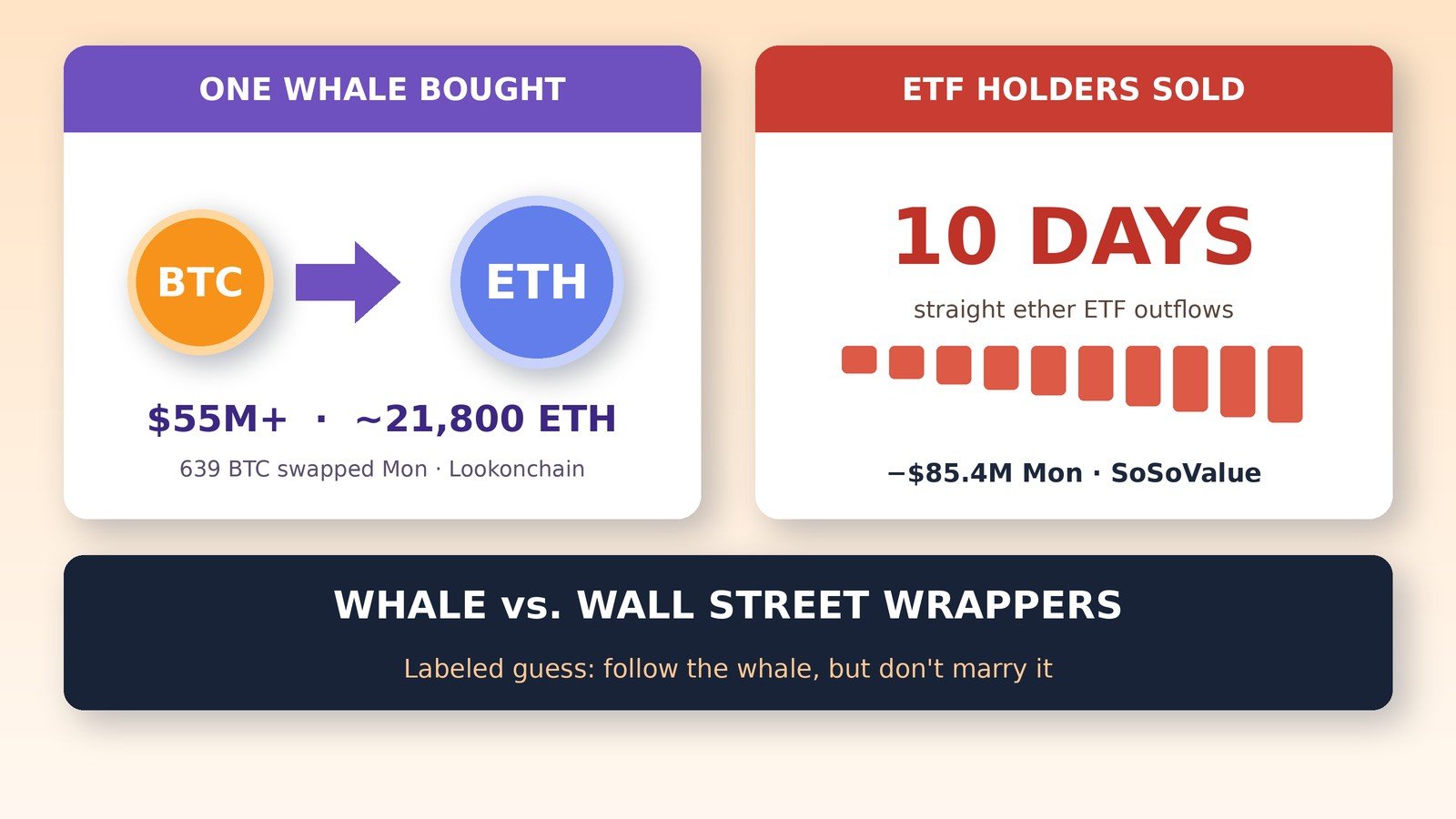
    Lookonchain flagged an unidentified wallet that sold 410.14 BTC, about $34.16 million, on Hyperliquid and then bought 14,341 ETH, about $36.14 million, on decentralized exchanges. Hours later the same wallet did it again: 229 BTC out, 7,469.8 ETH in, about $19.1 million each way. That’s more than $55 million moved from bitcoin into ether in one day, by one player. Lookonchain links it to an Arkham-tagged entity. Nobody has said who it is.

    Do the math on those fills and the whale paid roughly $2,520 to $2,560 per ether. By early Tuesday, ETH had slid to about $2,447, per KuCoin’s daily report, as a selloff in Korean chip stocks and more than $670 million in crypto liquidations hit the market. CoinDesk says ether has since bounced off five-day lows toward $2,500. Either way, the whale is starting underwater.

    The ETF crowd’s trade

    Now the other side. U.S. spot ether ETFs lost a net $85.4 million on Oct. 12, per SoSoValue data reported by TokenPost. That’s ten straight days of outflows. BlackRock’s ETHA alone shed $75.1 million. Lookonchain’s own weekly tally shows about 208,600 ETH, roughly $526 million, leaving the ether funds over seven days.

    So you’ve got one crypto-native trader buying $55 million of ether through Hyperliquid and Uniswap plumbing, and the Wall Street wrapper crowd selling more than that in a single afternoon.

    My read, labeled as a guess

    Here’s the speculation, and it’s only that. A wallet that rebalances this cleanly probably isn’t just guessing. It may hold a derivatives position we can’t see on-chain, or it may be betting that the ETF selling is close to done. On-chain trackers show the spot leg. They don’t show the whole book.

    And here’s the populist part. When the ETF tickers bleed, the headlines say “institutions are leaving ether.” But ETF flows only show fund holders pulling back. They don’t tell you what the people moving size on-chain are doing. My guess is the smart money that matters here isn’t the money with a ticker symbol.

    Still, one whale is not a season. If two or three more wallets make the same trade, and the ETF streak breaks, the story changes. Until then, “a whale bought ETH” is a fact. “Ether is about to rip” is a sales pitch. Follow the whale, but don’t marry it.

    This is opinion, not investment advice.

    Sources: Lookonchain; Lookonchain (second swap); Lookonchain (ETF flows); TokenPost; KuCoin; CoinDesk

  • Whales Stacked, SPAC Holders Cashed Out: XRPN’s Day One Test

    Whales Stacked, SPAC Holders Cashed Out: XRPN’s Day One Test

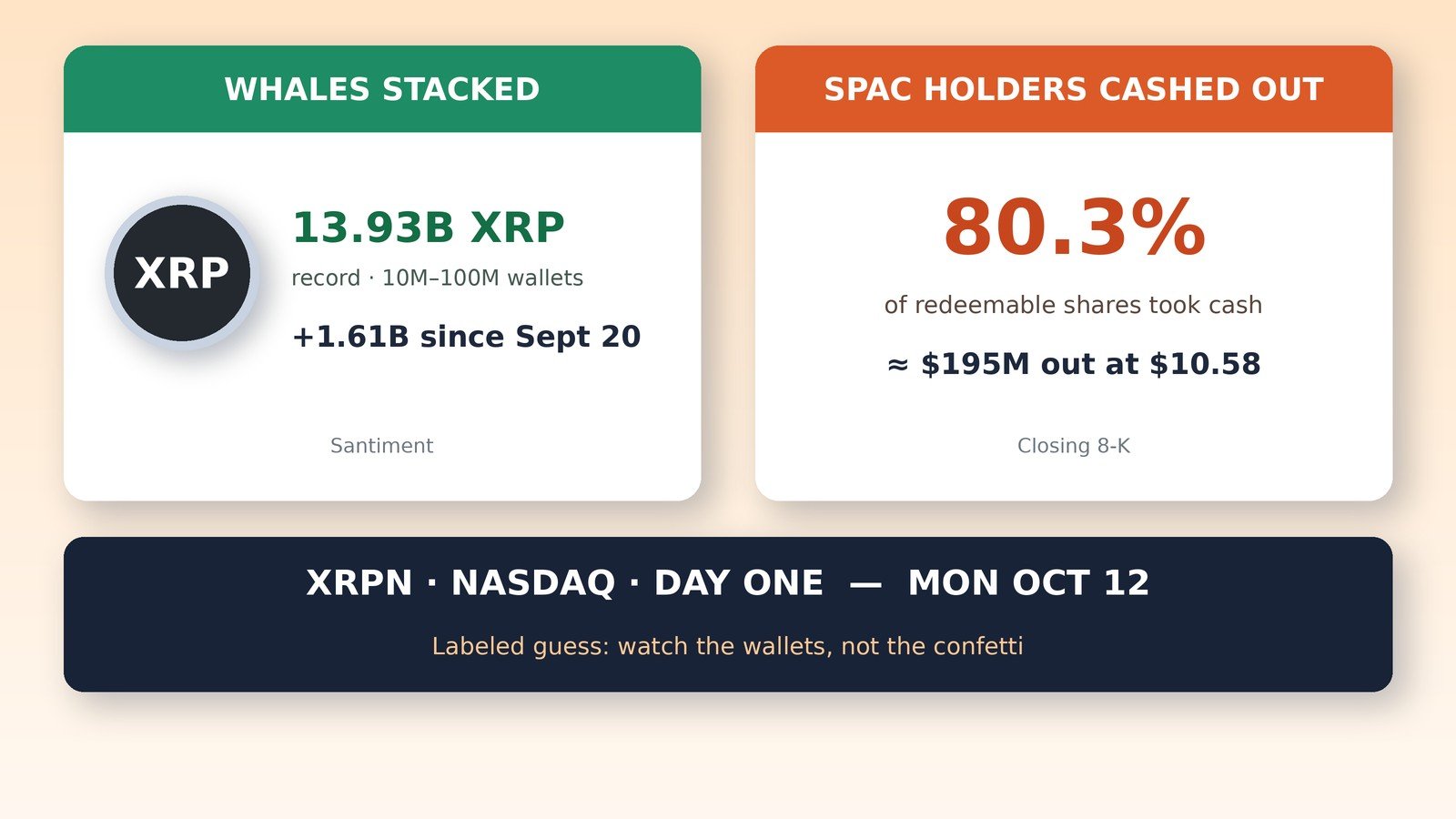
    Opinion. Today Evernorth’s XRPN and XRPNW start trading on Nasdaq. Wall Street finally gets an XRP treasury ticker. Before you cheer, look at who did what on the way in. The big wallets were buying. The SPAC crowd was cashing out.

    Two groups of “smart money.” Two opposite trades.

    The whales stacked

    Santiment data, as reported by The Crypto Basic, shows wallets holding 10 million to 100 million XRP added about 1.61 billion XRP from Sept. 20 into early October. That pushed the group to a record 13.93 billion XRP. A CryptoQuant contributor, per Bitcoin.com News, found 30-day whale withdrawals from Binance near 1.38 billion XRP, a seven-month high. Withdrawals alone don’t prove long-term holding, but coins leaving an exchange are not coins sitting on a sell button.

    The wrappers kept buying too. U.S. XRP ETFs added a net 7.9 million XRP in the week to Oct. 9, per XRP Insights, while spot bitcoin ETFs bled about $681 million, CoinDesk reported. XRP still lost about 7% on the week and sits near $1.40.

    The SPAC holders walked

    Now the other side. Evernorth’s closing filing shows holders of about 80.3% of Armada’s redeemable shares took roughly $10.58 a share, about $195 million in total, instead of riding into the new company. And the XRP filed at close adds up to about 389 million tokens, below the roughly 473 million Evernorth projected on Oct. 1.

    To be fair to Evernorth: redemptions are normal in SPAC deals, and a public company that files with the SEC is a cleaner way to hold XRP than a pile of promises. The skepticism here is aimed at the setup, not the people. Insiders and early money usually get the best seats. Retail usually gets the opening bell.

    My read, labeled as a guess

    Here is the speculation, and it is only that: some of that whale stacking looks like positioning ahead of exactly this week. The ticker opens today, and a closing-bell event is set for Oct. 14. If big wallets loaded up near the lows, a listing week full of headlines is a convenient time for someone to need buyers.

    My guess is the real tell won’t be today’s first print. It will be whether XRPN holds a premium to the XRP it owns once the party ends, and whether those whale balances keep climbing or start leaking back onto exchanges. Watch the wallets, not the confetti.

    This is opinion, not investment advice.

    Sources: Nasdaq Trader; SEC; The Crypto Basic; Bitcoin.com News; XRP Insights; CoinDesk

  • The DCM Stampede: Licenses Before Rails, Press Releases Before Product

    The DCM Stampede: Licenses Before Rails, Press Releases Before Product

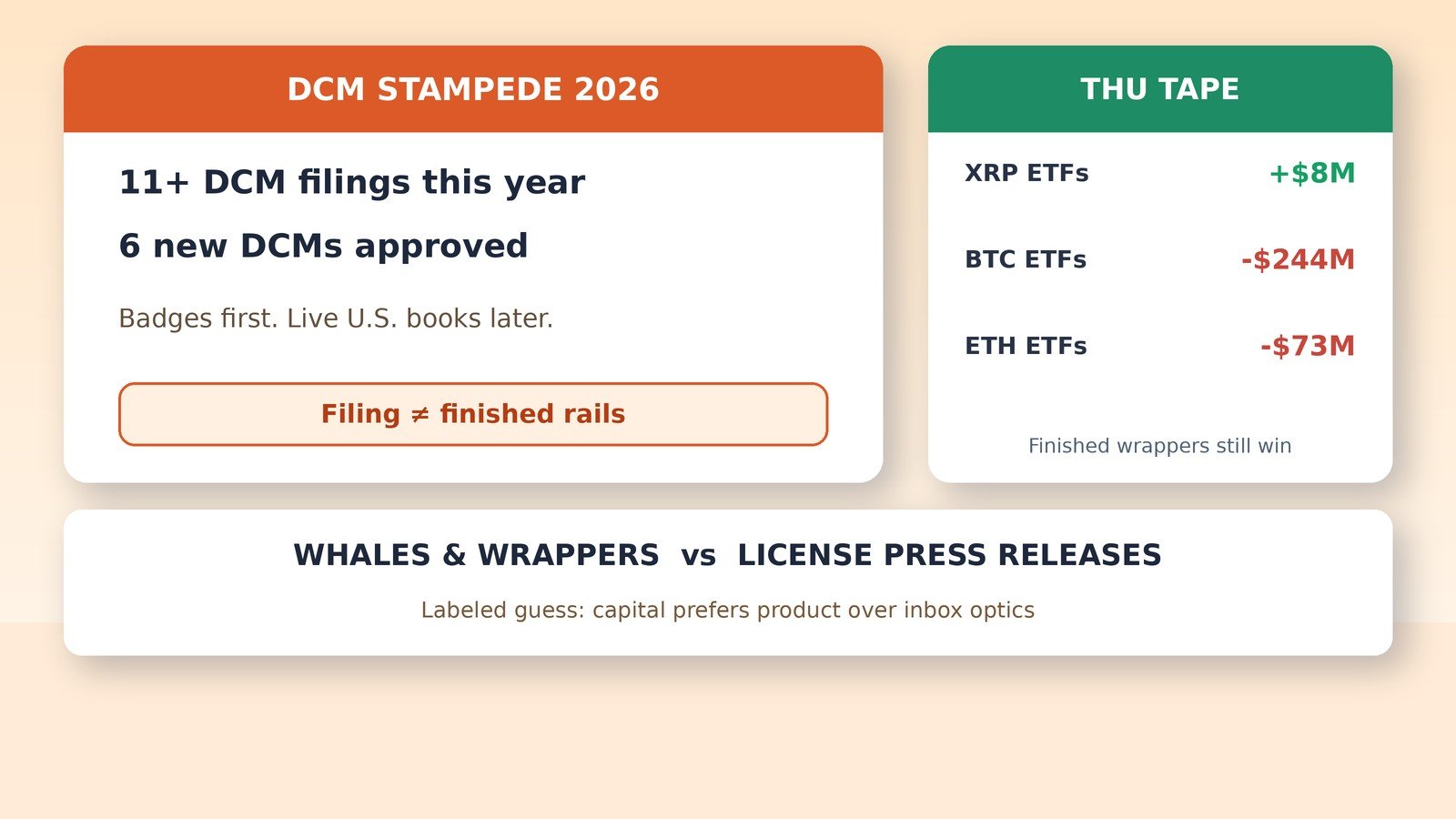
    Opinion. The CFTC inbox is having a moment. Blockchain.com told CNBC it filed for designated contract market and futures commission merchant licenses so it can chase U.S. event contracts and crypto derivatives. CNBC says it joins 11 other DCM filers this year, and the agency has already approved six new DCMs in 2026. That is a stampede for badges. It is not the same as finished U.S. rails.

    Everybody wants the DCM sticker before anybody finishes the product.

    Filings are cheap. Distribution is not.

    Finance Magnates checked the paperwork that actually shows up in public view. Blockchain.com Derivatives Inc. has had an FCM registration and NFA membership pending since Aug. 25. Still under review. Not authorized. The reported DCM application was not yet on the CFTC’s public list Friday, and there is no public rulebook, product list, or launch date. Press release first. Queue later.

    To be clear, I am not roasting Blockchain.com for filing. Filing the right forms is what serious shops do. The skepticism is aimed at the system: regulators get a parade of applications, markets get a parade of headlines, and retail gets the impression that U.S. prediction-market product is already on the shelf.

    Where the money actually went

    Look at Thursday’s tape for the contrast, used lightly because Friday already chewed on it. U.S. spot XRP ETFs took in about $8.17 million, all into Franklin’s XRPZ, while bitcoin ETFs lost about $244 million, ether about $73 million, and SOL about $3 million, per SoSoValue figures carried by CoinDesk and Benzinga. Same week, leveraged liquidations ran near $1.19 billion and XRP swept near $1.32 before rebounding toward $1.40. Whales and wrappers moved. License press releases did not clear those orders.

    Follow the cash, not the inbox. When institutions want exposure, they fund finished distribution. On Thursday that was an ETF wrapper, not a DCM application PDF.

    My read, labeled as a guess

    Here is the speculation, and it is only that: 2026’s prediction-market license stampede is partly regulatory theater and partly IPO optics. Blockchain.com confidentially filed for an IPO in May, with Bloomberg floating a roughly $4 billion to $6 billion valuation and about a $500 million raise. Dual DCM and FCM applications make a clean diligence slide. They do not mint a live U.S. event-contract book.

    My guess is capital still prefers finished wrappers over license press releases. DCM badges will matter when the public queue lists the name, when FCM clears, and when customers can actually trade under those rails. Until then, the stampede is noise around a CFTC inbox, and the tape still pays the shops that already shipped distribution.

    Sources: CNBC; Finance Magnates; CoinDesk

  • Bank Rails Went Live. The Burn Lever Still Carries a Mint Risk.

    Bank Rails Went Live. The Burn Lever Still Carries a Mint Risk.

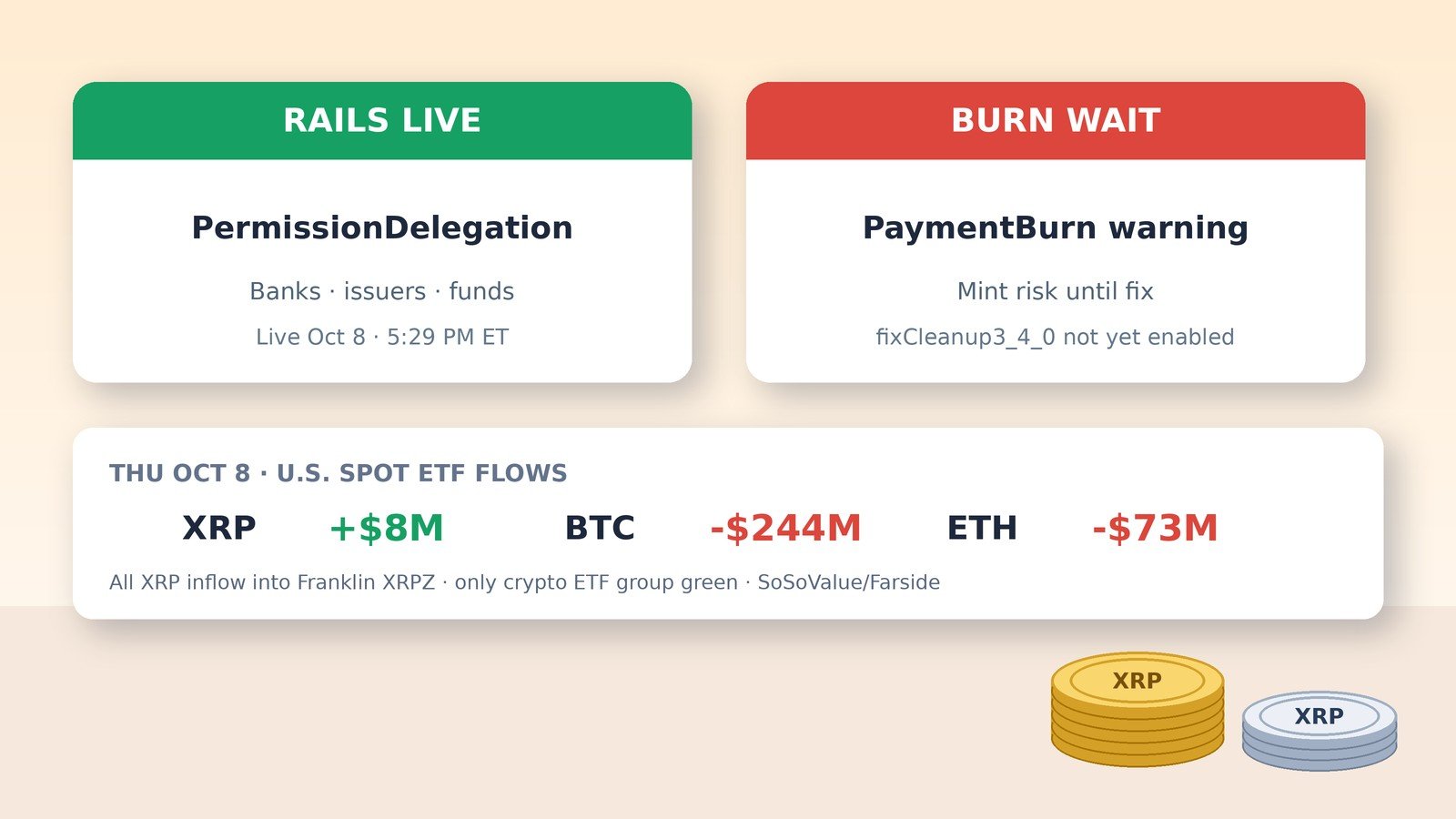
    Opinion. Thursday evening the XRP Ledger flipped on bank-style permission splits. Account owners can now hand payments to one helper, compliance to another, and keep the master keys offline. CoinDesk called it new controls for banks, stablecoins and tokenized funds. Then look at the tape that hit the same window: U.S. spot XRP ETFs were the only crypto ETF group in the green, taking in about $8 million, while bitcoin funds lost about $244 million and ether funds about $73 million, per SoSoValue data in CoinDesk’s live updates.

    Infrastructure PR on one side. Selective money on the other. Somebody is reading the fine print.

    Rails got a role map. Burning did not.

    PermissionDelegationV1_1 went live at ledger 107,524,865 on October 8, at 5:29 p.m. ET, per the ledger’s own record. That is real plumbing. Batch, the all-or-nothing bundling feature, is next in line Friday morning, if validator majorities hold. It is not live yet. A stablecoin desk can approve customers without parking the treasury key on the same laptop. Good.

    Here is the part the launch thread often skips. Official XRPL docs still say do not delegate PaymentBurn until fixCleanup3_4_0 activates. Before that fix, a helper with burn rights can, in some cases, mint issued tokens. The ledger logged a majority for that cleanup early Friday, but the roll calls disagree: 28 of 35 on XRPL Dashboard, 27 of 35 per CoinDesk, with 29 needed. Even if it holds, the earliest it could switch on is around Oct. 23. So the ledger sold “bank controls” while one of the burn levers still carries a mint risk. Rails are live. Rails are not finished.

    Who showed up with cash

    On Thursday’s ETF tape, all of that XRP inflow went into Franklin Templeton’s XRPZ, which added about 6 million XRP. The other four XRP funds saw zero flow. Bitcoin ETFs were deep red after Wednesday’s $485 million outflow. Ether and SOL funds bled too. That is not “crypto risk-on.” That is one fund family catching the only green print while the rest of the complex paid the liquidation bill from a roughly $1.19 billion leveraged washout.

    Follow the money, not the keynote. When institutions actually like a rail, they fund the wrapper that sits on top of it. On Thursday that wrapper was XRPZ, not a fresh round of “coming soon” bank pilots.

    My read, labeled as a guess

    Here is the speculation, and it is only that: the market is pricing finished distribution, not unfinished permission specs. Permission maps and offline master keys are what banks ask for in diligence decks. They are not the same as a named issuer running live customer approval on-ledger, and they are not the same as PaymentBurn being safe to hand to a helper. My guess is Franklin’s buyers were paying for ETF access and custody packaging, while the amendment headline bought attention that the burn warning still has to earn back.

    To be clear, turning on role-based delegation is the right direction. Separation of duties belongs on these ledgers. The populist question is simpler: if the ledger needs a cleanup amendment before one burn permission is safe, why does the launch copy sound like the bank branch already opened? Watch two things: when fixCleanup3_4_0 clears the two-week bar, and whether XRP ETF inflows keep showing up on days bitcoin funds are dumping.

    Sources: Farside Investors; XRPL.org Known Amendments; XRPL Dashboard; CoinDesk (PermissionDelegation); CoinDesk (ETF live updates); XRPL documentation

  • Whales Are Hoarding XRP While Leveraged Longs Pay the Toll

    Whales Are Hoarding XRP While Leveraged Longs Pay the Toll

    Opinion. On paper, this was XRP’s best week of the fall. Paxos, the regulated back end behind crypto at some of the biggest apps in finance, switched on XRP for its partners. A top Korean brokerage, Meritz Securities, signed up to study Ripple’s custody tech. Evernorth’s XRP treasury company still expects to start trading on Nasdaq on Monday. And the price? XRP was near $1.40 on Thursday, down nearly 7% on the week, FXStreet reported.

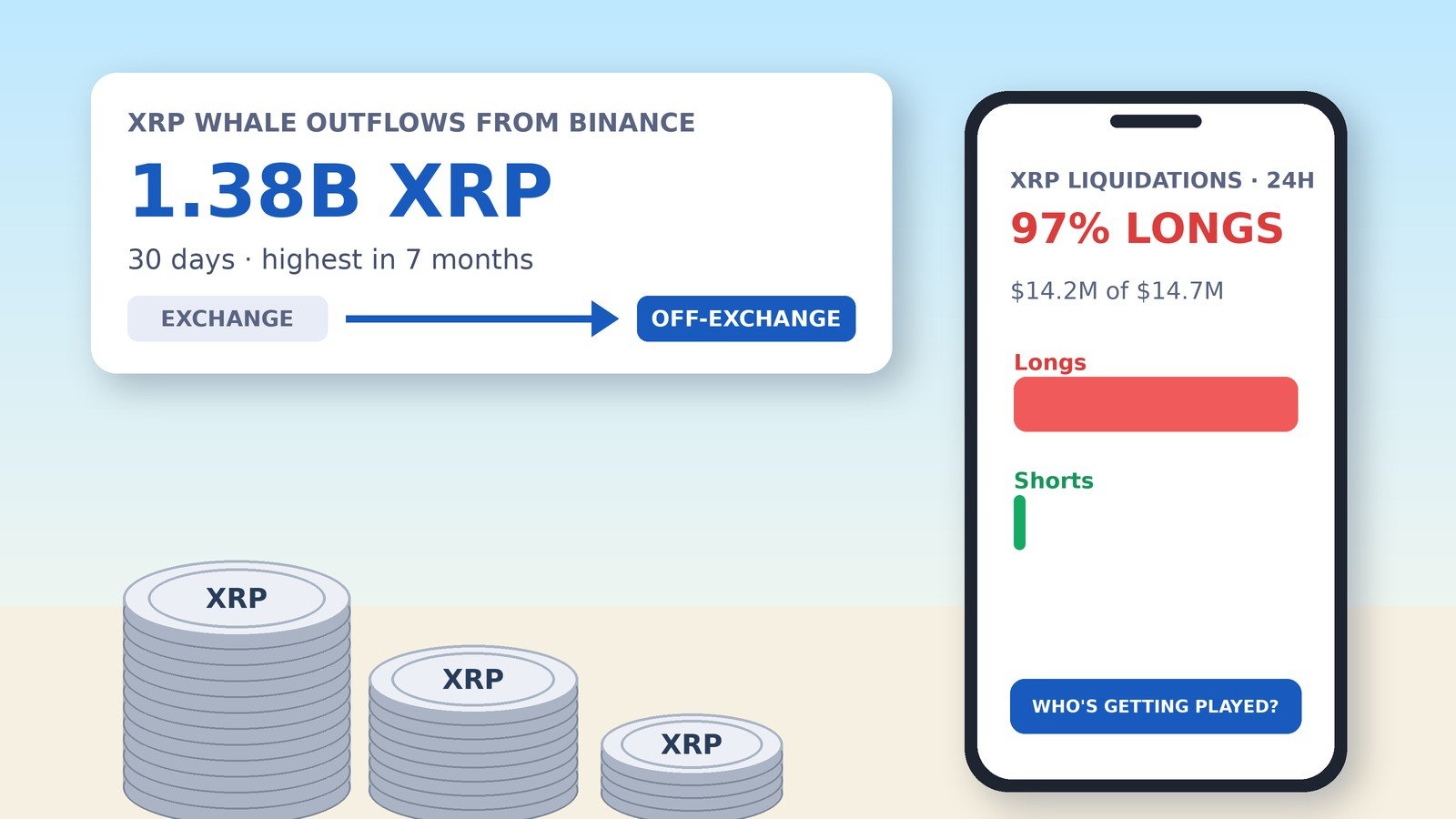
    Good news, falling price. Somebody is getting played. So follow the whales.

    Where the big coins went

    Large holders have been pulling XRP off the biggest exchange. The 30-day sum of whale outflows from Binance hit 1.38 billion XRP, the highest in seven months, according to CryptoQuant data cited by CoinGape.

    Santiment’s wallet data points the same way. Wallets holding 10 million to 100 million XRP added about 1.61 billion tokens in the two weeks after September 20, reaching a record 13.93 billion XRP as of October 3, The Crypto Basic reported.

    Fair warning: coins leaving an exchange are not proof of buying. Big wallets can belong to custodians, funds or Ripple itself, and exchange flows run in both directions. But coins moved to storage are not sitting on an order book waiting to be sold, either.

    Who paid for the dip

    Now look at who got hurt. Over the past 24 hours XRP saw $14.69 million in liquidations, and $14.24 million of it, about 97%, was long positions, according to CoinGlass data reported by The Crypto Times. That is the leveraged crowd that bought the headlines.

    The fund crowd sat on its hands. U.S. spot XRP ETFs recorded exactly zero net flow on Wednesday, while bitcoin ETFs lost $487 million and ether ETFs $161 million, per SoSoValue data compiled by CoinGabbar. And Washington did not help. Fed minutes released Wednesday showed most officials expect another hike by year-end, with Treasury yields near their highest since 2002, CNBC reported. When cash pays again, leverage pays the bill.

    My read, labeled as a guess

    Here is the speculation, and it is only that: the whales are positioning for the day a household-name app actually turns on the Paxos pipe. They would rather fill their bags from margin calls this week than compete with brokerage customers later. Wall Street gets the plumbing first. Main Street gets the liquidation notice.

    To be clear, that is not a knock on Paxos. Building regulated rails, and saying so in public, is exactly what this market needs more of. The question is who gets to use those rails first, and at what price. Watch two things: which partner flips XRP on for its customers, and whether whale balances keep climbing if $1.40 breaks.

    Sources: Paxos on X; FXStreet; CoinGape; The Crypto Basic; The Crypto Times; CoinGabbar; CNBC

  • The Biggest Ether Whale Just Put a Ceiling on Its Own Bid

    The Biggest Ether Whale Just Put a Ceiling on Its Own Bid

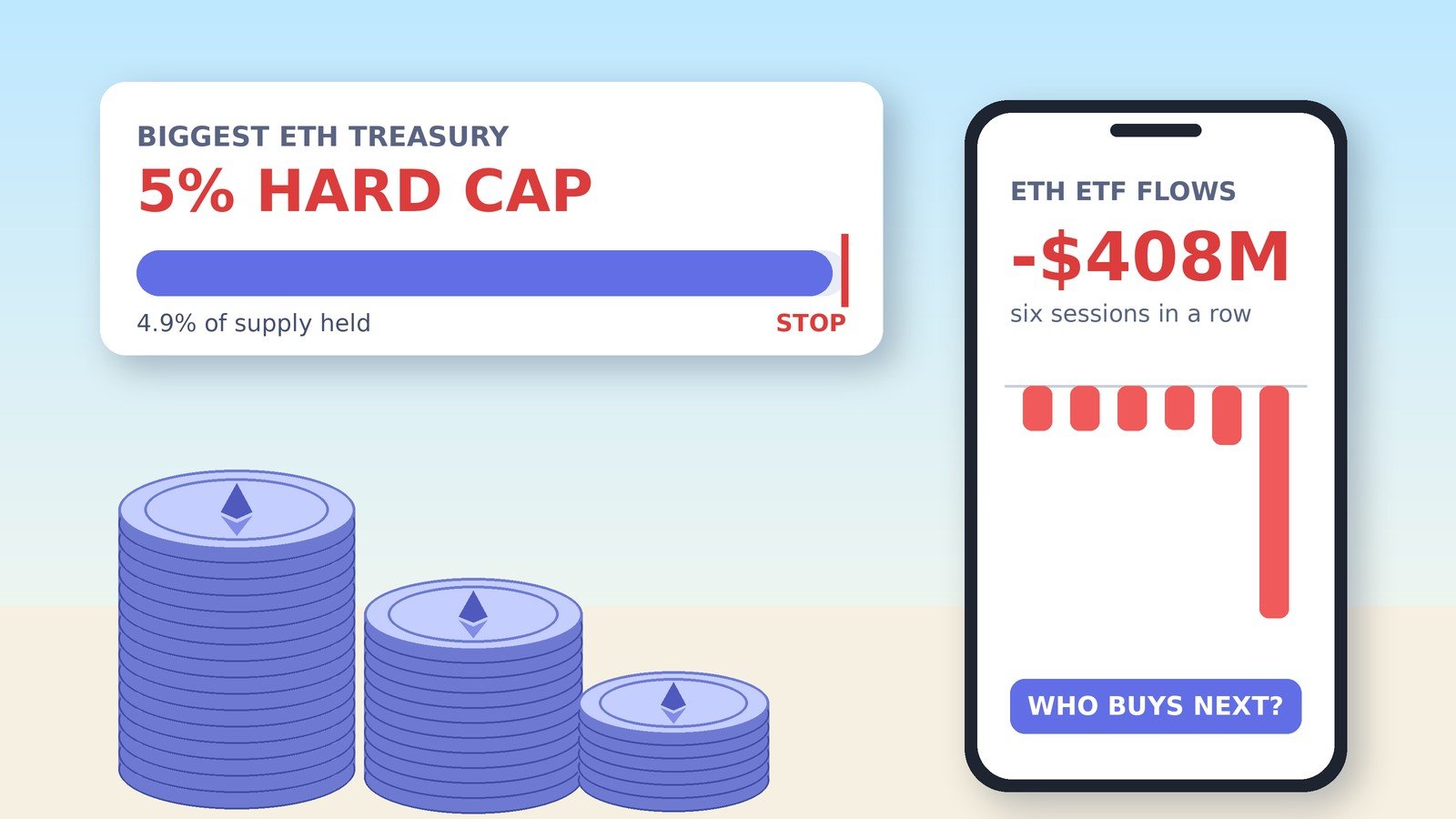
    Opinion. Yesterday this desk asked who picks up the ether bid when BitMine hits its target. On Wednesday, BitMine chairman Tom Lee answered half the question. Speaking at Token2049 in Singapore, he said the company will stop at 5% of ether’s supply. “That’s a hard cap. We’re not gonna be accumulating past 5%,” Lee said, according to Cointelegraph. “We’re not gonna own more than 5% of Ethereum.”

    That is a real change. Lee had left the door open to going past 5%, and as recently as an August interview with Bankless he said the company might revisit it in 2027, Cointelegraph noted. Now the target is a ceiling. Credit where due: BitMine announced its goal in public, reported its pile every week and is now telling the market exactly where it stops. Most whales never tell you anything.

    Do the math. BitMine’s October 5 update put its stack at 6,016,414 ETH, about 4.9% of a 122.1 million supply. Five percent is about 6.1 million. That leaves roughly 89,000 ETH by Hardwire’s count, or “about 100,000” in Lee’s round number. At Wednesday’s price near $2,616, that is somewhere around $230 million to $260 million of buying left. Then the biggest corporate bid in ether stops.

    Who else is selling

    Look at who was on the other side this week. U.S. spot ether ETFs lost $202 million on Tuesday, after about $51 million on Monday, and have now bled roughly $408 million over six straight sessions, Cointelegraph reported, citing SoSoValue. Bitcoin ETFs took in $119 million the same day. Money didn’t leave crypto. It left ether.

    The old money is cashing in too. On Monday, Lookonchain flagged a long-dormant early ether wallet sending 13,330 ETH, about $36.4 million, to Coinbase after six months of silence. Then came Wednesday morning’s flush. Ether fell below $2,600 at one point, The Crypto Times reported, with about $175 million in ETH liquidations. Across the market, more than $400 million in longs were wiped out in an hour, Bitcoin.com News reported, the same morning Lee told the room crypto is “2 days past the bottom.”

    Even Washington moved coins. Wallets linked to the U.S. government sent 833.6 BTC, about $71.6 million, toward Coinbase Prime deposit addresses on Tuesday, CoinDesk reported, citing Arkham. A transfer is not a sale, and no sale has been confirmed. But taxpayers are still learning what their own government does with seized bitcoin from a private blockchain-tracking firm, not from Washington. That should bother people on both sides of the aisle.

    The staking question

    Here’s the part the headline skips. BitMine’s update listed 5,067,309 ETH staked, and staking pays rewards in more ETH. Lee has said BitMine could sell staking-earned ETH to keep its share from rising above 5%, Cointelegraph reported. Speculation, labeled: if that’s the plan, the biggest ether buyer of the cycle could turn into a small, steady seller once it hits the cap. That’s not a scandal. It’s arithmetic. But it is the opposite of the “every week” headline that helped carry ether this year.

    Lee frames the cap as bullish. “We’re done stacking in front of a 25X move,” he said, and without new ETH buying BitMine doesn’t need to keep raising capital. That is a fair argument for BMNR shareholders. It is a different question for everyone holding ETH itself. Speculation, labeled: the whale just told you it’s leaving the buy side. Wall Street’s ETF money is already heading for the exit. Somebody has to replace both, and so far nobody has raised a hand.

    Hardwire’s read: thank BitMine for the clarity, then plan around it. Watch three things. Do the ETH ETF outflows stop? Does a new treasury buyer step up? And does BitMine’s first post-cap update show it selling staking rewards?

    Sources: Cointelegraph (BitMine hard cap); BitMine release (Oct 5); Cointelegraph (ETF flows); Lookonchain; The Crypto Times; Bitcoin.com News; CoinDesk

  • The Streak Is Intact. The Bid Is Shrinking.

    The Streak Is Intact. The Bid Is Shrinking.

    Opinion. BitMine Immersion Technologies said Monday it added 15,112 ETH last week, about $41 million at its $2,726 reference price. It now holds 6,016,414 ETH. That’s 4.9% of the 122.1 million supply, and the company says it’s 99% of the way to the “Alchemy of 5%” goal it set 15 months ago. The release leads with the streak: BitMine has bought ether every single week since June 30, 2025.

    The streak is real. So is the slowdown. Two weeks ago the weekly buy was 27,562 ETH. Last week it fell to 17,362, the smallest since mid-August, according to Unchained. This week it’s 15,112. Back in the spring, BitMine was buying more than 100,000 ETH in a week. To be fair to Tom Lee, he told Consensus in May that the pace would ease as the company closed in on 5%. Nobody hid the ball. But “we bought again” and “we’re still the bid” aren’t the same headline, and only one of them is getting printed.

    Do the math the press release doesn’t. Five percent of 122.1 million ETH is about 6.1 million. BitMine needs roughly 89,000 more, and at last week’s pace that’s about six weeks of buying. Then what? Either the biggest corporate ether buyer sets a new target, or one of the steadiest bids in this market shrinks to a maintenance trickle.

    Some other numbers in the release are worth a look. Cash and marketable securities fell to $643 million from $672 million a week earlier. The staked figure, 5,067,309 ETH, matches the count in every weekly update since at least mid-August, Unchained noted. So recent buys aren’t showing up as newly staked coins. Lee also highlighted the largest-ever crypto treasury equity buyback, 21 million shares this year. Speculation, labeled: a company that spends on its own stock while its ETH buys shrink may be choosing between propping up the share price and adding to its pile. That’s a legitimate capital choice, not a scandal. It just isn’t the story the streak tells.

    Strategy shows the same pattern with bitcoin. Its Monday 8-K reported 334 BTC for $28.7 million, down from 1,665 BTC the week before. That takes its stack to 848,000 BTC. In the same week, Michael Saylor said Strategy repurchased $176 million of its STRC preferred shares, about six times what it put into bitcoin. The orange chart still goes up and to the right. But more of the money is now going into managing the company’s own securities rather than buying bitcoin.

    Speculation, labeled: this looks less like whales losing faith and more like whales switching modes. One is finishing a target. The other is protecting the instruments that funded its buying. Either way, the steady corporate bid that helped carry this cycle is getting smaller, while the marketing keeps sounding the same. Lee keynotes Token2049 on Wednesday, and his October Chairman’s Message is titled “Crypto bull underway.” Maybe so. But a bull market needs a buyer at the margin, and the two loudest ones are buying less.

    Hardwire’s read: credit BitMine and Strategy for doing exactly what they said they’d do, in public, every week. Then watch the size, not the streak. If the next marginal buyer isn’t a treasury company, it has to be ETF flows, sovereigns or retail. Find out which before you trust the next “every week” headline.

    Sources: BitMine release (Oct 5); Decrypt; BitMine release (Sep 28); Unchained; The Block; Strategy 8-K

  • The Bank Lobby Found a Door It Didn’t Like. Now It Wants a Judge to Lock It.

    The Bank Lobby Found a Door It Didn’t Like. Now It Wants a Judge to Lock It.

    Opinion. On October 2, the Independent Community Bankers of America sued the Office of the Comptroller of the Currency in federal court in Washington. The suit asks a judge to throw out the OCC’s March 2 chartering rule and Interpretive Letter 1176, to cancel Protego’s conditional trust-bank approval, and to block the agency from using either document to approve any more charters. ICBA says the OCC has approved or conditionally approved 21 national trust banks under this administration, and that at least 13 of them are crypto companies.

    Read the press release and you get consumer protection and systemic risk. Read the complaint and you get something more honest. Paragraph after paragraph is about competition. Two anonymous member banks, each with less than $2.5 billion in assets, say they spend more than $1.5 million a year on compliance that crypto trust banks skip, and that they’ve already lost “hundreds of thousands of dollars” in business this year to firms with conditional OCC approval. That’s a real grievance. It’s also the oldest story in banking: whoever holds the license wants the next applicant held to a higher bar, or kept out.

    Give the bankers their due, because some of their points are strong. A national trust bank doesn’t carry FDIC insurance. It isn’t supervised like a bank holding company. And it can preempt a lot of state consumer law. The complaint also notes that the OCC hasn’t run an uninsured bank receivership in nearly a hundred years. If one of these new charters fails in a crypto crash, nobody has recently tested what happens next. Customers who see “national bank” on the door may assume protections that aren’t there. Those are fair questions, and the OCC’s two-page response to comments, as ICBA describes it, didn’t answer many of them.

    Here’s what they aren’t putting in the headline. The legal weapon is the major questions doctrine, the same conservative tool used to rein in agencies that claim sweeping powers Congress never granted. This time it’s pointed at a Trump-era OCC, and at an interpretive letter written by Jonathan Gould before he became Comptroller. ICBA also leans on the GENIUS Act, arguing that because Congress has now legislated on stablecoins, it meant to keep the bigger crypto-banking question for itself. Speculation, labeled: that line of argument would let incumbents treat every unfinished bill as a reason to freeze agency action in the meantime.

    Keep the scope straight, too. Ripple, Circle, and the other December 2025 conditional approvals aren’t named as targets for vacatur. Protego is the only charter the suit asks the court to cancel outright. Filing a complaint revokes nothing, and the OCC has declined to comment on the litigation. But the relief ICBA wants, an order stopping the OCC from using the rule or IL 1176 to approve future charters, would close the path for whoever comes next, however clean their books are.

    Hardwire’s read: be skeptical of the regulator that redefined a 1978 sentence into a national on-ramp, and be skeptical of the trade group that wants a judge to slam that ramp shut at the exact moment its members started losing customers. If crypto firms want bank-grade credibility, they should accept bank-grade scrutiny. If community banks want to keep their customers, they’ll need a better product, not just a better lawyer.

    Sources: ICBA complaint; ICBA release; CoinDesk; American Banker; OCC