
Blog

  • Polymarket Halts Trading for an Hour After Third-Party Provider Breach, Says It Will Fully Reimburse Traders

    Polymarket Halts Trading for an Hour After Third-Party Provider Breach, Says It Will Fully Reimburse Traders

    Polymarket put its international exchange into cancel-only mode on Thursday afternoon after users reported funds leaving their accounts without their permission. The company later said one of its outside providers had been compromised.

    Polymarket’s status page posted its first notice at 2:05 p.m. ET: “The exchange is currently in cancel-only mode and relayer actions paused while we investigate an incident.” In cancel-only mode, traders can pull open orders but can’t place new ones. Relayers are the services that submit users’ signed transactions to the blockchain.

    At 2:33 p.m. ET, the company’s Polymarket Traders account on X said: “We’ve identified & fixed an issue impacting our international platform, Polymarket.com. One of our 3rd party providers was compromised, and we have referred this to relevant law enforcement. Anyone who has been impacted will be made whole.” The status page carried the same statement and added that “out of an abundance of caution, we have temporarily halted trading and are working to bring the platform back online.”

    At 2:54 p.m. ET it said trading would resume at about 3 p.m. Six minutes later it posted: “Trading is now fully back online. We’ll make this right and are fully reimbursing all affected traders.” The status page marked the incident resolved at 3:05 p.m. ET, about an hour after the first notice.

    What hasn’t been confirmed

    • The amount. Polymarket hasn’t published a loss figure, and a representative declined to comment on one to NBC News. The Block and Decrypt, citing Arkham data, reported that a wallet identified as the suspected attacker’s held about $2.65 million in POL after a series of swaps out of USDC.e. That is a wallet balance, not a confirmed tally of losses. The Wall Street Journal, as cited by Quartz, counted more than $2.5 million taken from user accounts in over 900 transactions. Two analytics firms, Betting Intelligence and Polysights, told CNBC that at least $2.7 million was withdrawn across 710 wallets.
    • The provider. Polymarket hasn’t named it.
    • Who was affected. The company hasn’t said how many traders were hit. Its statements refer only to Polymarket.com, its international platform, and CNBC reported that the U.S. platform was not compromised.

    Polymarket hasn’t said when reimbursements will be paid or how they will be calculated.

    This isn’t the platform’s first vendor-related incident. In June, Polymarket said a third-party vendor had been compromised and promised to refund affected users, according to CNBC and Decrypt.

    The outage came five days before the U.S. midterm elections on Nov. 3, when Polymarket’s international and U.S. exchanges are both expected to see heavier trading.

    Sources: Polymarket status page; Polymarket Traders on X; The Block; Decrypt; CNBC; NBC News; Quartz

  • Washington Gave Up on Congress. Now the Agencies Write the Crypto Rules.

    Washington Gave Up on Congress. Now the Agencies Write the Crypto Rules.

    Six weeks after the CLARITY Act stalled on the Senate floor, Treasury and the CFTC say they’ll build crypto’s rulebook themselves. Nobody voted on that part.

    Here’s the timeline the press releases won’t line up for you.

    On September 15, the Senate tried to move to the CLARITY Act, the market-structure bill that was supposed to tell the industry once and for all what’s a security, what’s a commodity, and who polices which. It didn’t even get to debate. The cloture vote on the motion to proceed failed 49–50, according to the Senate’s own cloture record. It needed 60. Law firms Orrick and DLA Piper point to two sticking points: ethics rules on officials’ crypto holdings, and whether stablecoins can pay yield. With midterms next week, Orrick calls passage this Congress “widely viewed as unlikely.”

    Three weeks later, CFTC Chairman Michael Selig went to a Fordham Law symposium and said the quiet part out loud. “President Trump promised to deliver a crypto asset regulatory market structure with or without legislation,” he said, “and we will help him deliver it using our existing statutory authorities.” The CFTC then opened an advance notice of proposed rulemaking on leveraged retail crypto trading, along with a new exchange category it calls a “crypto asset market.”

    This week it was Treasury’s turn. Speaking at Ripple’s Swell conference in New York, Treasury Secretary Scott Bessent called the CLARITY setback disappointing. Bitcoin Magazine reports he said Treasury will “bring the SEC and CFTC together to close the gaps through regulation,” with or without Congress. “At Treasury, we have a lot of convening powers,” he said, and he called the two agencies “great partners.” TokenPost reported the same with-or-without-Congress pledge. Bitcoin Magazine also notes what he left out: no formal plan, no working group, no timeline.

    To be fair, a lot of this industry will cheer. Clear rules from an agency beat no rules from a Congress that can’t hold a vote. And Selig himself concedes the limit: only Congress can force every crypto exchange to register federally. The CFTC’s plan is an opt-in.

    But step back and look at who’s holding the pen now. It isn’t the 100 people you elected to the Senate. It’s three agencies, run by appointees. The bill was meant to settle the securities-versus-commodities line in statute. Instead, by Selig’s own description, that line is being drawn by him and SEC Chairman Paul Atkins. A rule written that way can be unwritten the same way. Bitcoin Magazine says as much: agency action “can be reversed by a future administration.”

    Speculation, labeled: The “with or without Congress” line is useful to people in both parties. Lawmakers skip a hard vote on stablecoin yield and ethics before an election. Agencies get to shape the market without a roll call. If that’s the deal, nobody signed it in public, and nobody will own it if it goes wrong.

    Then there’s the money backdrop. On Wednesday the Federal Reserve held its target range at 3.75% to 4% on a 10–2 vote. Per the Fed’s statement, Governor Lisa Cook and Cleveland Fed President Beth Hammack dissented because they wanted a quarter-point hike now. CoinDesk, citing CME FedWatch, put December hike odds at 86% before the decision. After Chair Kevin Warsh’s press conference, other FedWatch readings showed low-80s. That’s another unelected body setting the weather crypto trades in.

    Speculation, labeled: If rates are heading up while the rulebook is being written by memo, the firms best placed to win are the ones with lawyers in the room when Treasury “convenes.” Bessent made his pitch on a stage at Ripple’s own conference. So for XRP holders, and everyone else, the question isn’t just what the rules say. It’s who was invited to draft them.

    So who writes crypto policy now? On the evidence, agencies do. Congress had its shot on September 15 and didn’t take it. The least voters can ask is that every rule the agencies write goes through full public comment, and that they read the comments. Whatever passes for crypto law next year, it shouldn’t be signed in a conference hall.

    This is opinion, not investment advice.

    Sources: U.S. Senate, Orrick, DLA Piper, CFTC, Bitcoin Magazine, CoinDesk, TokenPost, Federal Reserve, TradingKey.

  • Bitcoin Slips to $80,000 After Fed Holds and Two Officials Vote for a Hike

    Bitcoin Slips to $80,000 After Fed Holds and Two Officials Vote for a Hike

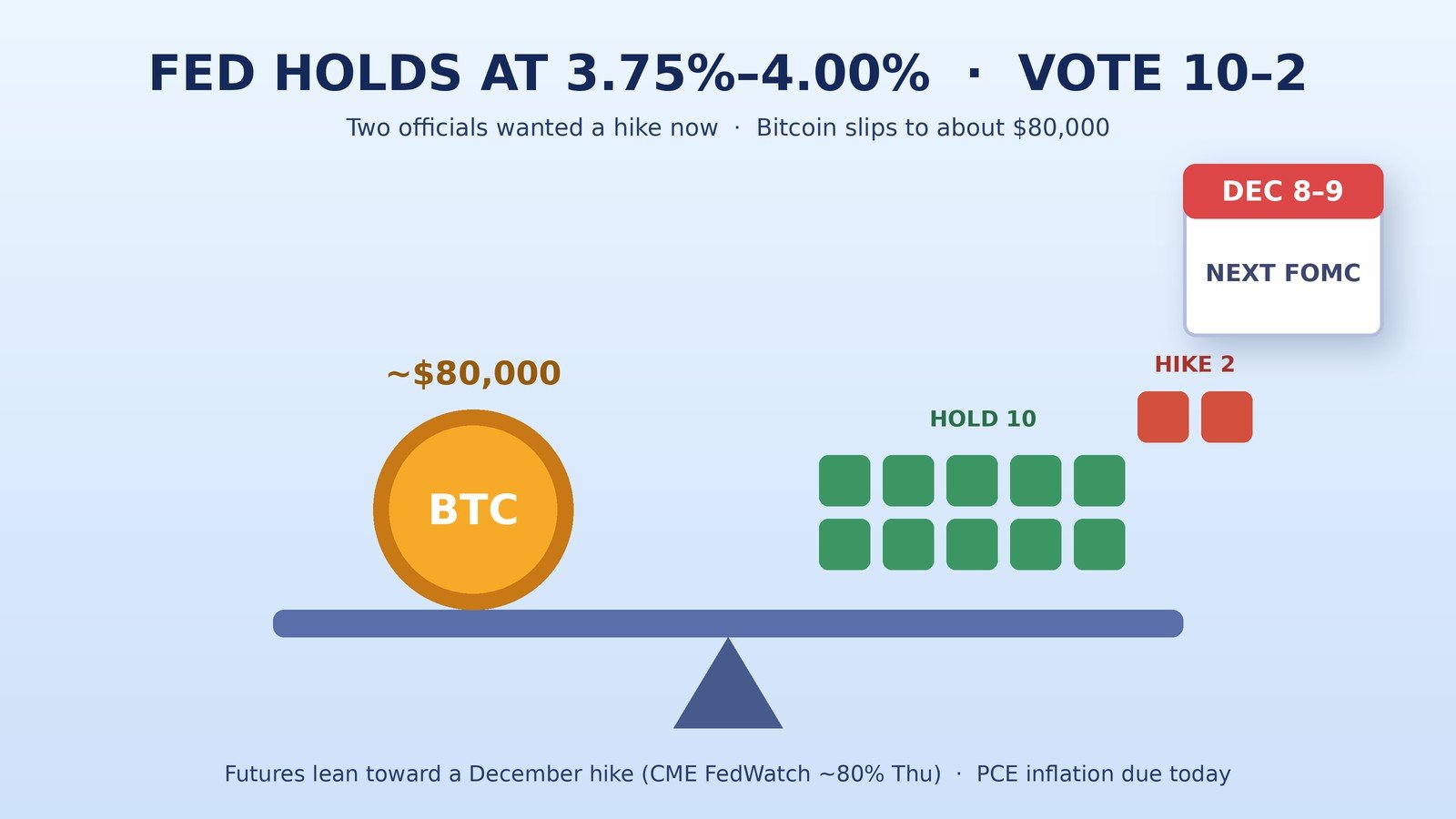
    Bitcoin traded near $80,000 on Thursday morning, down about 1% over 24 hours, after the Federal Reserve left rates unchanged but showed a split over whether to raise them.

    The Fed held its federal funds target range at 3.75% to 4.00% on Wednesday. The vote was 10–2. According to the Fed’s statement, Governor Lisa D. Cook and Cleveland Fed President Beth M. Hammack dissented. Both wanted a quarter-point increase at this meeting.

    The statement said economic activity “is expanding at a strong pace” and that inflation “remains elevated.” It did not commit to a next move. “The accumulation of more information will help the Committee determine the policy stance appropriate,” it said.

    Chair Kevin Warsh echoed that at his press conference. “The information we receive over the coming period will help us determine where we want policy to be,” he said, according to the Fed’s preliminary transcript.

    What markets are pricing. Futures still point to a December hike. Investing.com, citing CME FedWatch, put the chance of a quarter-point increase at 79.8% on Thursday, up from 73.4% a week earlier. These readings move through the day and are not forecasts. The next meeting is Dec. 8–9, per the Fed’s calendar.

    The 10-year Treasury yield was about 5.01% early Thursday, CoinDesk reported, after briefly pushing above 5% following the meeting.

    Crypto reaction. CoinGecko showed BTC at $80,049 at 8:13 a.m. ET, down 1.1% over 24 hours, and ether at $2,321, down 1.1%. CoinDesk said bitcoin dipped to about $79,600 overnight. It tied the move partly to a slide in tech stocks after Alphabet and Samsung earnings, with Nasdaq-100 futures down about 1.1%.

    Fund flows were steadier. U.S. spot bitcoin ETFs took in a net $137.3 million on Wednesday, the third straight day of inflows, according to Farside Investors. Almost all of it went to BlackRock’s IBIT. Spot ether ETFs saw net outflows of $21.4 million.

    What’s next. The Commerce Department’s September PCE report, the Fed’s preferred inflation gauge, is due Thursday. The October jobs report follows Nov. 6, then October consumer prices on Nov. 10, Decrypt reported. With policy now tied to incoming data, those releases may matter more for crypto than anything said on Wednesday.

    Sources: Federal Reserve, Federal Reserve press conference transcript, CoinDesk, Investing.com, Farside Investors, CoinGecko, Decrypt.

  • RLUSD Lands on Coinbase, a Day After Moody’s Gives It an Investment-Grade Rating

    RLUSD Lands on Coinbase, a Day After Moody’s Gives It an Investment-Grade Rating

    Ripple’s dollar stablecoin, RLUSD, is now on Coinbase, the largest U.S. crypto exchange. Ripple and Coinbase announced the partnership on Wednesday, Oct. 28, the main day of Ripple’s Swell conference in New York.

    According to Ripple’s announcement, retail and institutional customers can trade and manage RLUSD starting today through the Coinbase app, Coinbase Exchange and Coinbase Prime. Customers can convert U.S. dollars and other supported dollar stablecoins into RLUSD at a 1:1 rate. Deposits and withdrawals work on three networks: the XRP Ledger, Base and Ethereum. Ripple says it will provide liquidity on Base. Coinbase and Coinbase Institutional confirmed the listing.

    Not everything is live yet. Ripple says access for Coinbase’s international exchange customers, including using RLUSD as collateral, “will follow.” No date was given.

    The listing came hours after a credit rating. On Tuesday, Moody’s Ratings assigned RLUSD an A2 long-term and P-1 short-term deposit rating, both investment grade, as The Block and Decrypt reported and Ripple’s Jack McDonald confirmed. Moody’s pointed to reserves held mostly in Treasury bills, other short-term U.S. government assets and cash, largely with custodian BNY, and a 103% reserve coverage target. The ratings were requested by the issuer.

    Moody’s also flagged limits. Per Decrypt, the issuer, Standard Custody & Trust Company, is not bankruptcy-remote, and RLUSD holders don’t currently have a direct ownership interest in the reserves. Moody’s said the GENIUS Act, due to take effect in 2027, will shield required reserves from an issuer’s bankruptcy estate.

    Ripple says RLUSD has passed $2.4 billion in market value since it launched in December 2024. Ripple’s McDonald and Coinbase Institutional co-CEO Brett Tejpaul are scheduled to discuss the deal on the Swell stage at 4:45 p.m. ET today.

    XRP was about $1.31 on Wednesday afternoon, down about 0.7% over 24 hours, per CoinGecko.

  • Europe Didn’t Pick the Better Stablecoin. Regulators Picked the Licensed One.

    Europe Didn’t Pick the Better Stablecoin. Regulators Picked the Licensed One.

    Opinion. Europe just ran a live experiment on what happens when regulators, not customers, decide which digital dollar you get to use. The result is in, and it should make Americans think.

    According to the market data firm Kaiko, Circle’s USDC now handles 56% of stablecoin trading against the euro. In January 2024, it had 10%. Tether’s USDT, the biggest stablecoin on the planet, lost the top spot in Europe.

    Did Europeans wake up one morning and decide they liked USDC better? No. Kaiko says the shift came after big exchanges restricted USDT for customers in the European Economic Area to comply with the EU’s crypto law, known as MiCA. Kraken and Binance pulled USDT for EEA clients in March 2025, and USDC’s share jumped from 25% to 46% that month, the biggest single jump in Kaiko’s data.

    Outside Europe, Tether is still about 2.5 times bigger than USDC. So this was not the market choosing. This was a rulebook choosing.

    Brussels is not done

    On Oct. 8, Europe’s securities regulator, ESMA, said EU platforms should stop letting customers buy or swap into stablecoins that lack MiCA approval. People can still sell or withdraw what they hold, but platforms have to wind those holdings down by around early January. Six days later, the European Banking Authority named USDC the EU’s first “significant” e-money token, which puts its reserves under the EBA’s direct watch starting Nov. 12.

    To be fair, there is a real argument for rules like these. Regulators want to know what backs a stablecoin and whether people can get their money out. Those are fair questions. But notice how the answer works in practice: one approved company ends up with most of the market, and customers get fewer choices.

    Coming soon to a country near you

    Kaiko itself says the U.S. is taking a similar approach under the GENIUS Act. The OCC’s first final rule under that law takes effect Jan. 18, 2027. Starting in July 2028, U.S. platforms face limits on offering stablecoins from issuers that don’t meet the law’s approval requirements.

    Speculation, labeled: I think Washington is about to run Europe’s experiment on American wallets. The companies with charters, lawyers and friends in the right offices will be on the approved list. Everyone else, including the next upstart that might have built something better, will be fighting to get through the door. Tether has already launched a separate U.S. stablecoin, USAT, which looks like a bet that this is exactly where things are headed.

    That isn’t a secret plot. It’s what happens when the gatekeepers write the menu. But “safer” and “more choice” are not the same thing, and nobody asked the customers which one they wanted.

    Watch what the exchanges do between now and 2028. If U.S. platforms start trimming their stablecoin lists early, you’ll know the menu is already being written.

    This is opinion, not investment advice.

    Sources: Cointelegraph, Kaiko, Crypto News Australia, European Securities and Markets Authority, European Banking Authority, Office of the Comptroller of the Currency.

  • DTCC’s Tokenization Service Is Live, Starting With 34 Securities

    DTCC’s Tokenization Service Is Live, Starting With 34 Securities

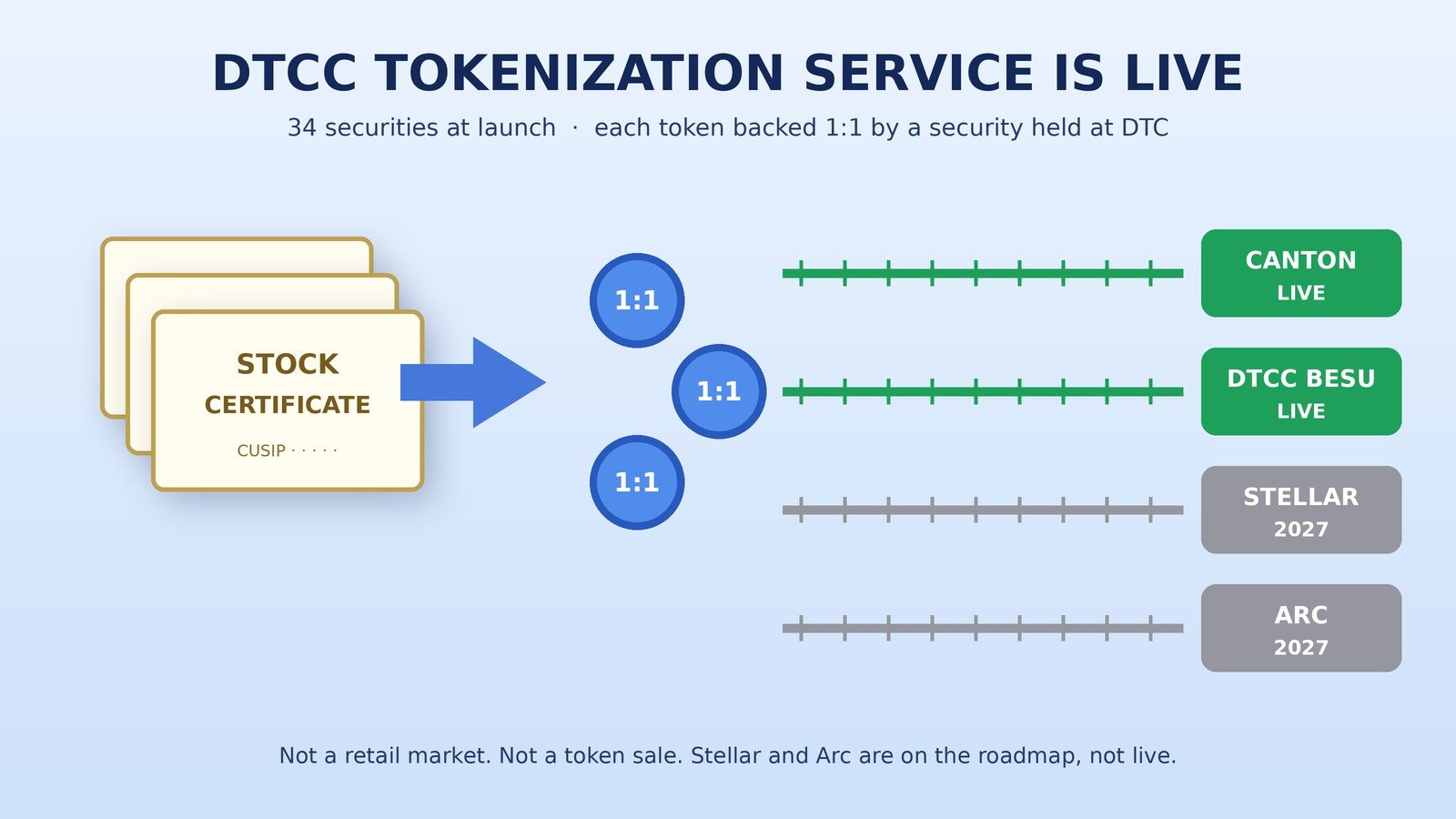
    The Depository Trust & Clearing Corporation says its Tokenization Service is now live. As of Wednesday morning, DTCC’s product page lists 34 securities available to tokenize at launch.

    What it does. The service lets eligible DTC participants convert certain securities they already hold at DTC into tokens. According to DTCC, each token is backed one-for-one by the security held at DTC, keeps the same CUSIP identifier, and carries the same legal rights and economic interests as the underlying security. Tokens can move between DTC-registered wallets around the clock, but only within the same network.

    What it doesn’t do. This is not a new market open to retail investors, and it is not a public token sale. DTCC describes it as a voluntary service for DTC participants. It operates under a Securities and Exchange Commission no-action letter issued in December 2025, which covers a three-year authorization period. DTCC also says built-in token controls support compliance and near real-time ownership tracking.

    Scale, in context. DTCC’s page puts assets under custody at DTC at about $30 trillion. That is the pool the service draws from, not the amount tokenized. The launch list of 34 securities is a small starting set, and DTCC has not published usage figures.

    Which networks. DTCC’s Day 1 tear sheet, dated Oct. 23, lists Canton and DTCC’s private Besu network as live at launch. It shows Stellar and Circle’s Arc as “anticipated in 2027” and calls the roadmap “indicative and subject to change.” Wallet providers shown on DTCC’s page include BitGo, Blockdaemon, Fireblocks, HashKey, Kaleido, Talos and Tradeweb.

    Stellar’s week. Separately, Securitize said Wednesday it plans to integrate the Stellar network, which it called its 17th supported network. It gave no timeline and named no first products. On Tuesday, Janus Henderson and Centrifuge launched JQQQ, a Nasdaq-100 fund issued on Stellar for non-U.S. professional investors; as of Tuesday afternoon, Centrifuge’s fund page said it was still “seeding” and not yet open for investment. Neither announcement is connected to DTCC’s service.

    What to watch. How quickly the list grows beyond 34 securities, how much participants actually tokenize, and whether the 2027 network additions hold to schedule.

    Sources: DTCC, DTCC tear sheet, Securitize (PR Newswire), Janus Henderson, Centrifuge, CoinDesk.

  • Ripple’s Swell Pitch Is Plumbing, Not Price

    Ripple’s Swell Pitch Is Plumbing, Not Price

    Opinion. If you came to Ripple’s Swell conference on Tuesday hoping for a moonshot, day one let you down. If you came to see whether Wall Street will actually use Ripple’s rails, it delivered more than the hype accounts will give it credit for.

    Start with BNY. The world’s largest custody bank says its digital asset custody platform now holds XRP and Ripple’s dollar stablecoin, RLUSD, for eligible institutional clients. The two firms also say they intend to let BNY clients mint and redeem RLUSD directly through the bank, but that part is a plan, not a live service, and the release marks it that way.

    Then Robinhood. It plans to settle institutional trades in RLUSD on the XRP Ledger and to run its own treasury on Ripple Treasury. RLUSD is already live on Robinhood Chain and on Bitstamp by Robinhood. Separately, C2FO plans to settle Instant Pay supplier payments in RLUSD on the XRP Ledger and is taking sign-ups through a waitlist.

    None of that is exciting, and that’s the point. Custody, settlement and treasury management are the pipes behind the wall. Nobody throws a party for pipes, but nothing in the building works without them. No deal sizes were disclosed, and nobody on stage made a promise about XRP’s price.

    Speculation, labeled: if these pipes work at scale, the boring stuff may matter more for Ripple’s future than any headline price move. A bank that holds your asset, a broker that settles in your stablecoin and a treasury desk running on your software are harder to replace than a rally is to repeat.

    Now the part that deserves a second look. American Banker reports that Treasury Secretary Scott Bessent, speaking with Ripple CEO Brad Garlinghouse on stage, said dollar-backed stablecoins could become an important source of demand for Treasuries as adoption grows, especially overseas. He didn’t put a number or a date on it.

    Speculation, labeled: that tells you why Washington warmed up to stablecoins. It isn’t only about innovation or your freedom to move money. Every dollar stablecoin backed by government debt is another buyer for that debt. That isn’t a conspiracy. The Treasury Secretary said it out loud. But it means the government’s interest and the crypto user’s interest won’t always line up, and holders should remember who benefits when the rules get written.

    So judge Swell by what goes live, not what gets applauded. Watch whether BNY’s mint-and-redeem plan actually launches, whether Robinhood’s RLUSD settlement shows real volume, and whether C2FO’s waitlist turns into paid suppliers. The pipes are the story this week. Price can wait.

    This is opinion, not investment advice.

    Sources: Ripple, BNY (via Business Wire), C2FO, Robinhood, American Banker.

  • At Swell, BNY and Robinhood Take Bigger Roles With Ripple’s RLUSD and XRP

    At Swell, BNY and Robinhood Take Bigger Roles With Ripple’s RLUSD and XRP

    Ripple opened its Swell conference in New York on Tuesday, Oct. 27, with two expanded partnerships announced the same morning: one with BNY, and one with Robinhood. Both rest on Ripple’s dollar stablecoin, RLUSD, and on the XRP Ledger. Neither release discloses a deal size.

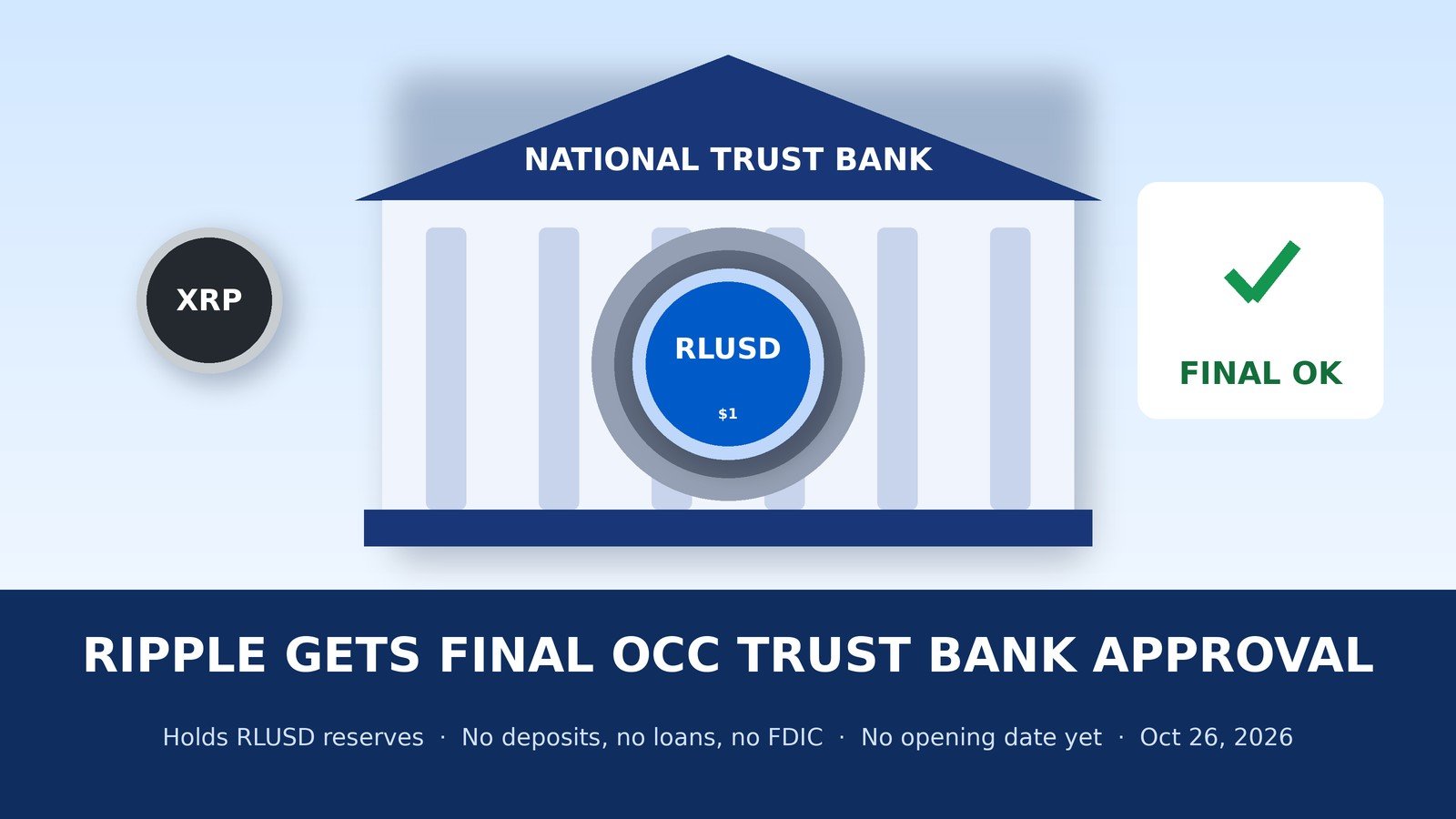
    The news follows Monday’s final OCC approval for Ripple National Trust Bank, which will manage RLUSD’s reserves. That trust charter takes no deposits, makes no loans, has no FDIC insurance, and has no opening date yet.

    BNY: custody for XRP and RLUSD

    • BNY’s Digital Asset Custody platform now supports XRP and RLUSD for eligible institutional clients, the companies said in a Business Wire release.
    • BNY was already the primary reserve custodian for RLUSD and holds assets for Ripple Prime. The expansion adds client custody of the tokens themselves, not only of the dollar reserves behind the stablecoin.
    • BNY and Ripple say they intend to let BNY clients mint and redeem RLUSD directly through BNY. The release marks that step with an asterisk as a future plan. It is not live, and no launch date was given.
    • BNY also intends to broaden support for tokenized assets issued on the XRP Ledger as use cases develop.

    “We’re moving past the initial issuance of assets onchain – now, it’s all about making these tokenized assets usable for payments and collateral across financial markets,” Ripple President Monica Long said.

    Trade finance: exploratory with BNY, waitlist with C2FO

    Ripple and BNY also said they intend to advance tokenized trade finance on the XRP Ledger, “subject to client requirements.” As a first step, they are exploring a supply-chain finance initiative with C2FO, a working-capital platform. That work is exploratory, not a live book of business.

    Separately, C2FO plans to settle Instant Pay supplier payments on the XRP Ledger in RLUSD, in seconds rather than days, and is taking sign-ups through a waitlist. The release does not say Instant Pay is live.

    Robinhood: RLUSD, treasury and prime brokerage

    • RLUSD is live now on Robinhood Chain and on Bitstamp by Robinhood. It is expected in the main Robinhood app later this year, according to a Ripple–Robinhood release. The releases do not say XRP is being added to the Robinhood app.
    • Robinhood plans to use RLUSD on the XRP Ledger to settle institutional trades through Bitstamp by Robinhood.
    • Robinhood will integrate Ripple Treasury to run its own cash, liquidity, forecasting, payments, risk management and intercompany netting.
    • Ripple Prime already provides Bitstamp with lending and margin financing across about 20 digital assets and gives Ripple Prime clients access to trade spot on Bitstamp. Support for perpetual futures on Bitstamp is planned for later in the year.

    “Utility is what moves stablecoins forward,” said Johann Kerbrat, SVP and general manager of Robinhood Crypto and International.

    What it is not

    None of these releases says BNY clients can mint or redeem RLUSD today, that tokenized trade-finance volume is live on the XRP Ledger, or that XRP is coming to the Robinhood app. No dollar amounts were disclosed for either partnership. Figures for RLUSD’s market size vary slightly across the same day’s releases, so this piece does not treat any single number as settled fact.

    Sources: Business Wire, Ripple, Robinhood, C2FO, BNY, Office of the Comptroller of the Currency.

  • Washington Gave Ripple a Bank Charter. It Gave Your Hometown Bank Homework.

    Washington Gave Ripple a Bank Charter. It Gave Your Hometown Bank Homework.

    Monday was a big day at the Office of the Comptroller of the Currency. Two moves, same day, and they tell you a lot about who Washington is building this new money system for.

    Move one: Ripple got final approval for a national trust bank to hold the reserves behind its dollar stablecoin, RLUSD. A federal charter. A seat at the table.

    Move two: the OCC posted on X that community banks are “encouraged to consider applying” to become stablecoin issuers under the GENIUS Act. A suggestion. A to-do list.

    One side got a charter. The other side got homework.

    Who’s actually inside the gate

    Circle got its final trust charter in July. Ripple got its final charter Monday. Coinbase, Crypto.com and Bridge are holding earlier-stage approvals. The OCC’s stablecoin rule doesn’t even take effect until Jan. 18, 2027, and applications under it haven’t opened yet.

    So the biggest players are already through the gate while your hometown bank is being told to “consider” starting the paperwork.

    And the hometown banks are not cheering. Their trade group, the Independent Community Bankers of America, sued the OCC on Oct. 2. They say these trust charters are “a side door into the banking system” — banks without deposit insurance, under a regulator that, by the ICBA’s count, hasn’t run an uninsured bank receivership in almost 100 years.

    The fine print

    Here’s what most people scrolling past the headline won’t hear: a national trust bank is not the bank on Main Street. It doesn’t take deposits. It doesn’t make loans. There’s no FDIC sticker on the door.

    That doesn’t mean RLUSD is unsafe. Ripple says the reserves are segregated, BNY is the main custodian, and it publishes monthly attestations. Those are real protections. But they are not deposit insurance, and holders should know the difference before anyone sells them “bank-grade” as if it meant “FDIC.”

    Speculation, clearly labeled

    This part is my opinion, not reported fact. My hunch is that by the time the GENIUS rule switches on in January, the dollar-token market will already have a short list of federally blessed issuers, and the “community bank stablecoin” will mostly mean small banks renting a big issuer’s coin and its plumbing. Washington gets to say it opened the door to everyone. The firms that walked in first get the customers.

    Nobody needs a secret plan for that to happen. Being first through a regulator’s door has always been worth more than a press release telling everyone else the door exists.

    Crypto was supposed to cut out the gatekeepers. Watch who’s holding the keys now.

    Sources: Ripple, Office of the Comptroller of the Currency, PYMNTS, Independent Community Bankers of America, Cointelegraph, The Block, Decrypt.

  • Ripple Gets Final OCC Approval for a National Trust Bank. Here’s What It Can and Can’t Do

    Ripple Gets Final OCC Approval for a National Trust Bank. Here’s What It Can and Can’t Do

    The Office of the Comptroller of the Currency (OCC) has given final approval to Ripple National Trust Bank, a federally chartered national trust bank that will manage the reserves behind Ripple’s dollar stablecoin, RLUSD. Ripple announced the approval on Monday, Oct. 26, the evening before its Swell conference opens in New York (Oct. 27–29).

    Ripple applied in July 2025 and received conditional approval on Dec. 12, 2025. Monday’s decision moves the charter from conditional to final.

    What the trust bank is approved to do

    • Manage RLUSD’s segregated reserve assets.
    • Act as collateral trustee on behalf of RLUSD holders.
    • Provide fiduciary digital asset custody for enterprise clients.

    RLUSD itself will still be issued by Standard Custody & Trust Company, Ripple’s trust company regulated by the New York Department of Financial Services. Ripple says that puts RLUSD under both state and federal oversight. Ripple puts RLUSD’s market value at about $2.5 billion; CoinGecko showed about $2.6 billion on Tuesday morning. BNY is the primary custodian of RLUSD’s reserves, and Ripple publishes monthly attestations.

    “For years, we’ve said crypto and banks work better together. Final approval for Ripple National Trust Bank is what that looks like in practice,” CEO Brad Garlinghouse said.

    What it is not

    A national trust bank is not a commercial bank. Trust banks of this kind do not take deposits or make loans, and they do not carry FDIC deposit insurance. Ripple’s release describes what the bank will do “once open” and gives no opening date.

    The approval does not involve any purchase or sale of XRP. RLUSD is a dollar-backed stablecoin. XRP traded near $1.30 Tuesday morning, up less than 1% over 24 hours, per CoinGecko.

    Where it fits

    Circle received final OCC approval for its national trust bank in July. Coinbase holds a preliminary approval from April, and Crypto.com and Bridge received conditional approvals in February.

    The same day, the OCC separately urged community banks to consider applying, directly or through a subsidiary, to become permitted payment stablecoin issuers under the GENIUS Act. The OCC’s final GENIUS Act rule takes effect Jan. 18, 2027; applications open after the paperwork is cleared by the Office of Management and Budget.

    The charter program faces a court challenge. On Oct. 2, the Independent Community Bankers of America (ICBA) sued the OCC in federal court in Washington, D.C., challenging the agency’s March 2026 chartering rule, a related interpretive letter, and one firm’s conditional trust bank approval. The ICBA argues that uninsured trust banks give crypto firms “a side door into the banking system.” The case is pending.

    What to watch

    • An opening date for Ripple National Trust Bank.
    • Any RLUSD or bank-related announcements at Swell this week.
    • Rulings in the ICBA case against the OCC.
    • Final decisions on the remaining conditional charters.

    Sources: Ripple, Business Wire, Office of the Comptroller of the Currency, CoinDesk, Decrypt, The Block, Cointelegraph, PYMNTS, CoinGecko.