Blog

  • Standard Chartered Signs Deal to Own Its Crypto Custodian Outright. Here’s What Changes for Clients

    Standard Chartered Signs Deal to Own Its Crypto Custodian Outright. Here’s What Changes for Clients

    Standard Chartered said Wednesday it has signed definitive agreements to buy all of Zodia Custody, an institutional crypto custodian, and bring the business inside the bank.

    The buyer is Standard Chartered I H Limited. The target is Zodia Custody Limited, the parent of regulated operating companies in Singapore, Hong Kong, Australia, the United Arab Emirates and Luxembourg. The deal still needs regulatory approvals and customary closing conditions. The bank didn’t disclose a price or a completion date.

    After closing, Zodia’s custody business will be merged into the digital asset custody Standard Chartered already runs inside its Securities Services business. The bank says the aim is a single offering that covers both traditional and digital securities services for institutional clients.

    The deal also splits Zodia in two. Its software and professional-services arm moves to a new, independent company, Zodia Solutions, set up under SC Ventures, the bank’s venture unit. Listed backers include Northern Trust, NAB Ventures, SBI Ventures, Emirates NBD and Investcorp’s Zodia Investments. Standard Chartered will be one of its customers.

    For clients, the bank says it expects no disruption and that existing custody clients will “continue to be serviced as usual.” The bigger change comes later. Once the deal closes, those clients’ crypto will sit with a unit of a global bank listed in London and Hong Kong rather than with a separately owned company. Institutions that use Zodia may want to review the change-of-control terms in their agreements and confirm which company will supply the technology after closing.

    The deal has taken longer than planned. Zodia’s shareholders and noteholders accepted the bank’s non-binding offer in May, and definitive agreements were first targeted for the end of June with completion by the end of August, The Block reported. Zodia’s chief executive, Julian Sawyer, stepped down in September, and former chief revenue officer Richard Clark now runs the company.

    Standard Chartered is also building custody on its own. Earlier this month it said it plans to launch crypto custody in Singapore by the end of 2026, according to The Block.

    “Custody is increasingly becoming part of the global banking landscape,” Clark said in the bank’s release.

    What to watch next: approvals in each of the five jurisdictions, whether a price is ever disclosed, and whether clients see any change in fees or terms after closing.

    Sources: Standard Chartered; The Block
  • Wall Street’s Biggest Names Don’t Want Their Stock Trading at 3 A.M. Ask Who That Protects

    Wall Street’s Biggest Names Don’t Want Their Stock Trading at 3 A.M. Ask Who That Protects

    Opinion. Imagine it’s 3 a.m. on a Sunday. Big news breaks. You want to buy or sell a slice of Microsoft right now, not on Monday morning. A new venue backed by the owner of the New York Stock Exchange says it can make that happen. Microsoft, Alphabet and Goldman Sachs have officially said: not with our stock.

    First, what’s real

    OKXICE is a 50-50 joint venture between crypto exchange OKX and Intercontinental Exchange, the NYSE’s parent. It wants to run a “tokenized securities venue” that trades blockchain versions of U.S. stocks 24 hours a day, seven days a week. Each token is paired with a dollar stablecoin, either USDC, USDG or USDT, and trades in Uniswap v4 pools on OKX’s XLayer network, according to the venue’s public notice.

    The SEC opened this door last month with a temporary exemption. The catch: companies get 30 days after being notified to object. If they object, their token can’t trade on that venue under the exemption.

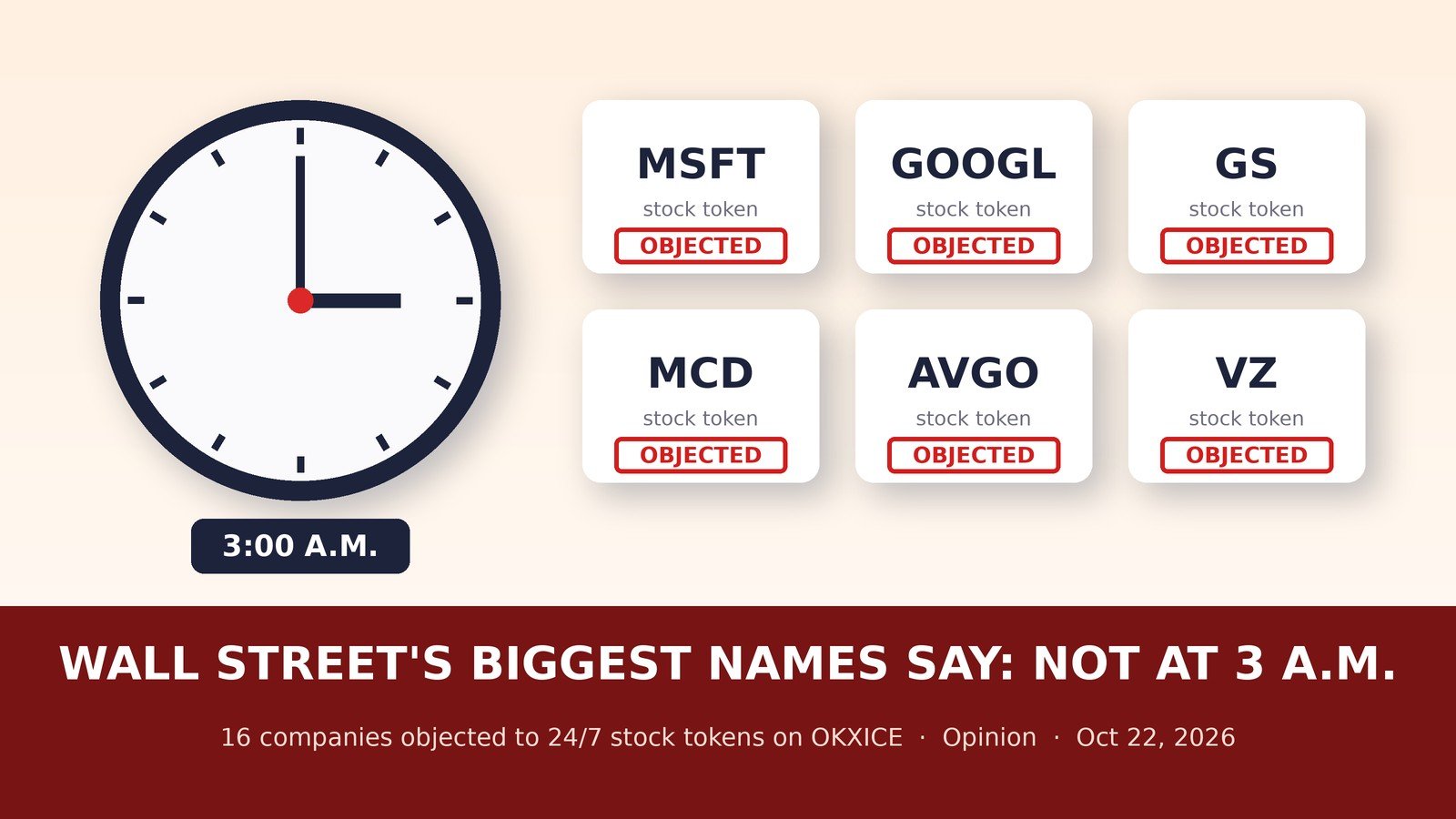
    As of OKXICE’s Oct. 19 notice, 16 companies had objected: Cerebras, AppLovin, Applied Digital, Rocket Lab, CoreWeave, Verizon, Applied Optoelectronics, Broadcom, UnitedHealth, Goldman Sachs, Microsoft, Qualcomm, Caterpillar, McDonald’s, Western Digital and Alphabet. OKXICE had planned to offer more than 60 stocks. Fortune reports Apple, Nvidia and Amazon are among those that haven’t objected yet, and some companies have until early November.

    Speculation, labeled

    Speculation, labeled: my read is that big companies like a stock market with a bedtime. When the market closes, they get quiet hours to release earnings and let the news sink in. A market that never sleeps takes that cushion away. A lawyer at Morgan Lewis told Fortune exactly that: companies would lose the pause they normally use to announce earnings. That’s a real concern. It’s also a concern about control, not about protecting you.

    Also speculation, labeled: notice who’s on the list. Goldman Sachs isn’t just a stock. It’s one of the biggest trading houses on Wall Street. I can’t prove why Goldman objected. It didn’t say, and neither did 14 of the others. But when the firms that profit most from today’s market plumbing are first in line to say “not yet” to new plumbing, regular people are allowed to raise an eyebrow.

    And let’s not pretend OKXICE is the people’s champion either. It’s co-chaired by former New York Gov. Andrew Cuomo. It’s a joint venture with the NYSE’s own parent. And only wallets holding a special permission token can trade there, its notice says. This isn’t Main Street storming Wall Street. It’s two sets of insiders arguing over who runs the new toll road.

    To be fair

    The objectors have real points. Prices in these pools come from a formula and can drift from the real stock price, especially when trading is thin. Applied Optoelectronics, the only company that explained itself to Fortune, said the effects on its share price, liquidity and volatility are unclear, and that investors might wrongly think it backed the product.

    The objections also don’t stop tokenized stocks from growing. They only block trading on this one venue under this one exemption. Tokenized stock volume on Robinhood Chain jumped to $11.31 billion in September from $526 million in July, CNBC reported, citing Bitwise. Cuomo called the objections “a very natural response” and said many companies want to “wait and see.”

    Fine. But “wait and see” from the biggest names in America sounds a lot like “wait until we figure out how to own it.” If 24/7 trading is coming anyway, the question is simple: does it come built for you, or built for them?

    This is opinion, not investment advice.

    Sources: OKXICE public notice (Oct. 19); SEC; Fortune; CNBC; CoinDesk; Cointelegraph

  • SoFi Launches a Bank ‘Deposit Token’ for Crypto Users: 4.40% Interest, FDIC Insurance, Swaps 1:1 Into Its Stablecoin

    SoFi Launches a Bank ‘Deposit Token’ for Crypto Users: 4.40% Interest, FDIC Insurance, Swaps 1:1 Into Its Stablecoin

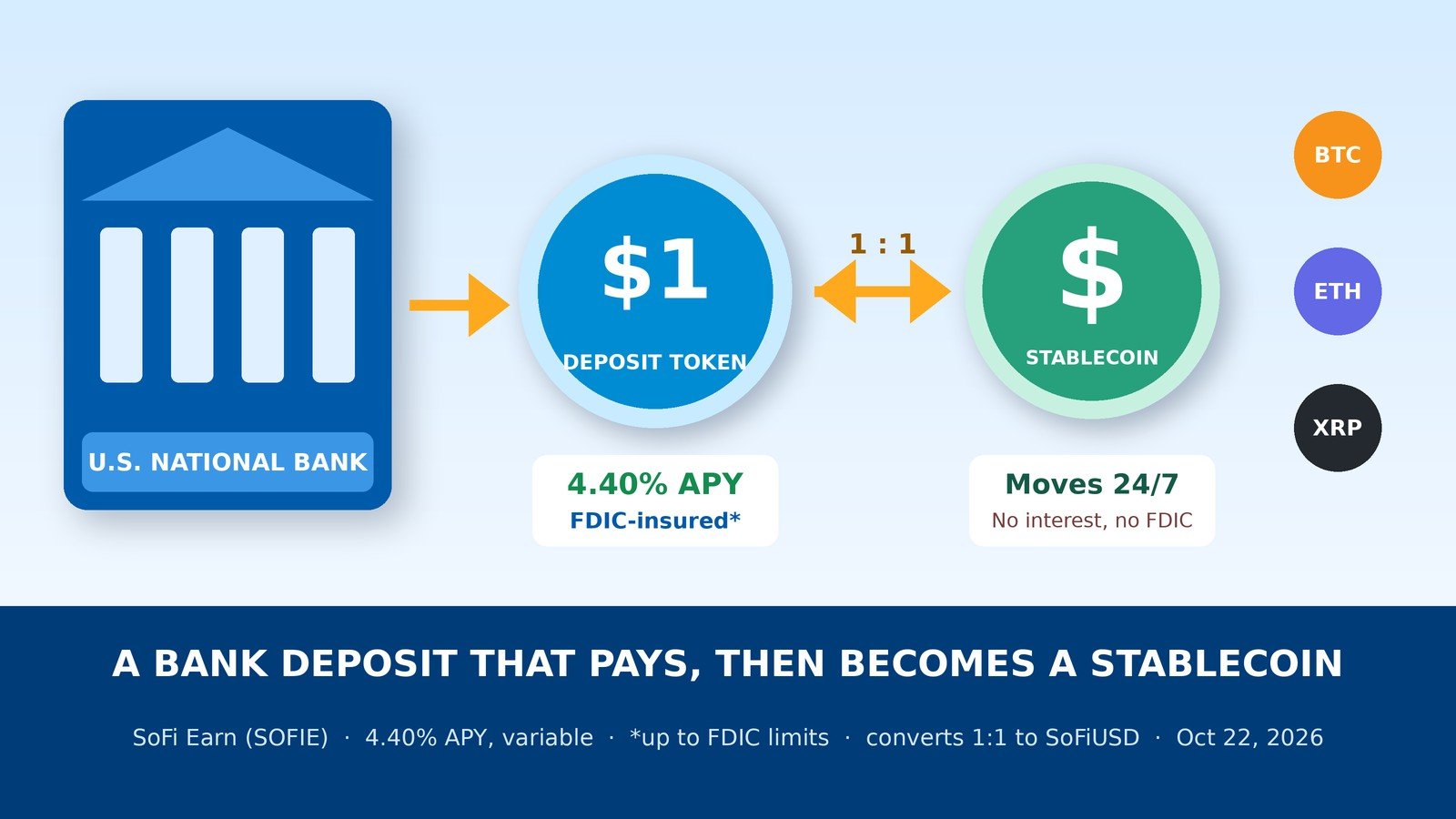
    SoFi on Thursday launched SoFi Earn, a “tokenized deposit” for its crypto customers that pays interest and carries FDIC insurance. The token, called SOFIE, pays a 4.40% annual percentage yield. Each SOFIE stands for $1 held on deposit at SoFi Bank, the company said in its announcement.

    SoFi calls it the first and only tokenized deposit offered to consumers by a U.S. national bank. The rollout to SoFi Crypto members runs through November.

    How it works

    Think of SOFIE as a parking spot for digital dollars. While the money sits in SOFIE, it earns interest and is covered by FDIC insurance up to the usual $250,000 limit per depositor, per bank, for each ownership category.

    When a customer wants to use the money, they convert SOFIE 1:1 into SoFiUSD, the bank’s own stablecoin. SoFiUSD can then buy crypto in the SoFi app, or be sent to a supported outside wallet over blockchain rails at any hour, SoFi said. Customers can also withdraw SOFIE as cash into SoFi Checking and Savings, the company said on X.

    The trade-off is in the fine print. Once the money becomes SoFiUSD, it stops earning that interest, and SoFiUSD is not an FDIC-insured deposit, The Block reported. SoFi’s own disclosure says SOFIE “is not a payment stablecoin.” The 4.40% rate is variable, can change at any time, and was current as of Oct. 20, according to SoFi.

    Why a deposit, not a stablecoin

    The design follows the rules. Under the GENIUS Act, stablecoin issuers may not pay holders interest. The OCC’s final rule under that law, issued Wednesday, keeps that ban for issuers and says rewards paid by others will be judged case by case. It takes effect Jan. 18, 2027.

    A bank deposit is a different legal product. It can pay interest and be insured. By keeping the earning part as a deposit and the moving part as a stablecoin, SoFi offers both, just not in the same token at the same time.

    SoFi makes the pitch directly. CEO Anthony Noto said too much money in the digital asset world “is sitting idle.” The company cited Federal Reserve research estimating that about $64 billion, or 21.2% of the stablecoin market, sits in rarely used, forgotten or inactive wallets.

    The bigger picture

    This is SoFi’s fifth crypto product in less than a year, the company said. It started consumer crypto trading in November 2025 and launched SoFiUSD in December 2025. In September, SoFi began settling card transactions with SoFiUSD on Mastercard’s network, The Block reported. SoFi says it has 15.8 million members.

    Big banks have been testing deposit tokens mostly with business clients. JPMorgan’s JPM Coin, a deposit token for institutional clients, expanded to Ethereum on Monday. SoFi is aiming the same idea at everyday savers.

    SoFi’s announcement did not say which blockchain SOFIE runs on, and it did not describe SOFIE itself moving to outside wallets. Those trips go through SoFiUSD.

    The launch landed on a down morning for crypto. At about 8:15 a.m. ET Thursday, Bitcoin traded near $81,741, Ether near $2,401, XRP near $1.32 and Solana near $104, each down about 2% to 3% over 24 hours, according to CoinGecko. USDC held at about $1.00.

    Sources: SoFi (Business Wire); The Block; SoFi on X; OCC; The Block (JPM Coin); CoinGecko

  • Six Months in Plain Sight: The Drift Hack Money Is Finally Moving

    Six Months in Plain Sight: The Drift Hack Money Is Finally Moving

    Opinion. On Tuesday, after about two months of silence, wallets labeled as the Drift Protocol exploiter sent 25,700 ETH, about $61.6 million, into Tornado Cash over roughly two hours, according to Lookonchain. Arkham data cited by Cointelegraph shows the exploiter’s addresses still holding about 81,450 ETH, worth roughly $194 million. Drift says it lost about $295 million in the April 1 attack on the Solana-based exchange. In June, Drift said a Mandiant investigation attributed the attack to UNC6862, a North Korean threat group.

    Update, Oct. 21: A second batch of ETH from the exploiter’s wallets moved into Tornado Cash on Wednesday morning, so the remaining balance is now lower than the figure above. Trackers differ on the size of the new batch.

    Here’s the part that should bother people. This money hasn’t been hiding. Drift’s own September update laid out the trail: the stolen funds were bridged to Ethereum and split across four wallets holding about 130,259 ETH. One wallet sent about 23,094 ETH to Tornado Cash on July 23. The other three, holding 107,165 ETH, hadn’t moved at all. For six months, everyone could see the wallets, the labels and the balances. Drift says about $9.2 million has been frozen so far. That’s roughly 3% of the loss.

    Tuesday’s move came from that untouched pile. Subtract 25,700 from 107,165 and you land near the 81,450 ETH Arkham still shows, so the numbers line up.

    Don’t let the story turn into “ban the mixer” again. Washington already tried that. Treasury sanctioned Tornado Cash in 2022, then lifted those sanctions in March 2025 after the Fifth Circuit ruled that its immutable smart contracts weren’t property that could be blocked. A state-linked hacking group was always going to find a laundering route. The real question is why nine figures of attributed stolen ether could sit untouched on a public ledger for half a year while the recovery tally barely moved. Speculation, labeled: freezing works at the edges, at exchanges and stablecoin issuers, and patient attackers simply wait until attention fades before they walk through the middle. Tuesday looks like that playbook.

    The victims are left with a bounty program and a recovery pool. Drift has partnered with Bybit on a 10% bounty for recovered funds, and its DFX recovery tokens opened for claims on October 1, backed by a pool that held about $3.1 million at launch. That’s a long way from $295 million.

    Now the market angle, and it’s all speculation, labeled: money that goes into a mixer usually doesn’t hit the order book right away. It comes out in pieces and often gets swapped into other assets through bridges or over-the-counter desks. If the remaining ~81,500 ETH follows, that’s about $194 million that could eventually be sold. That’s a real number, but it’s spread over weeks or months and set against a deep ETH market. Watch the outflows and the bridges. Don’t treat one headline as a sell signal.

    Hardwire’s read: give the on-chain sleuths credit, because they caught this in real time. Then ask why catching it isn’t the same as stopping it. Six months of open-ledger visibility recovered about 3% of the loss. That isn’t a privacy problem. It’s an enforcement problem.

    This is opinion, not investment advice.

    Sources: Cointelegraph; Lookonchain; Lookonchain; Arkham

  • U.S. Bank Regulator Finalizes First Stablecoin Rulebook: Two-Day Redemptions, No Automatic Freeze, Rewards Judged Case by Case

    U.S. Bank Regulator Finalizes First Stablecoin Rulebook: Two-Day Redemptions, No Automatic Freeze, Rewards Judged Case by Case

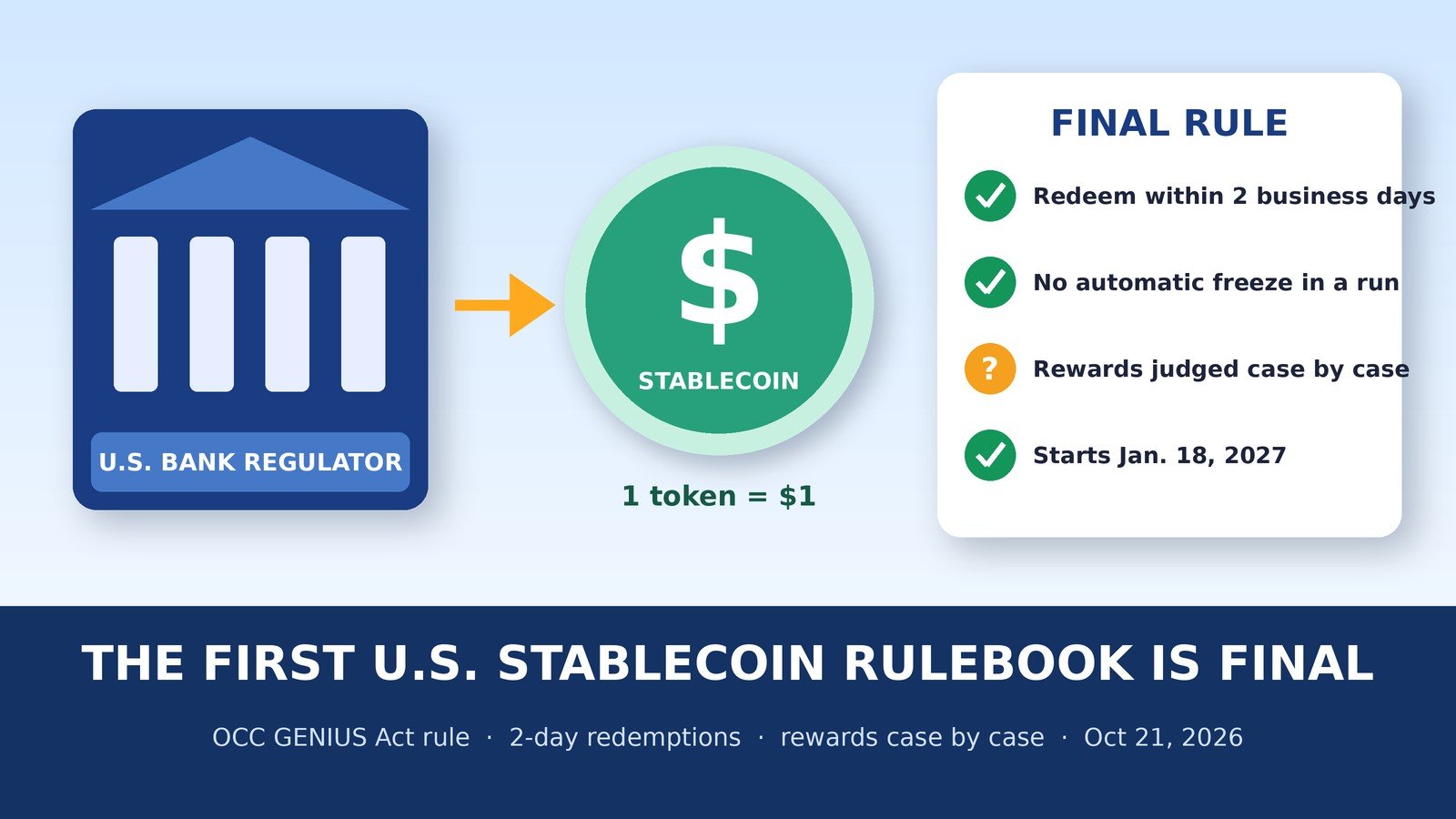
    The first U.S. rulebook for stablecoin issuers is final. On Wednesday, Oct. 21, the Office of the Comptroller of the Currency (OCC), which regulates national banks and federal trust banks, issued its final rule putting the GENIUS Act into practice. The rule and the law both take effect on Jan. 18, 2027. CoinDesk reported that the OCC is the first federal agency to finish its GENIUS Act rules. Other regulators are still writing theirs.

    The rule covers stablecoin issuers that fall under the OCC: subsidiaries of national banks and federal savings associations, federally chartered issuers, certain state-qualified nonbank issuers, and foreign issuers. It also covers some crypto custody done by OCC-supervised firms. Anti-money-laundering and sanctions rules are not in this package. The OCC said those will come in a separate rule written with the Treasury Department.

    What changed from the draft

    The OCC first proposed the rule on March 2, 2026, and received about 328 comments. The final version changes three things that matter to users.

    1. Stablecoin rewards will be judged case by case. The GENIUS Act bans issuers from paying interest or yield to holders “solely in connection with” holding, using or keeping a stablecoin. The draft would have presumed that certain payments through affiliates and related third parties broke that ban unless the issuer proved otherwise. The final rule drops that presumption. The OCC said it will “apply the language of the statute to the facts and circumstances” of each arrangement. It also declined to give a list of allowed or banned setups, declined a small-payments exemption, and said rewards programs that existed before the law “will be evaluated the same” as new ones. The OCC said it keeps its power to act against arrangements that try to evade the ban.

    2. No automatic redemption freeze. Issuers must pay out redemptions within two business days. The draft would have stretched that to seven calendar days automatically if holders asked to redeem more than 10% of a stablecoin’s supply in 24 hours. The OCC removed that, saying an automatic extension “could prove pro-cyclical and trigger or exacerbate runs.” Instead, an issuer that crosses the 10% line must notify the OCC within 24 hours and may ask for more time. The OCC said it expects such extensions to be “rare.”

    3. A smaller cash buffer. The draft required issuers to keep at least 10% of reserves as cash on demand, in bank deposits or at the Federal Reserve. The final rule lowers that to 5%, pointing to new stress-testing and liquidity planning requirements.

    What it means

    For banks, this is the operating manual for issuing a regulated dollar stablecoin under federal supervision. The OCC said it will announce separately when it starts taking applications. Under the law, firms with a pending application when the law takes effect can ask for a waiver of up to 12 months.

    For crypto users, the open question is rewards. Exchanges that pay customers for holding stablecoins get no safe harbor. Whether a given program passes will depend on how the OCC reads the word “solely,” one case at a time. CoinDesk noted the agency signaled that a reward paid “at least in part” for other reasons may fall outside the ban.

    The stakes are growing. Stablecoin transfers reached about $891 billion in the third quarter, according to a Coinbase and The Block study published this week.

    Treasury Secretary Scott Bessent called the GENIUS Act “a watershed moment in American finance.” Comptroller Jonathan Gould said the rule sets “strong standards for reserve backing, redemption, and risk management.”

    A practical note: nothing changes for stablecoin holders today. The rules apply from Jan. 18, 2027.

    Sources: Office of the Comptroller of the Currency (news release); OCC final rule; CoinDesk; The Block

  • Your Savings Bank Now Sells XRP. It Also Keeps the Keys

    Your Savings Bank Now Sells XRP. It Also Keeps the Keys

    Opinion. Germany’s savings banks spent years telling customers crypto was too risky to touch. On Monday, the first of them started selling it right inside the banking app. Bitcoin, Ether, XRP, Solana, Polygon. Ninety-nine cents an order. Sounds like a win for crypto. Read the fine print first.

    First, what’s real

    The service, “Krypto – powered by Deka,” runs through DekaBank, the securities house of the Sparkassen. Westen’s desk has the straight write-up. Read that first.

    The key facts come from DekaBank’s own product page. Your coins sit in a shared “omnibus” wallet. DekaBank holds the private keys in trust. And coins can only be sent out to wallet addresses of certain licensed crypto service providers. Sending them anywhere else, like a hardware wallet in your drawer, is excluded.

    The €0.99 fee is real, and it’s cheap on bigger orders. But your price also includes a DekaBank spread on top of a market reference price, and the published documents don’t put a number on it, as CryptoCompass pointed out. According to that report, the price list also says pricing can be adjusted, for example through the spread, when volumes are large or markets get wild.

    Speculation, labeled

    Speculation, labeled: my read is the banks didn’t fall in love with crypto. They watched younger customers buy it at Trade Republic, N26 and Revolut, and decided it was better to keep that money in the house. The savings banks association more or less says so itself: it points to customer demand.

    Also speculation, labeled: this looks like the template for how big banks tame crypto. You get the price exposure. The bank gets the fee, the spread, the customer and the keys. The one thing crypto was built to give you, holding your own money without asking anyone’s permission, is the one thing this product leaves out. A wallet you can only leave through approved doors starts to look a lot like the bank account crypto was supposed to replace.

    Americans should watch this closely. JPMorgan’s JPM Coin, which just headed to Ethereum, follows the same idea at the institutional level: public blockchain rails, bank-controlled access. I’m not saying anyone coordinated it. Pooled custody is normal at big exchanges too, and rules like the EU’s MiCA push banks toward caution. But when “crypto at your bank” means “the bank holds your crypto, and you leave only through doors it approves,” it’s fair to ask whose freedom just got the upgrade.

    To be fair

    This is a regulated, simple way for ordinary savers to buy a little crypto, with honest warnings about total loss. Sending coins out to an approved provider is free, according to CryptoCompass’s reading of the price list, and many exchanges then let you move coins on to your own wallet. For a lot of people, a bank they already know beats a random offshore app. And it puts XRP, Solana and Polygon in front of a customer base of around 50 million, which some holders will cheer.

    Just know what you’re buying: price exposure, held by the bank. If you want the keys, you’ll have to take the long way around.

    This is opinion, not investment advice.

    Sources: Deka Krypto product page; DekaBank; CryptoCompass; dpa-AFX (via finanzen.net); DSGV; The Block

  • Germany’s Savings Banks Start Selling Crypto in Their App: Bitcoin, Ether, XRP, Solana and Polygon

    Germany’s Savings Banks Start Selling Crypto in Their App: Bitcoin, Ether, XRP, Solana and Polygon

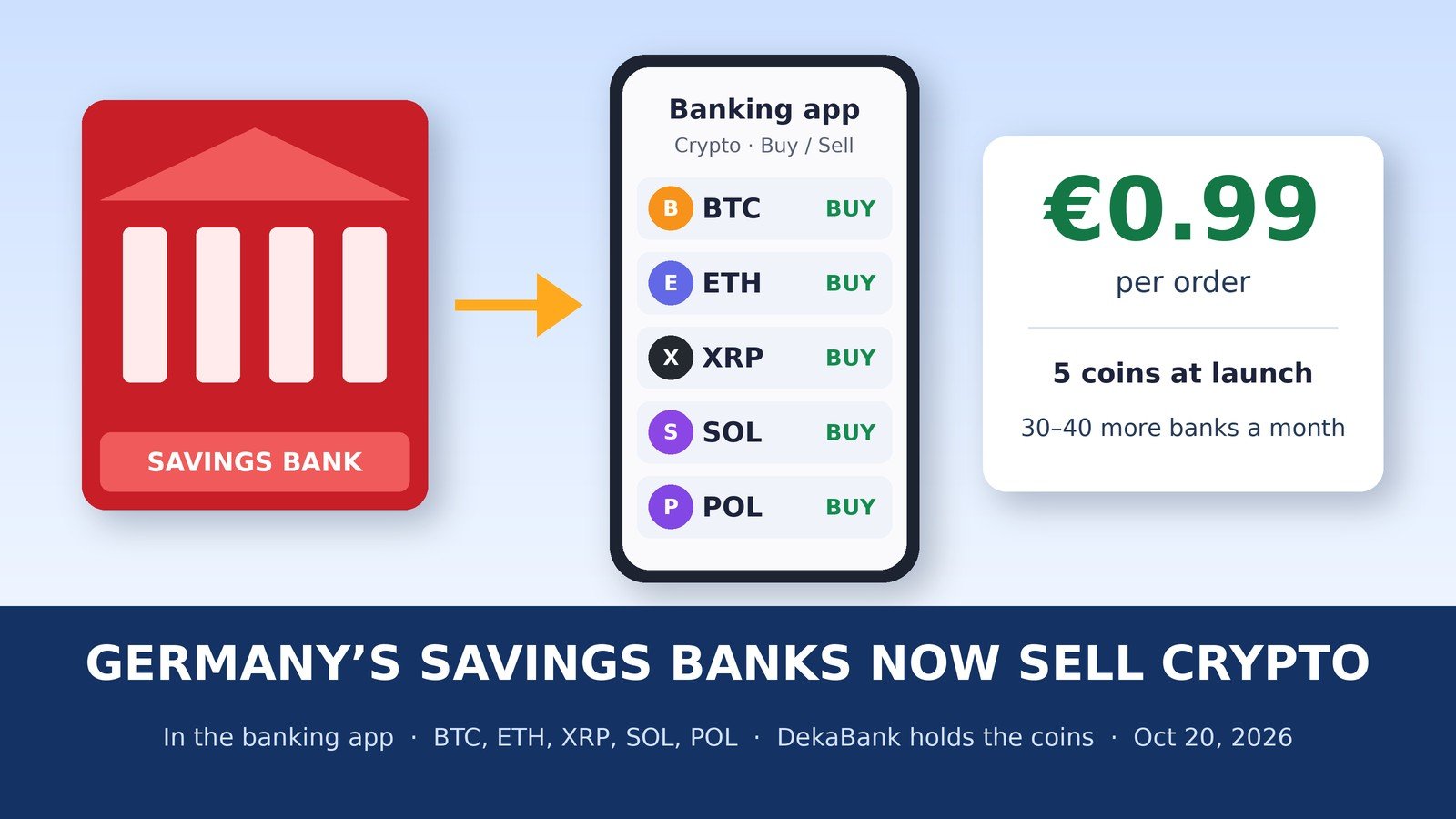
    Germany’s savings banks, the Sparkassen, have started selling crypto inside their everyday banking app. Since Monday, Oct. 19, customers at the first participating banks can buy, sell and hold Bitcoin, Ether, XRP, Solana and Polygon in the app “Sparkasse,” through a service called “Krypto – powered by Deka.”

    The rollout is gradual. Five savings banks went first: Frankfurter Sparkasse, Taunus Sparkasse, Sparkasse Karlsruhe, Sparkasse Rottal-Inn and Niederrheinische Sparkasse RheinLippe, according to the German banking newsletter Platow. The savings banks association, the DSGV, told dpa that 30 to 40 more banks should join each month. There is no single nationwide start date. Each savings bank decides for itself when to switch the service on.

    How it works

    DekaBank, the securities house of the Sparkassen, runs the trading, holds the coins and handles customer support. Customers open a separate crypto account at DekaBank inside the app. A securities account is not required. Each order costs €0.99, DekaBank said in its announcement.

    The fee is not the whole price. DekaBank quotes a price based on a market reference price plus its own spread, and its published documents do not put a number on that spread, CryptoCompass reported after reviewing the bank’s price list.

    Two details matter for anyone used to crypto exchanges. First, the coins sit in a shared “omnibus” wallet, and DekaBank holds the private keys in trust for customers, according to its product page. Second, coins can only be sent out to wallet addresses of certain licensed crypto service providers. Sending them to any other address, such as a personal hardware wallet, is excluded.

    The banks are not pushing it. The offer is for customers who decide on their own: no advice and no broad marketing, the DSGV said. Customers are warned about sharp price swings and the risk of total loss, and crypto holdings are not covered by Germany’s statutory deposit insurance.

    Why it matters

    The Sparkassen-Finanzgruppe says it serves around 50 million customers. Platow reported that more than 200 of the roughly 340 savings banks are considering the offer. Joachim Schmalzl, an executive board member at the DSGV, told dpa the group wants a large share of the interested banks connected in the first half of 2027. He said customer demand and a “reliable European legal framework,” meaning the EU’s MiCA crypto rules, drove the decision.

    For years the savings banks stayed away from crypto as too risky, while app banks such as N26, Trade Republic and Revolut offered it. Germany’s cooperative Volksbanken recently started offering crypto, too. Now the Sparkassen are in.

    The coin list is worth noticing. Next to Bitcoin and Ether, the first five include XRP, Solana and Polygon. At about 8:18 a.m. ET Tuesday, XRP traded near $1.30, Solana near $104 and Ether near $2,383, each down roughly 1% to 2% over 24 hours, according to CoinGecko.

    A practical note: the service only shows up in the app once your own Sparkasse has switched it on. If you don’t see it yet, your bank hasn’t joined.

    Sources: DekaBank; Deka Krypto product page; dpa-AFX (via finanzen.net); Golem; Platow; CryptoCompass; DSGV; CoinGecko

  • France’s Stablecoin-Swap Tax Passed by One Vote. It Isn’t Law, and LCP Says Tuesday’s Budget Vote Will Slip

    France’s Stablecoin-Swap Tax Passed by One Vote. It Isn’t Law, and LCP Says Tuesday’s Budget Vote Will Slip

    France’s National Assembly voted on Friday, Oct. 16, to make swapping crypto into euro- or dollar-pegged stablecoins a taxable event starting Jan. 1, 2027. The margin was one vote, and the measure is still a long way from becoming law.

    Amendment I-3898 to the 2027 finance bill, tabled by Nicolas Sansu of the Democratic and Republican Left group, passed 38 to 37 with 25 abstentions, according to the Assembly’s record of public vote no. 8836. One hundred of the chamber’s 577 deputies took part.

    What the amendment does

    Under current French rules, trading one crypto-asset for another doesn’t trigger tax. The bill comes due when a holder sells for euros or spends. The amendment removes that deferral for swaps that end in “e-money tokens” as defined by the EU’s MiCA regulation, the category that covers single-currency stablecoins such as USDC and EURC. Those gains would fall under France’s existing flat tax on crypto gains. The amendment itself sets no rate; French outlets including Journal du Coin put that tax at 31.4%. The text also changes how gains are counted, using the cost of the specific assets sold rather than France’s current whole-portfolio formula.

    The government opposed it

    Public accounts minister David Amiel asked deputies to withdraw the amendment, telling them that “as things stand, implementing this measure would be too complex,” according to the official record of the sitting. He said stablecoins would first need a clear definition and the tax administration would need a way to trace reallocations inside a portfolio. The finance committee had adopted the measure, although its rapporteur général, Philippe Juvin, said on the floor that he personally considers the current deferral justified given crypto’s volatility.

    What happens next

    The timeline is less settled than several reports suggest. The Assembly’s official agenda, last set by its Conference of Presidents on Oct. 13, still lists a solemn vote on the revenue half of the budget for Tuesday afternoon. But LCP, the Assembly’s own broadcaster, reported Monday that 2,828 of the 3,396 amendments filed remain to be debated and that the vote can’t take place as planned. According to LCP, deputies will resume the revenue section after the social-security budget debate. LCP added that, with no majority in the chamber, the revenue section is more than likely to be rejected. Either way, the bill then goes to the Senate, which can strip the amendment, and a government using Article 49.3 can choose which amendments to keep.

    Hardwire’s Easton argued last week, before the floor vote, that it would tax people for using the very stablecoins Europe’s rules steer them toward.

    What it means for holders

    For holders in France, nothing changes before 2027, and the measure may not survive the process. The amendment names no specific tokens. Several French outlets say it would not reach USDT, which is not authorized under MiCA, but tax authorities have not issued guidance.

    This is a news report on proposed legislation, not tax advice.

    Sources: Assemblée nationale (vote record); Assemblée nationale (amendment I-3898); Assemblée nationale (transcript); LCP; Journal du Coin

  • JPMorgan Wants Ethereum’s Rails. Wall Street Keeps Selling the Ether

    JPMorgan Wants Ethereum’s Rails. Wall Street Keeps Selling the Ether

    Opinion. On Monday the timeline lit up with one headline: JPMorgan is taking its JPM Coin onto Ethereum. Big bank, public chain, 24/7 money. Bullish, right? Then look at what Wall Street has been doing with ether itself.

    First, what’s real

    JPMorgan’s blockchain unit, Kinexys, says its dollar deposit token, JPMD, now supports transfers on Ethereum as well as Base. It is for approved institutional clients only. The bank’s own FAQ says it is “not a cryptocurrency or a stablecoin.” It is a JPMorgan deposit that moves on a blockchain, and only vetted counterparties can touch it. Westen’s desk has the straight write-up. Read that first.

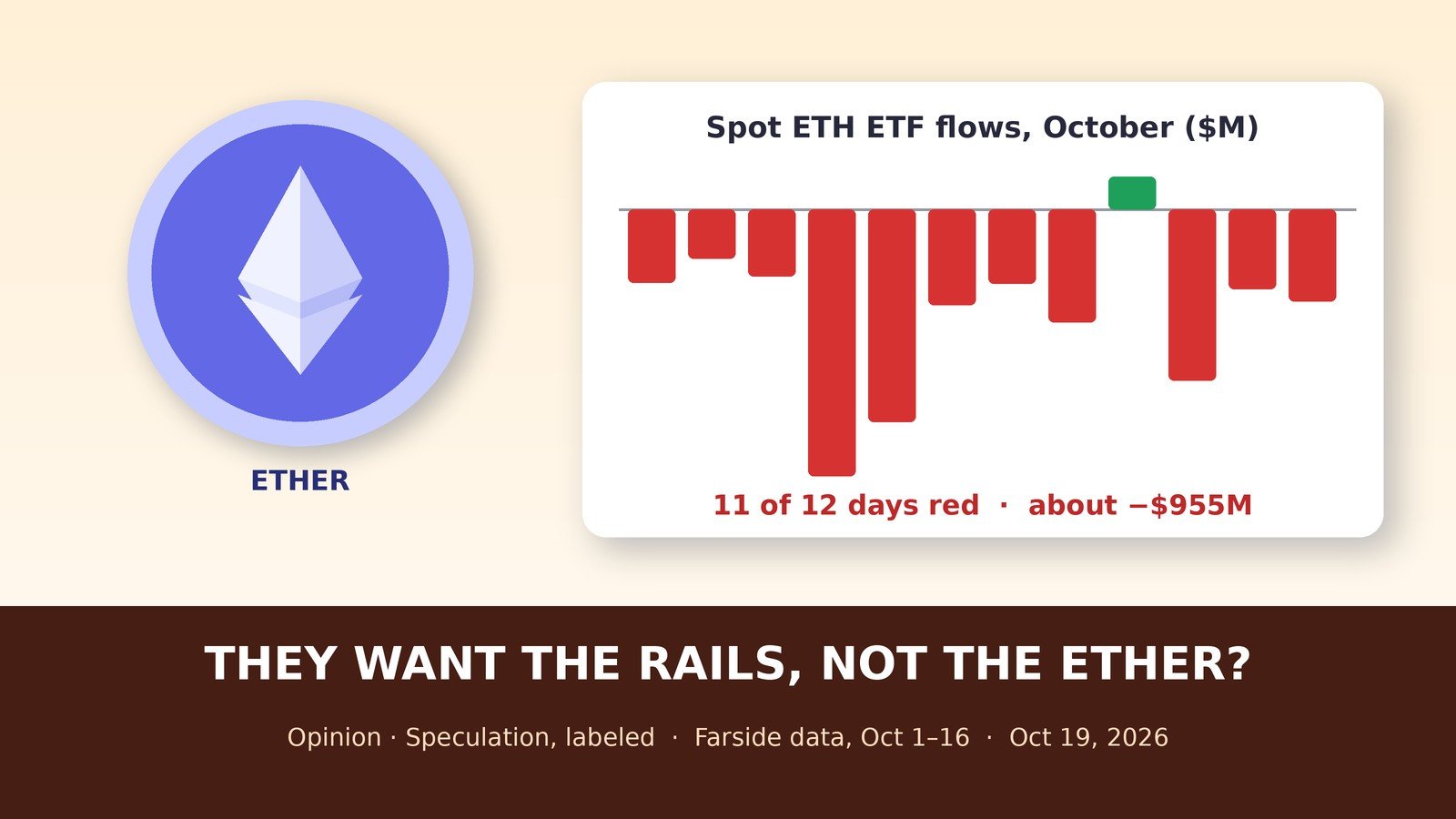
    Now the flows. U.S. spot ether ETFs have seen net outflows on 11 of the 12 trading days in October so far, per Farside Investors data. The total through Oct. 16 is about $955 million out. BlackRock’s ETHA, the biggest ether fund, accounts for roughly $796 million of that. The only green day was Oct. 13, at $24.8 million in.

    Speculation, labeled

    Speculation, labeled: my read is that the big money wants Ethereum’s rails, not its coin. The banks are happy to run their own dollars on the highway. They are much less excited about owning the asphalt.

    Think about who wins in this setup. JPMorgan keeps the deposit, the customer and the interest margin. The token never leaves its banking system. The public chain gets used as plumbing. Meanwhile, the ETF crowd that was supposed to be the steady bid for ether has been heading for the exits almost every day this month.

    I’m not saying anyone is coordinating that. ETF flows have plenty of boring causes: hedge funds unwinding trades, rebalancing, people moving to cash in a rough tape. But when the biggest bank in the country shows up on Ethereum the same month the biggest ether fund keeps redeeming, it’s fair to ask whether “institutions are coming” means what retail thinks it means.

    To be fair

    Every transfer on Ethereum’s main network pays a fee in ether, so real bank traffic would mean some real demand for the coin. JPMorgan also put two tokenized money market funds on Ethereum before this, so it is not a one-off. And a few weeks of outflows can flip fast; ether was trading around $2,420 on Monday morning, up slightly on the day. But if your thesis is “banks on Ethereum means ether goes up,” the ETF tape this month says the banks haven’t signed that part.

    This is opinion, not investment advice.

    Sources: Farside Investors; The Block; CoinDesk; J.P. Morgan Kinexys; Watcher.Guru (X)

  • JPMorgan Takes Its JPM Coin Deposit Token to Ethereum. Here’s What It Is, and What It Isn’t

    JPMorgan Takes Its JPM Coin Deposit Token to Ethereum. Here’s What It Is, and What It Isn’t

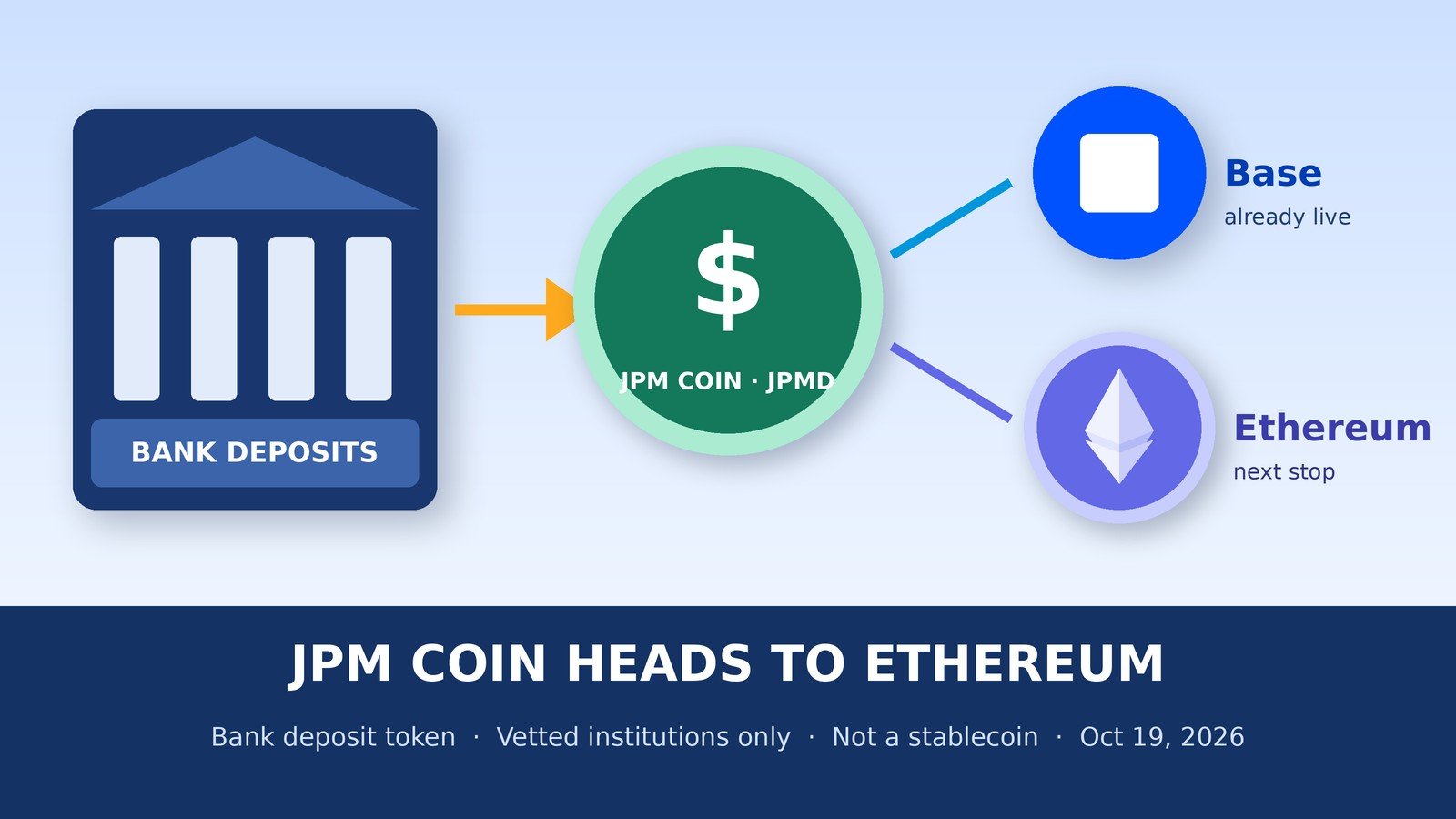
    JPMorgan is taking JPM Coin, its token for dollar deposits at the bank, onto Ethereum. Kinexys, the bank’s blockchain unit, said in a Monday statement shared with The Block that the token, known as JPMD, now supports peer-to-peer transfers across the Ethereum ecosystem, including Ethereum itself and Base, the Coinbase-built network where it launched.

    The token is for approved institutional clients only. It is not something retail users can buy, and it is not listed on exchanges.

    What JPM Coin is

    JPM Coin is a deposit token. Each one represents U.S. dollars sitting in an account at JPMorgan. The bank’s own FAQ says it is “not a cryptocurrency or a stablecoin,” and that clients’ funds “never leave the firm’s regulated banking infrastructure.” Clients move between cash and tokens through accounts at the bank, and only vetted counterparties can transact.

    That is the key difference from a stablecoin like USDC. A stablecoin is issued by a company that holds reserves. JPM Coin is a claim on a bank deposit at the largest U.S. bank, with JPMorgan controlling who can hold it.

    JPMorgan first tested the token on Base in mid-2025 and made it available to institutional clients there in November 2025.

    Why Ethereum, and what’s still unclear

    Kinexys said Ethereum’s “established depth of onchain liquidity and tokenized assets” made it the natural next network. Emma Landriault, global head of Kinexys Labs, told Bloomberg the bank wants to serve crypto firms making blockchain payments and financial firms that need a token to settle trades or back tokenized assets, according to CoinDesk’s summary of that interview.

    One detail is not settled in public yet. CoinDesk, citing Bloomberg, reported that Landriault did not say when JPM Coin would become available on Ethereum. As of Monday morning, JPMorgan’s JPM Coin web page still described the token as issued on Base. Clients should confirm timing and the official token details with the bank directly.

    The bigger picture

    JPMorgan said Kinexys has handled more than $4 trillion in transactions since launch and averages about $7 billion a day. That is still a small slice of the bank’s overall payments business. The bank has also launched tokenized money market funds on Ethereum, the first in December 2025 and a second in May 2026, and said in January it planned to take JPM Coin to the Canton Network as well.

    The move adds to a busy month for bank tokenization. Japan’s three megabanks reported a joint yen stablecoin test, and a U.S. bank, Cross River, added Ripple’s RLUSD to its core banking system. The pattern is the same: big banks are putting regulated money on public blockchains, while keeping control over who gets to use it.

    A safety note: JPM Coin is not sold to the public. Any token calling itself “JPM Coin” on a public trading app or decentralized exchange should be treated as suspect.

    Sources: The Block; CoinDesk; J.P. Morgan Kinexys; J.P. Morgan Payments; TokenPost