
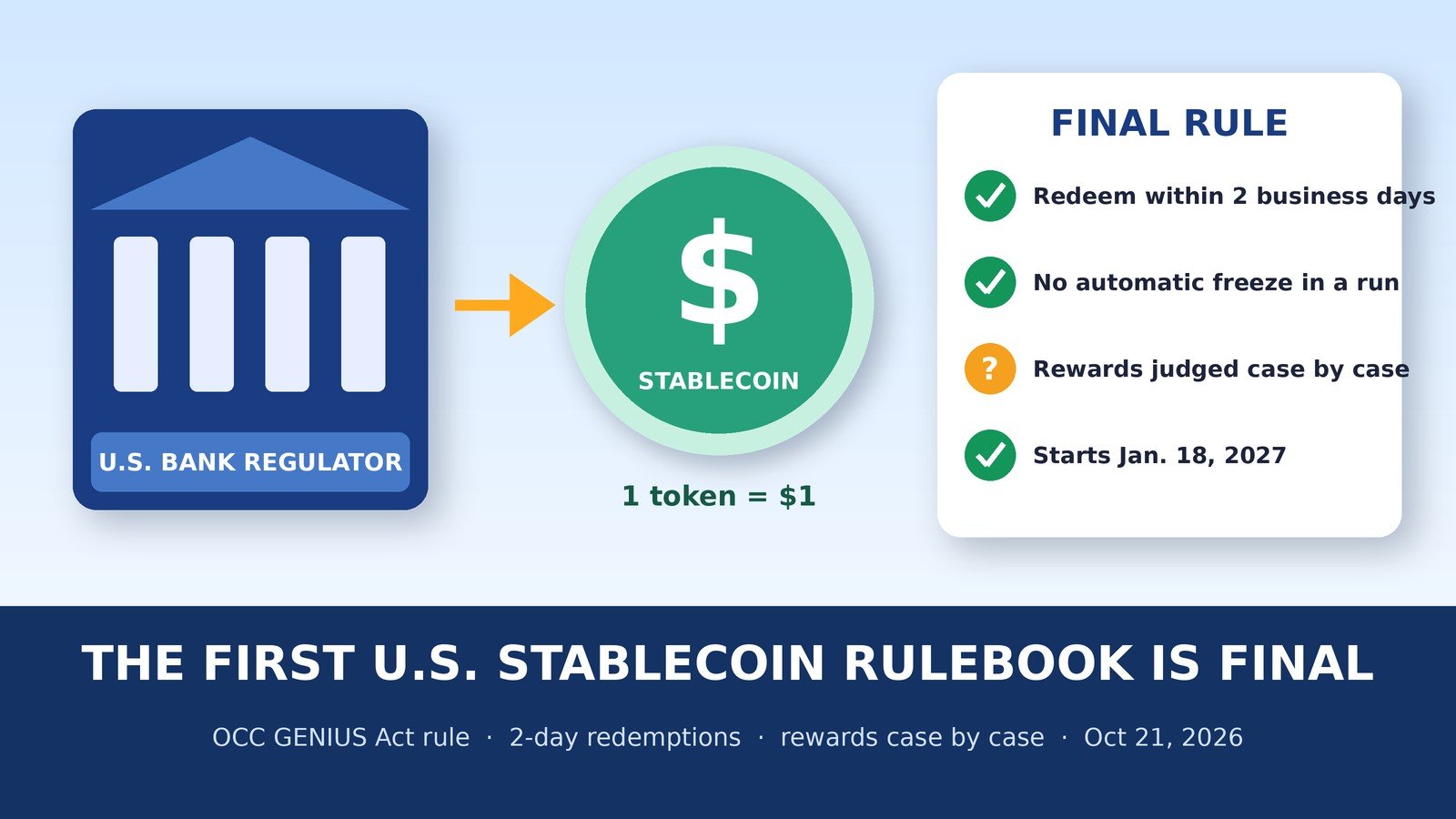
The first U.S. rulebook for stablecoin issuers is final. On Wednesday, Oct. 21, the Office of the Comptroller of the Currency (OCC), which regulates national banks and federal trust banks, issued its final rule putting the GENIUS Act into practice. The rule and the law both take effect on Jan. 18, 2027. CoinDesk reported that the OCC is the first federal agency to finish its GENIUS Act rules. Other regulators are still writing theirs.
The rule covers stablecoin issuers that fall under the OCC: subsidiaries of national banks and federal savings associations, federally chartered issuers, certain state-qualified nonbank issuers, and foreign issuers. It also covers some crypto custody done by OCC-supervised firms. Anti-money-laundering and sanctions rules are not in this package. The OCC said those will come in a separate rule written with the Treasury Department.
What changed from the draft
The OCC first proposed the rule on March 2, 2026, and received about 328 comments. The final version changes three things that matter to users.
1. Stablecoin rewards will be judged case by case. The GENIUS Act bans issuers from paying interest or yield to holders “solely in connection with” holding, using or keeping a stablecoin. The draft would have presumed that certain payments through affiliates and related third parties broke that ban unless the issuer proved otherwise. The final rule drops that presumption. The OCC said it will “apply the language of the statute to the facts and circumstances” of each arrangement. It also declined to give a list of allowed or banned setups, declined a small-payments exemption, and said rewards programs that existed before the law “will be evaluated the same” as new ones. The OCC said it keeps its power to act against arrangements that try to evade the ban.
2. No automatic redemption freeze. Issuers must pay out redemptions within two business days. The draft would have stretched that to seven calendar days automatically if holders asked to redeem more than 10% of a stablecoin’s supply in 24 hours. The OCC removed that, saying an automatic extension “could prove pro-cyclical and trigger or exacerbate runs.” Instead, an issuer that crosses the 10% line must notify the OCC within 24 hours and may ask for more time. The OCC said it expects such extensions to be “rare.”
3. A smaller cash buffer. The draft required issuers to keep at least 10% of reserves as cash on demand, in bank deposits or at the Federal Reserve. The final rule lowers that to 5%, pointing to new stress-testing and liquidity planning requirements.
What it means
For banks, this is the operating manual for issuing a regulated dollar stablecoin under federal supervision. The OCC said it will announce separately when it starts taking applications. Under the law, firms with a pending application when the law takes effect can ask for a waiver of up to 12 months.
For crypto users, the open question is rewards. Exchanges that pay customers for holding stablecoins get no safe harbor. Whether a given program passes will depend on how the OCC reads the word “solely,” one case at a time. CoinDesk noted the agency signaled that a reward paid “at least in part” for other reasons may fall outside the ban.
The stakes are growing. Stablecoin transfers reached about $891 billion in the third quarter, according to a Coinbase and The Block study published this week.
Treasury Secretary Scott Bessent called the GENIUS Act “a watershed moment in American finance.” Comptroller Jonathan Gould said the rule sets “strong standards for reserve backing, redemption, and risk management.”
A practical note: nothing changes for stablecoin holders today. The rules apply from Jan. 18, 2027.
Sources: Office of the Comptroller of the Currency (news release); OCC final rule; CoinDesk; The Block