
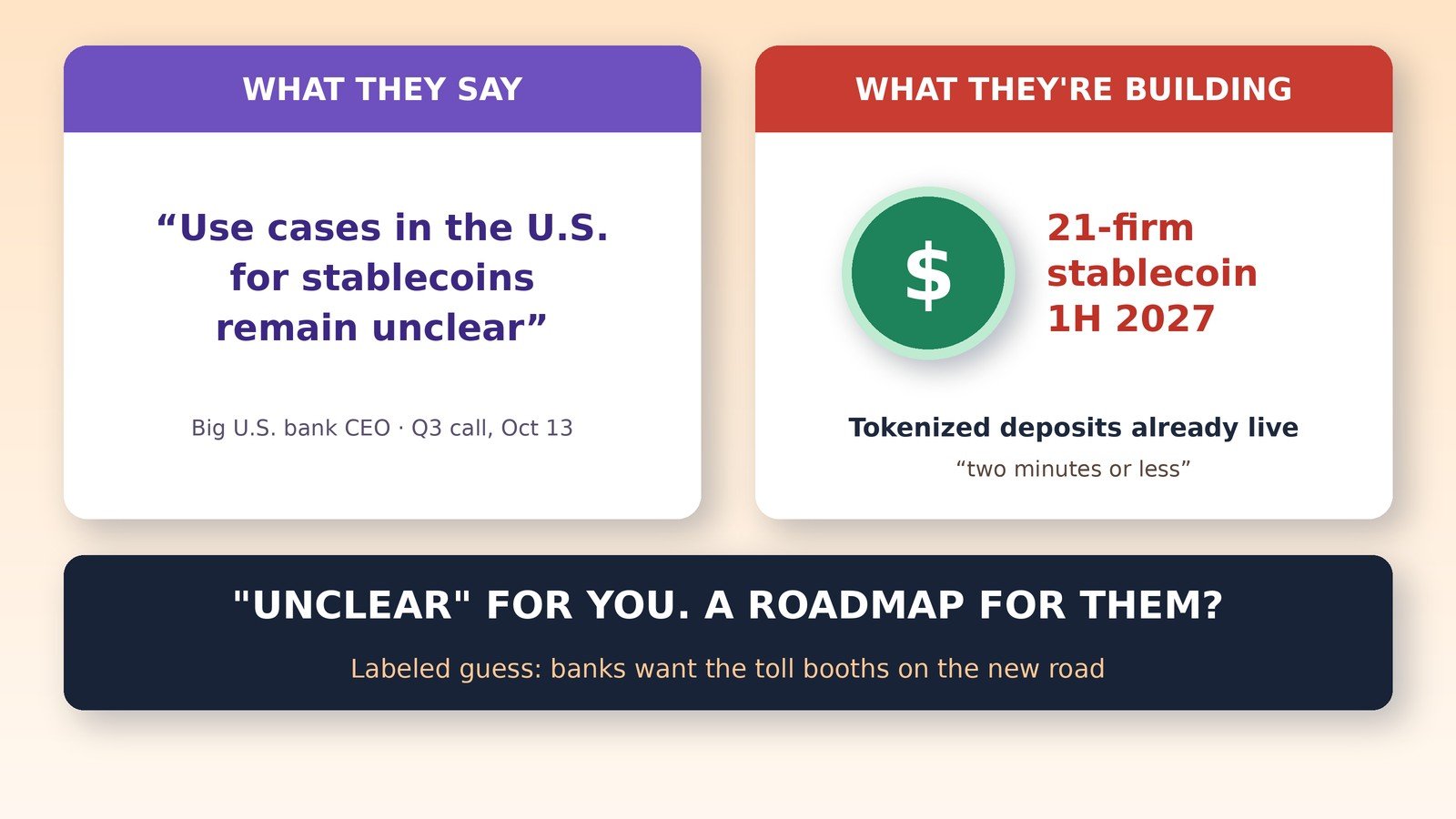
Opinion. On Tuesday, the CEO of one of America’s biggest banks told Wall Street analysts that stablecoins don’t have a clear use in this country. In the very next breath, he told them his bank is building one. Both things can be true. But it’s worth asking who that first sentence is for.
What Wells Fargo actually said
Here’s Charlie Scharf on the bank’s third-quarter call: “Use cases in the U.S. for stablecoins remain unclear, but we’re building solutions to be prepared as opportunities potentially unfold.” Then: Wells Fargo, “along with 20 other international financial institutions,” is setting up a new company “to issue stablecoins beginning in the first half of 2027,” for wholesale, institutional and retail customers.
And it isn’t just talk. Scharf said the bank launched tokenized deposits on its own blockchain last month for corporate and commercial clients. His CFO, Mike Santomassimo, said it’s “in production,” at “small volume so far,” and payments land “in two minutes or less” instead of a day or two.
Meanwhile, across the Atlantic, Qivalis, a euro stablecoin company backed by 37 European banks, just got its license from the Dutch central bank on Wednesday.
Read the fine print
Look at how Scharf pitched the tokenized deposits: clients will move money around the clock “without changing how they bank with us.” That’s the tell. A tokenized deposit is still a bank deposit. The money stays on the bank’s books, and the bank keeps earning on it.
An open stablecoin from an outside issuer is a different animal. Money that leaves a checking account for a token is money the bank no longer holds. So when a big bank says the use case is “unclear,” I hear a bank that isn’t in a hurry for you to find one before it does.
My read, labeled as a guess
Here’s the speculation, and it’s only that. I think the big banks figured out that they can’t stop stablecoins, so they’re doing the next best thing: build their own, on their own timeline, and make sure the toll booths on the new road have familiar logos on them. “Unclear” is a handy word when you’d like the upstarts to slow down while you catch up.
To be fair, there’s a boring explanation too. Banks answer to regulators, and nobody wants to oversell a product that doesn’t exist yet. Wells Fargo’s dollar token is still a 2027 plan, and the company that would issue it is still being set up.
But for regular people, the question isn’t whether banks get into stablecoins. They clearly are. It’s whether you end up with real choice, or just your same bank in a new costume. Watch who gets to issue, who gets to hold, and who gets paid for it.
This is opinion, not investment advice.
Sources: Wells Fargo Q3 2026 earnings call; crypto.news; Qivalis; CoinDesk