
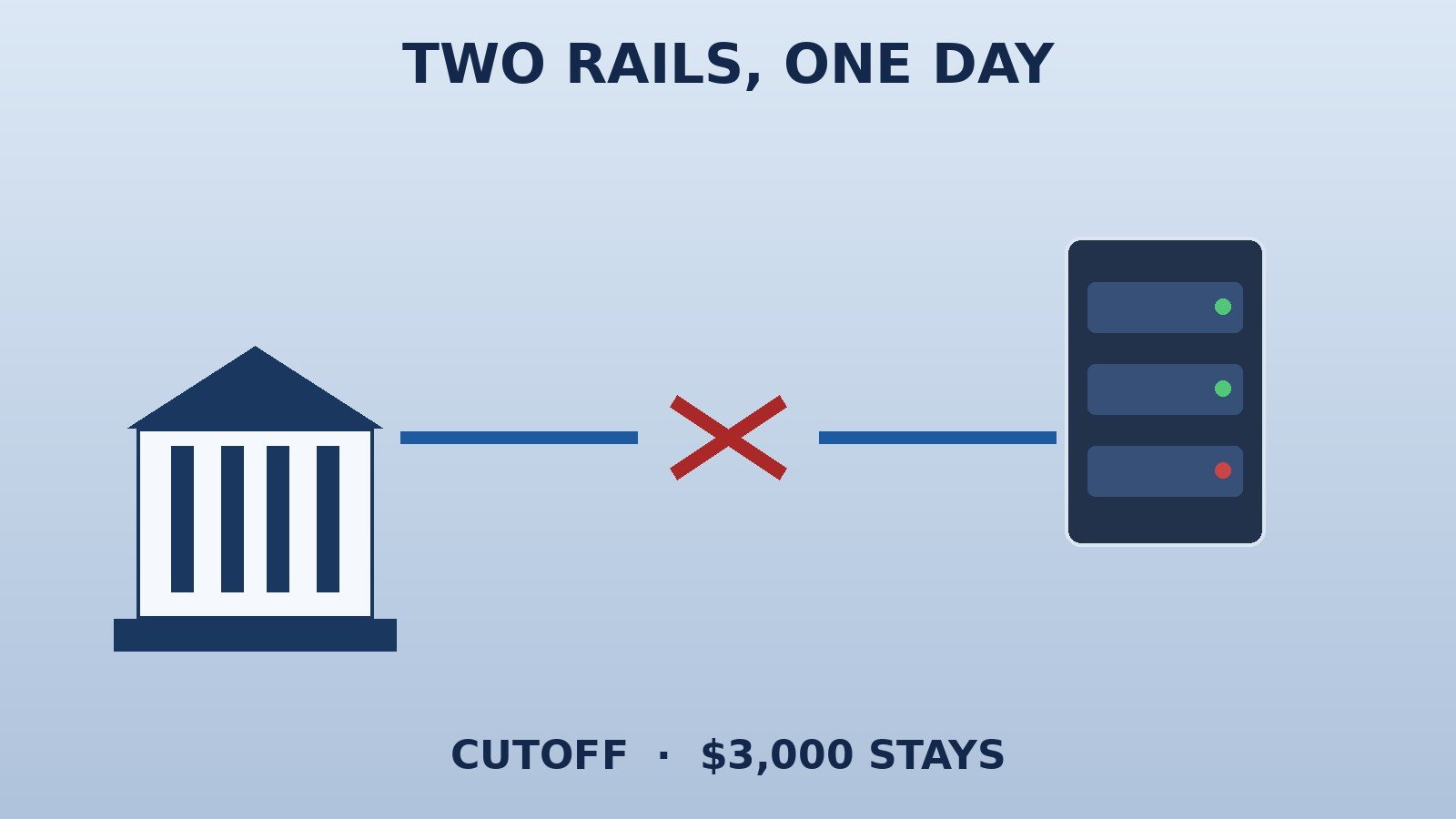
On Friday, Treasury’s Financial Crimes Enforcement Network moved on two separate rails at once. It ordered U.S. banks cut off from MEXC Global over alleged illicit flows tied to Iran, North Korea and Russia. The same day, FinCEN and the Federal Reserve withdrew a 2020 plan that would have dropped the cross-border Travel Rule and Recordkeeping threshold from $3,000 to $250. Neither action changes bitcoin’s price. Both change who U.S. institutions can touch and what they have to keep on file.
FinCEN cuts off MEXC Global. In a Nov. 6 order under section 9714(a) of the Combating Russian Money Laundering Act, FinCEN found that MEXC Global—including subsidiaries, branches, offices and successors operating outside the United States—is a financial institution of primary money laundering concern in connection with Russian illicit finance. The order prohibits covered U.S. financial institutions from engaging in any transmittal of funds to or from MEXC Global. It takes effect 30 days after publication in the Federal Register. Treasury’s press release framed the step as part of Operation Economic Outcast.
Treasury said MEXC, founded in 2018, processed more than $1 billion a day as of September 2026, held about $5 billion in reserves and ranked among the world’s top 20 convertible virtual currency exchangers. Between May 2021 and May 2026, FinCEN said, the platform facilitated at least $16 billion in funds connected to sanctions evasion, cybercrime and other illicit activity. That includes nearly $1.5 billion linked to Russian sanctions evasion, with $232 million in direct transactions with U.S.-, EU- and UK-sanctioned entities. FinCEN said MEXC was still processing transactions with sanctioned Russian exchanger Garantex and its successor Grinex as recently as June 2026—more than four years after OFAC designated Garantex. The agency also cited about $200 million tied to the A7A5 stablecoin, roughly $1 billion in direct transactions with more than 40 identified Iranian CVC exchangers, and about $22 million benefiting Iran’s central bank and the Islamic Revolutionary Guard Corps and its Qods Force.
Treasury Secretary Scott Bessent said financial institutions “cannot have it both ways,” and that either they support the Iranian regime or they keep access to the U.S. financial system. The order does not change existing Bank Secrecy Act duties or OFAC sanctions. Violations can bring civil or criminal penalties. MEXC said in a Nov. 6 statement that it is reviewing the order with its legal and compliance teams, that operations and user assets remain secure, that it intends to engage constructively with FinCEN and other regulators, and that it has begun an independent review of its AML and sanctions controls.
Agencies withdraw the $250 Travel Rule plan. Also on Nov. 6, FinCEN and the Board of Governors of the Federal Reserve System filed a withdrawal of their Oct. 27, 2020 joint notice of proposed rulemaking (85 FR 68005, RIN 1506-AB41). That NPRM would have cut the threshold for collecting, retaining and transmitting information on funds transfers and transmittals that begin or end outside the United States from $3,000 to $250. FinCEN alone had proposed the same cut for the Travel Rule. The agencies also proposed clarifying that the rules cover convertible virtual currency and digital assets with legal tender status. The withdrawal notice, FR Doc. 2026-22809, is scheduled for Federal Register publication on Nov. 9, 2026, and takes effect as of that publication. The existing $3,000 thresholds stay. The agencies said they will not take further action on the NPRM.
Nearly 3,000 comments came in, most of them form letters. Commenters generally opposed the $250 cut, citing burden on smaller institutions, remittance disruption and liability for holding personal data. The agencies gave two reasons for withdrawing: more than five years have passed and they want a fresh comment period before anything similar is adopted, and the convertible virtual currency market has changed since 2020, including passage of the GENIUS Act. Convertible virtual currency travel-rule duties under existing guidance, including FinCEN’s FIN-2019-G001, are not repealed by the withdrawal.
Why it matters. One order closes a U.S. banking door on a large offshore exchange FinCEN says moved tens of billions for sanctioned and cybercrime actors. The other keeps the cross-border information threshold at $3,000 instead of pulling smaller wires into the same recordkeeping net. Banks and money transmitters get a hard stop date on MEXC once the Federal Register publishes the order, and certainty that the 2020 $250 plan is dead unless a new proposal is issued.
What to watch: the Federal Register publication dates for the MEXC order and the Travel Rule withdrawal, whether other U.S. institutions or counterparties pre-emptively exit MEXC before the 30-day clock runs, and whether FinCEN or the Fed open a new Travel Rule or CVC recordkeeping proposal after Nov. 9.
Sources: U.S. Department of the Treasury, FinCEN (MEXC news release), FinCEN (Section 9714 order PDF), Federal Register (public inspection 2026-22809), Federal Register (withdrawal PDF), MEXC, ABA Banking Journal, Decrypt.