Deutsche Bank’s crypto custody service is now open for business. Germany’s largest lender said Wednesday that its Digital Asset Custody service has gone live for paying institutional and corporate clients in Europe, a day after a report that it and 20 other financial firms had lined up about $270 million for a joint bank-backed stablecoin company.
Together, the two moves show big banks shifting from studying crypto to building the plumbing for it: who holds the assets, and what kind of digital dollar moves between them.
What went live
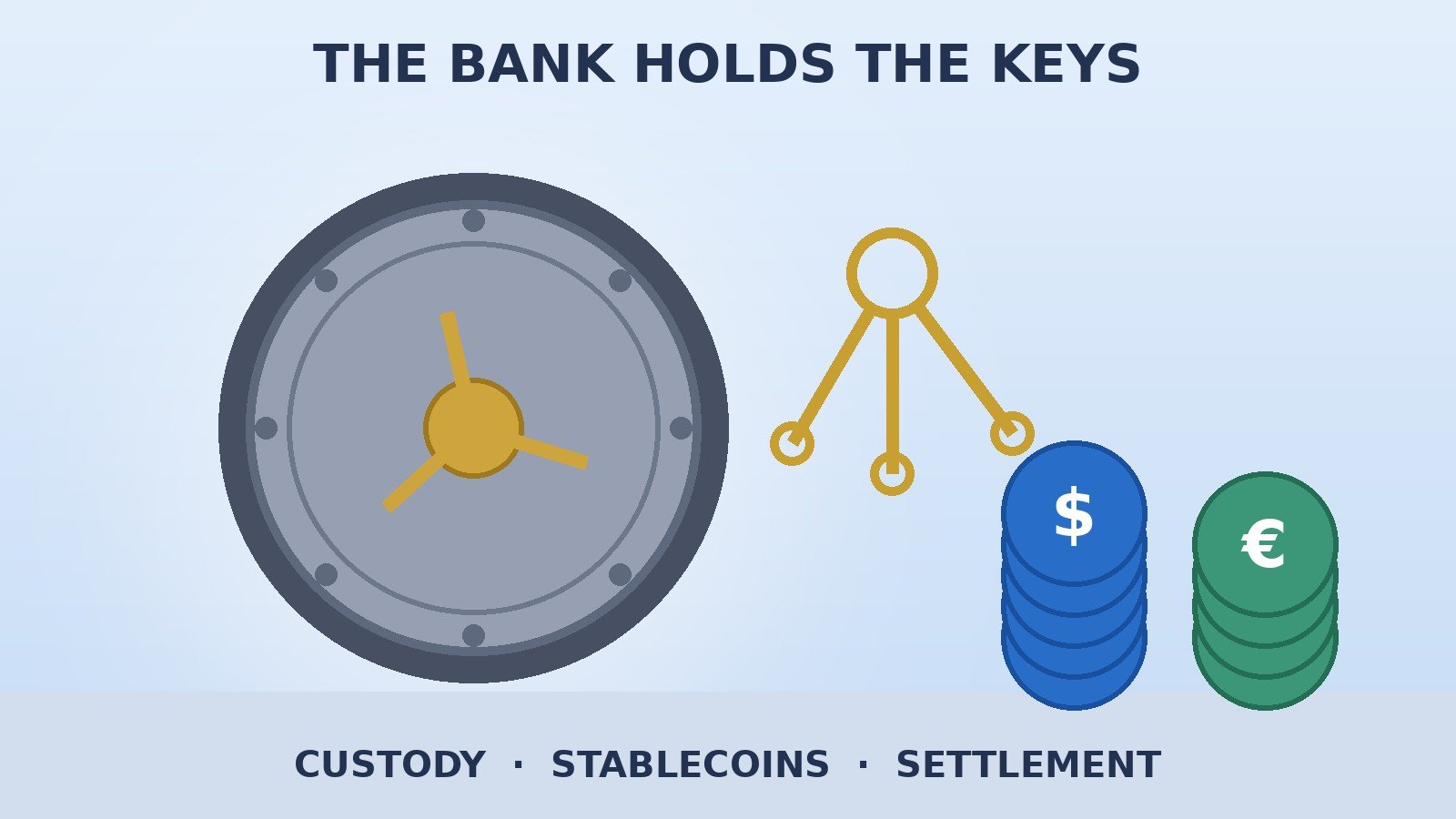
The custody service lets clients hold and transfer bitcoin, ether and three stablecoins, USDC, EURC and EURAU, with Deutsche Bank managing the digital wallets and private keys for them, according to the bank’s September announcement and Wednesday’s launch. It is aimed at clients of the bank’s corporate and investment banking divisions, including companies, asset managers, hedge funds, custodians, brokers and sovereign institutions. It is not open to retail customers.
The bank has described hardware-protected key storage, separate warm and cold wallets, and transaction approvals that require more than one person. Germany’s financial regulator, BaFin, authorized the bank to provide crypto custody and transfer services under the EU’s Markets in Crypto-Assets rules on Oct. 12, according to the European Securities and Markets Authority’s register, as reported by CoinDesk.
“In the medium term we aim to deliver a fully integrated, regulated ecosystem that supports the custody, tokenisation, and settlement of digital assets,” said Paul Maley, Deutsche Bank’s global head of trust and securities services, Reuters reported.
The bank also signed a memorandum of understanding with Deutsche Asset Management, the money manager it mostly owns and that was until recently known as DWS. The two will explore tokenized money market funds, crypto-asset exchange-traded commodities and stablecoins, The Block reported, and Deutsche Asset Management said it plans to launch a tokenized money market fund. The bank has previously told Reuters it wants to expand custody to Asia.
The bank stablecoin behind it
On Tuesday, Bloomberg reported that Goldman Sachs, Citigroup, Banco Santander and Deutsche Bank were among firms that committed about $270 million to fund five years of operations at a joint stablecoin company, citing people familiar with the matter. CoinDesk, citing the report, said the venture is known as Project Faro and is expected to be incorporated in the U.S.
The group of 21 institutions, which also includes Bank of America, Wells Fargo, Fidelity Investments, UBS and MUFG Bank, said in September it would set up the company in the second half of 2026 and aims to bring a dollar stablecoin to market in the first half of 2027, with a euro version as the next priority. The members said they intend to comply with the U.S. GENIUS Act and Europe’s MiCA rules.
What it does not mean yet
- Deutsche Bank has not named its first custody clients, said how much it holds, or disclosed its fees.
- Custody is storage and transfers only for now. The bank says crypto assets are not covered by a deposit guarantee comparable to the one for bank deposits.
- Project Faro’s funding figure comes from unnamed sources. The group has not announced a name, a blockchain or a chief executive, and its plans remain subject to closing conditions.
Prices were calm. Bitcoin traded near $73,800 at 8:15 a.m. ET, down about 0.7% over 24 hours, while ether was near $2,050 and XRP near $1.06, according to CoinGecko. U.S. spot bitcoin ETFs lost a net $95 million on Tuesday, according to Farside Investors.
For cautious readers, the signal is about who is building the rails. A bank holding the keys trades one risk for another: less chance of losing a password, more reliance on the bank’s rules.
Sources: Reuters, Deutsche Bank, The Block, CoinDesk, Bloomberg, CoinDesk (Project Faro), Banco Santander (consortium release), CoinGecko, Farside Investors.