Author: Westen

  • Bitcoin Holds Near $80,000 After Weekend Selling Hit Leveraged Longs

    Bitcoin Holds Near $80,000 After Weekend Selling Hit Leveraged Longs

    Bitcoin traded at about $80,460 early Sunday, roughly flat over 24 hours, according to CoinGecko data at 8:08 a.m. ET. That followed a Saturday-morning slide below $80,000, to its weakest level in more than a month, according to CoinDesk. The Block’s price data put Saturday’s low at about $79,280 around 11:20 a.m. ET before a rebound to roughly $80,140 by 1 p.m.

    Ether was about 1% lower over 24 hours early Sunday at roughly $2,336, and solana was little changed near $101, while XRP was up about 1.5% at $1.30, CoinGecko data showed. On Saturday morning, all three had been down between 3% and 4% over 24 hours, CoinDesk reported.

    Most of the damage landed on traders betting on higher prices. In the four hours to 1 p.m. ET Saturday, $436.4 million of crypto futures positions were liquidated, and $404.2 million of that came from longs, according to CoinGlass data cited by The Block. Two 15-minute bursts, starting at 10:15 a.m. and 11:15 a.m., accounted for about $339 million of long liquidations. Ether positions made up $136.7 million of the four-hour total, close to bitcoin’s $158.5 million. The pace has since slowed. CoinGlass’s 24-hour count for the 20 most-liquidated coins stood at $452.9 million as of about 3 a.m. ET Sunday, with $391.1 million from longs, TokenPost reported.

    Fund flows had already turned. U.S. spot bitcoin exchange-traded funds recorded net outflows of $635.6 million on Thursday and $137.9 million on Friday, according to Farside Investors, about $773 million over the two days. SoSoValue data reported by The Block show nearly identical figures. Farside’s Friday total is still provisional, with one fund yet to report. Even after the two down days, the funds were still net positive for the week, by about $305 million on SoSoValue’s count.

    The selling came as markets digested reports about U.S. staffing in the Middle East. The Wall Street Journal reported Saturday that the U.S. is evacuating personnel from embassies and bases in the region, CoinDesk said. The State Department’s own Saudi Arabia travel advisory, dated Oct. 23, says it ordered non-emergency government employees and their families to leave that country. The Associated Press reported that the department is also reducing staff at embassies in Jordan, Lebanon, Qatar and the United Arab Emirates, which remain open. Hardwire Crypto has not established a direct link between those reports and the price move.

    BitMEX co-founder Arthur Hayes posted “I dumped it all” on X at about 2:18 a.m. ET Saturday, The Block reported.

    Sources: CoinGecko, CoinDesk, The Block, TokenPost, Farside Investors, U.S. Department of State, Associated Press


  • Bank of Israel Says Crypto Cannot Be Used to Get Around Sanctions

    Bank of Israel Says Crypto Cannot Be Used to Get Around Sanctions

    The Bank of Israel said Saturday that cryptocurrencies “cannot serve as a means to circumvent sanctions,” a day after Prime Minister Benjamin Netanyahu said he had asked for a plan involving blockchain to prepare for possible sanctions, including banking sanctions.

    The statement, quoted in translation from Hebrew by Globes, the Times of Israel and Ynet, went on: “The right course for the Israeli economy is to maintain economic relations with our primary trading partners and to focus on preventing sanctions and their negative impact on the economy. This is the responsibility of the political leadership, and it should act upon it.” The Times of Israel rendered the opening line as crypto “cannot be used as a route for bypassing sanctions.”

    As of Saturday afternoon ET, the statement did not appear on the press release page of the bank’s English-language website.

    Netanyahu made the remarks in an interview with Roy Katz broadcast Friday, Oct. 23, on Channel 10, Israel’s economic news channel. “We need to understand that there could be sanctions, including banking sanctions. You need to prepare an economy that can bypass them,” he said, according to a translation by The Block. “I’m working on that too.” Asked whether blockchain was the alternative, he answered, “One of them, certainly. And I have already requested that a plan for this should be prepared,” in Globes’ translation.

    He did not say which countries might impose such sanctions, who would draw up the plan, which networks or currencies it might use, or when. Ynet reported that officials in Israel’s economic ministries and the Prime Minister’s Office said they knew of no such plan. A senior economic official told Channel 12 that “the idea will certainly not achieve its goal. Even talking about it could harm the economy,” the Times of Israel reported. Separately, 109 senior economists, business executives and former public officials, writing as the Economists’ Forum, said in a joint statement that they felt “grave concern and anxiety” over the remarks, the Times of Israel reported.

    The remarks followed sanctions announced by Britain and 11 other Western countries on goods from Israeli settlements in the West Bank, the Times of Israel reported. Israelis vote in a general election on Oct. 27.

    Speaking to Channel 14 on Saturday evening, Netanyahu did not withdraw the idea. “We have other means; crypto is one of them — it is not the sole method, and it is not certain that it will actually be used,” he said, according to Globes. “I thank the Bank of Israel for their advice, but I do what I think is right.”

    Sources: Globes, The Times of Israel, Ynet, The Times of Israel (Economists’ Forum), The Block

  • Keystone Says Website Breach Exposed Customer Shipping Data, Not Keys or Seeds

    Keystone Says Website Breach Exposed Customer Shipping Data, Not Keys or Seeds

    Hardware wallet maker Keystone said Saturday that a third party obtained customer shipping information from its official website, and it apologized to affected buyers.

    “On October 20, we detected unauthorized access to our official website,” the company wrote in a notice posted on its verified X account on Oct. 24. “After verifying API activity with Shopify, we confirmed on October 23 that a third party obtained customer shipping information.”

    According to the notice, the exposed data were “names, contact details, shipping addresses, and order details (items and prices).” Keystone said payment card or bank details, recovery phrases, private keys and wallet passwords were not exposed.

    “We’ve blocked access, fixed the vulnerability, opened an investigation, and are emailing affected customers,” the company said. It has not said how many customers were affected or what period of orders the data covers. Customers asked on X how far back the affected orders go. Keystone did not give a range, and said in replies that it is “still conducting a thorough investigation and will publish a detailed report in the coming days.”

    The bigger risk now is impersonation. Keystone warned that “scammers may pose as Keystone by phone, text, email, or mail, offering refunds, replacement devices, or ‘fixes’ for your order or address. None of it is from us.”

    The company’s guidance to customers, in its own words:

    • “NEVER share your recovery phrase or private keys, and NEVER enter your recovery phrase into a device you didn’t order. We will never ask for them.”
    • “Don’t click links in unexpected messages.” Type the company’s web address, keyst.one, directly.
    • “Trust only our official channels. If anything feels off, email support@keyst.one.” (The notice says this applies until its detailed report is out.)

    Hours before the notice, at about 1 a.m. ET Saturday, Keystone said on X that it had opened an urgent investigation after a customer reported a scam call that used details from a 2024 order. Hardwire Crypto has not independently verified the customer’s account.

    “A detailed report is coming soon,” the notice said. “Again, we’re truly sorry to everyone affected.”

    Sources: Keystone Hardware Wallet on X

  • Malaysia and Thailand Join Singapore’s BLOOM Project for Cross-Border Stablecoin and Tokenized-Deposit Settlement

    Malaysia and Thailand Join Singapore’s BLOOM Project for Cross-Border Stablecoin and Tokenized-Deposit Settlement

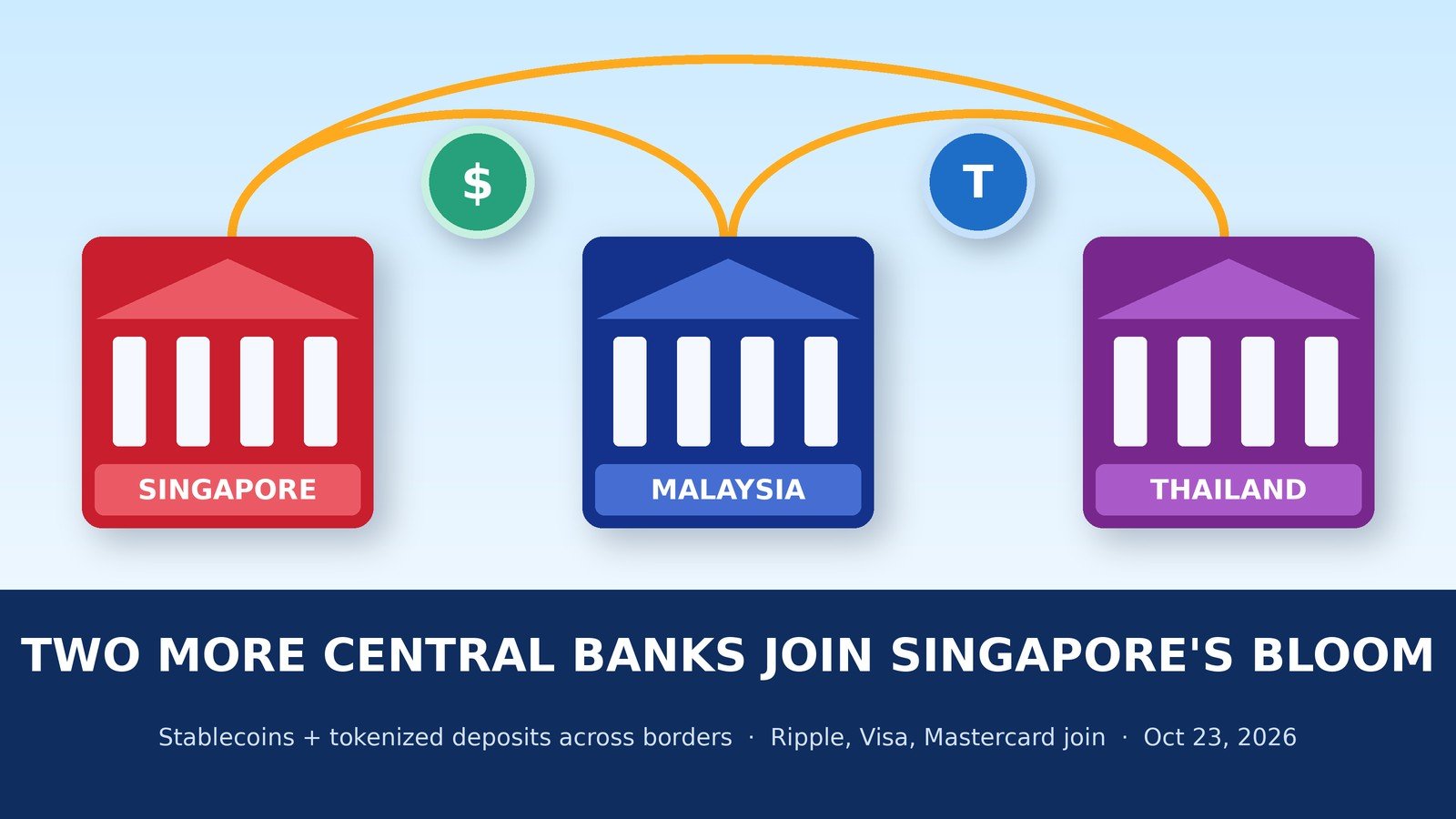
    Singapore’s central bank says two of its neighbors are now inside its project to move money across borders with stablecoins and tokenized bank deposits.

    The Monetary Authority of Singapore (MAS) announced on Oct. 23 that Bank Negara Malaysia and the Bank of Thailand have joined BLOOM as “policymaker members.” BLOOM stands for Borderless, Liquid, Open, Online, Multi-currency.

    MAS also named nine new industry participants: Airwallex, Mastercard, Maybank, Monee, Nium, Ripple, ShopeePay, Visa and the World Bank Group. They join a list that already included Anchorage Digital, Ant International, Circle, Coinbase, DBS, J.P. Morgan, Kasikornbank, OCBC, Partior, Schroders, Standard Chartered, StraitsX, Stripe, Temasek, UOB and Xweave.

    What BLOOM is trying to fix

    Banks that want to pay each other in digital money across borders today often need a separate deal with each partner and each market. MAS says BLOOM aims to build shared frameworks so they don’t have to, which it says should cut costs and speed up launches.

    The settlement assets in view are tokenized commercial bank money and stablecoins “that meet regulatory expectations,” according to MAS. The project builds on Project Orchid, Singapore’s earlier work on a digital Singapore dollar.

    MAS listed three work areas:

    • Acceptance and settlement: how banks accept different forms of digital money in cross-border deals, how counterparties contract, and how trades finally settle.
    • Interoperability: how separate digital money systems can work across networks and borders.
    • Programmable controls: safeguards such as identity checks, sanctions screening and transaction controls built into the payment itself.

    What the central banks said

    “The future of finance will involve multiple forms of digital money operating across different institutions and markets,” said Leong Sing Chiong, MAS deputy managing director for markets and development.

    Bank Negara Malaysia Deputy Governor Aznan bin Abdul Aziz said frictionless cross-border payments using multiple digital monies are “now closer to a tangible reality than a far-fetched fantasy.”

    Bank of Thailand Deputy Governor Daranee Saeju said the work would help inform “forward-looking regulatory approaches for tokenised money, particularly in cross-border payments and wholesale settlement,” while keeping oversight “prudent, proportionate, and responsive to evolving risks.”

    What it is not

    This is a coordination project, not a product launch. The MAS release does not name a go-live date, a single token or a single blockchain. Central bank membership means the three regulators will shape the rules as the frameworks are written. It does not mean any of them has approved a specific stablecoin for cross-border use.

    For XRP Ledger watchers, Ripple’s name on the list is the hook. The Block reported that Ripple has said its BLOOM work involves testing trade payments with its RLUSD stablecoin on the XRP Ledger. MAS’s release does not single out any network.

    MAS did not publish expected volumes or a timeline for live cross-border transactions.

    Sources: Monetary Authority of Singapore (media release and BLOOM page, Oct. 23, 2026); The Block; The Business Times.

  • Coldcard Maker Coinkite Faces Proposed Class Action Over Seed-Generation Flaw

    Coldcard Maker Coinkite Faces Proposed Class Action Over Seed-Generation Flaw

    Coinkite Inc., the Toronto maker of Coldcard bitcoin hardware wallets, and co-founders Rodolfo Novak and Peter D. Gray have been named in a proposed class action in the Ontario Superior Court of Justice. The statement of claim was issued Sept. 11 and surfaced this week on the Canadian Bar Association’s class action database, which lists the case as not certified. The allegations are unproven.

    The plaintiff is Amir Reza Naderi of Los Angeles, represented by Foreman & Company of London, Ontario. He says he bought a Coldcard Mk3 in 2022. According to the claim, 1.22940052 BTC, worth about $79,764, was taken from his wallet without authorization on Aug. 6.

    The suit alleges that since about March 2021, Coldcards generated recovery phrases with MicroPython’s Yasmarang software generator instead of the hardware random number generator Coinkite advertised. The claim says the generator relied on predictable inputs such as the device serial number, which left the phrases open to reconstruction.

    Coinkite’s July 30 advisory describes the same mechanism as a “build and link integration error.” It covers two groups of seeds. The first is seeds made on Mk2 and Mk3 firmware 4.0.1 through 4.1.9. The second is seeds made on Mk4, Mk5 and Q models before firmware 5.6.0 or 1.5.0Q. Coinkite estimates effective entropy fell to about 40 bits on older models and 72 bits on newer ones, against a 128-bit target. It says attackers regenerated seeds offline and the devices were not hacked. Fixed firmware is available, but the company says updating “does not change or repair an existing seed,” so affected owners must move to a new seed.

    The claim says thefts began on or about July 30 and puts class losses above $140 million. That figure is the plaintiff’s, and the filing does not explain how it was calculated. Galaxy Research, which tracks the thefts on-chain, attributed 1,789.28 BTC to the exploit with high confidence as of Aug. 24. That was about $114.7 million when taken.

    The suit also alleges that bitcoin engineer James O’Beirne warned Coinkite of “the Defect and other flaws” in May 2025. He has not commented publicly. On July 30, Coinkite wrote: “We were unaware of the bug until today.”

    Naderi seeks certification, damages under Ontario consumer-protection and sale-of-goods law, negligence and contract damages, and punitive damages. The claim names no total dollar figure. It also challenges the arbitration and class-proceeding limits in Coinkite’s terms of sale.

    Coinkite told Bitcoin.com News it “can’t comment on pending litigation” and expects to publish a full postmortem within days. As of Friday morning, its Coldcard security page still said a detailed technical postmortem “remains in preparation.” Hardwire found no statement of defence in the public record.

    Sources: Ontario Superior Court of Justice (statement of claim, via the Canadian Bar Association class action database); Coinkite; Galaxy Research; Bitcoin.com News

  • Standard Chartered Signs Deal to Own Its Crypto Custodian Outright. Here’s What Changes for Clients

    Standard Chartered Signs Deal to Own Its Crypto Custodian Outright. Here’s What Changes for Clients

    Standard Chartered said Wednesday it has signed definitive agreements to buy all of Zodia Custody, an institutional crypto custodian, and bring the business inside the bank.

    The buyer is Standard Chartered I H Limited. The target is Zodia Custody Limited, the parent of regulated operating companies in Singapore, Hong Kong, Australia, the United Arab Emirates and Luxembourg. The deal still needs regulatory approvals and customary closing conditions. The bank didn’t disclose a price or a completion date.

    After closing, Zodia’s custody business will be merged into the digital asset custody Standard Chartered already runs inside its Securities Services business. The bank says the aim is a single offering that covers both traditional and digital securities services for institutional clients.

    The deal also splits Zodia in two. Its software and professional-services arm moves to a new, independent company, Zodia Solutions, set up under SC Ventures, the bank’s venture unit. Listed backers include Northern Trust, NAB Ventures, SBI Ventures, Emirates NBD and Investcorp’s Zodia Investments. Standard Chartered will be one of its customers.

    For clients, the bank says it expects no disruption and that existing custody clients will “continue to be serviced as usual.” The bigger change comes later. Once the deal closes, those clients’ crypto will sit with a unit of a global bank listed in London and Hong Kong rather than with a separately owned company. Institutions that use Zodia may want to review the change-of-control terms in their agreements and confirm which company will supply the technology after closing.

    The deal has taken longer than planned. Zodia’s shareholders and noteholders accepted the bank’s non-binding offer in May, and definitive agreements were first targeted for the end of June with completion by the end of August, The Block reported. Zodia’s chief executive, Julian Sawyer, stepped down in September, and former chief revenue officer Richard Clark now runs the company.

    Standard Chartered is also building custody on its own. Earlier this month it said it plans to launch crypto custody in Singapore by the end of 2026, according to The Block.

    “Custody is increasingly becoming part of the global banking landscape,” Clark said in the bank’s release.

    What to watch next: approvals in each of the five jurisdictions, whether a price is ever disclosed, and whether clients see any change in fees or terms after closing.

    Sources: Standard Chartered; The Block

  • SoFi Launches a Bank ‘Deposit Token’ for Crypto Users: 4.40% Interest, FDIC Insurance, Swaps 1:1 Into Its Stablecoin

    SoFi Launches a Bank ‘Deposit Token’ for Crypto Users: 4.40% Interest, FDIC Insurance, Swaps 1:1 Into Its Stablecoin

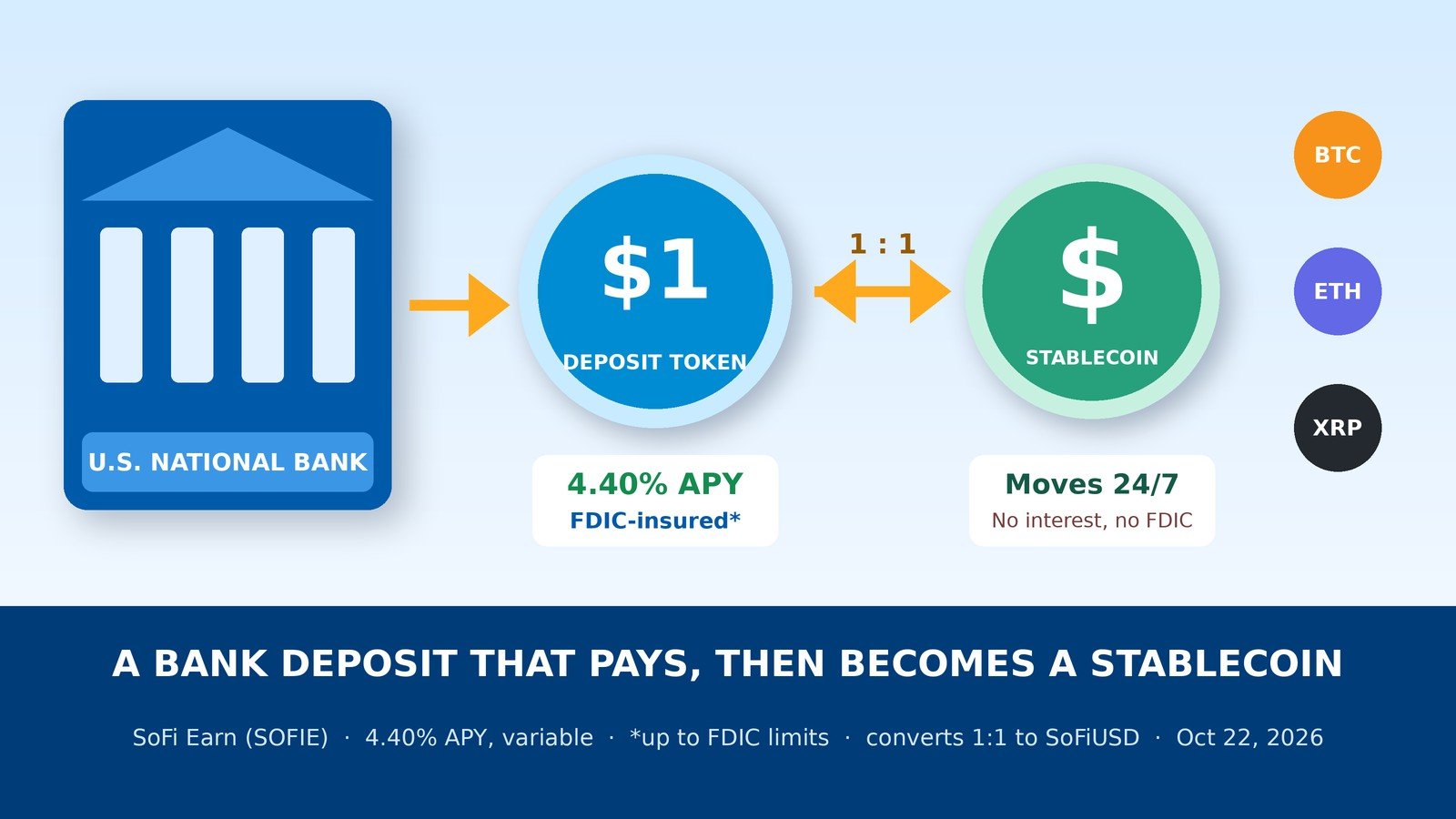
    SoFi on Thursday launched SoFi Earn, a “tokenized deposit” for its crypto customers that pays interest and carries FDIC insurance. The token, called SOFIE, pays a 4.40% annual percentage yield. Each SOFIE stands for $1 held on deposit at SoFi Bank, the company said in its announcement.

    SoFi calls it the first and only tokenized deposit offered to consumers by a U.S. national bank. The rollout to SoFi Crypto members runs through November.

    How it works

    Think of SOFIE as a parking spot for digital dollars. While the money sits in SOFIE, it earns interest and is covered by FDIC insurance up to the usual $250,000 limit per depositor, per bank, for each ownership category.

    When a customer wants to use the money, they convert SOFIE 1:1 into SoFiUSD, the bank’s own stablecoin. SoFiUSD can then buy crypto in the SoFi app, or be sent to a supported outside wallet over blockchain rails at any hour, SoFi said. Customers can also withdraw SOFIE as cash into SoFi Checking and Savings, the company said on X.

    The trade-off is in the fine print. Once the money becomes SoFiUSD, it stops earning that interest, and SoFiUSD is not an FDIC-insured deposit, The Block reported. SoFi’s own disclosure says SOFIE “is not a payment stablecoin.” The 4.40% rate is variable, can change at any time, and was current as of Oct. 20, according to SoFi.

    Why a deposit, not a stablecoin

    The design follows the rules. Under the GENIUS Act, stablecoin issuers may not pay holders interest. The OCC’s final rule under that law, issued Wednesday, keeps that ban for issuers and says rewards paid by others will be judged case by case. It takes effect Jan. 18, 2027.

    A bank deposit is a different legal product. It can pay interest and be insured. By keeping the earning part as a deposit and the moving part as a stablecoin, SoFi offers both, just not in the same token at the same time.

    SoFi makes the pitch directly. CEO Anthony Noto said too much money in the digital asset world “is sitting idle.” The company cited Federal Reserve research estimating that about $64 billion, or 21.2% of the stablecoin market, sits in rarely used, forgotten or inactive wallets.

    The bigger picture

    This is SoFi’s fifth crypto product in less than a year, the company said. It started consumer crypto trading in November 2025 and launched SoFiUSD in December 2025. In September, SoFi began settling card transactions with SoFiUSD on Mastercard’s network, The Block reported. SoFi says it has 15.8 million members.

    Big banks have been testing deposit tokens mostly with business clients. JPMorgan’s JPM Coin, a deposit token for institutional clients, expanded to Ethereum on Monday. SoFi is aiming the same idea at everyday savers.

    SoFi’s announcement did not say which blockchain SOFIE runs on, and it did not describe SOFIE itself moving to outside wallets. Those trips go through SoFiUSD.

    The launch landed on a down morning for crypto. At about 8:15 a.m. ET Thursday, Bitcoin traded near $81,741, Ether near $2,401, XRP near $1.32 and Solana near $104, each down about 2% to 3% over 24 hours, according to CoinGecko. USDC held at about $1.00.

    Sources: SoFi (Business Wire); The Block; SoFi on X; OCC; The Block (JPM Coin); CoinGecko

  • U.S. Bank Regulator Finalizes First Stablecoin Rulebook: Two-Day Redemptions, No Automatic Freeze, Rewards Judged Case by Case

    U.S. Bank Regulator Finalizes First Stablecoin Rulebook: Two-Day Redemptions, No Automatic Freeze, Rewards Judged Case by Case

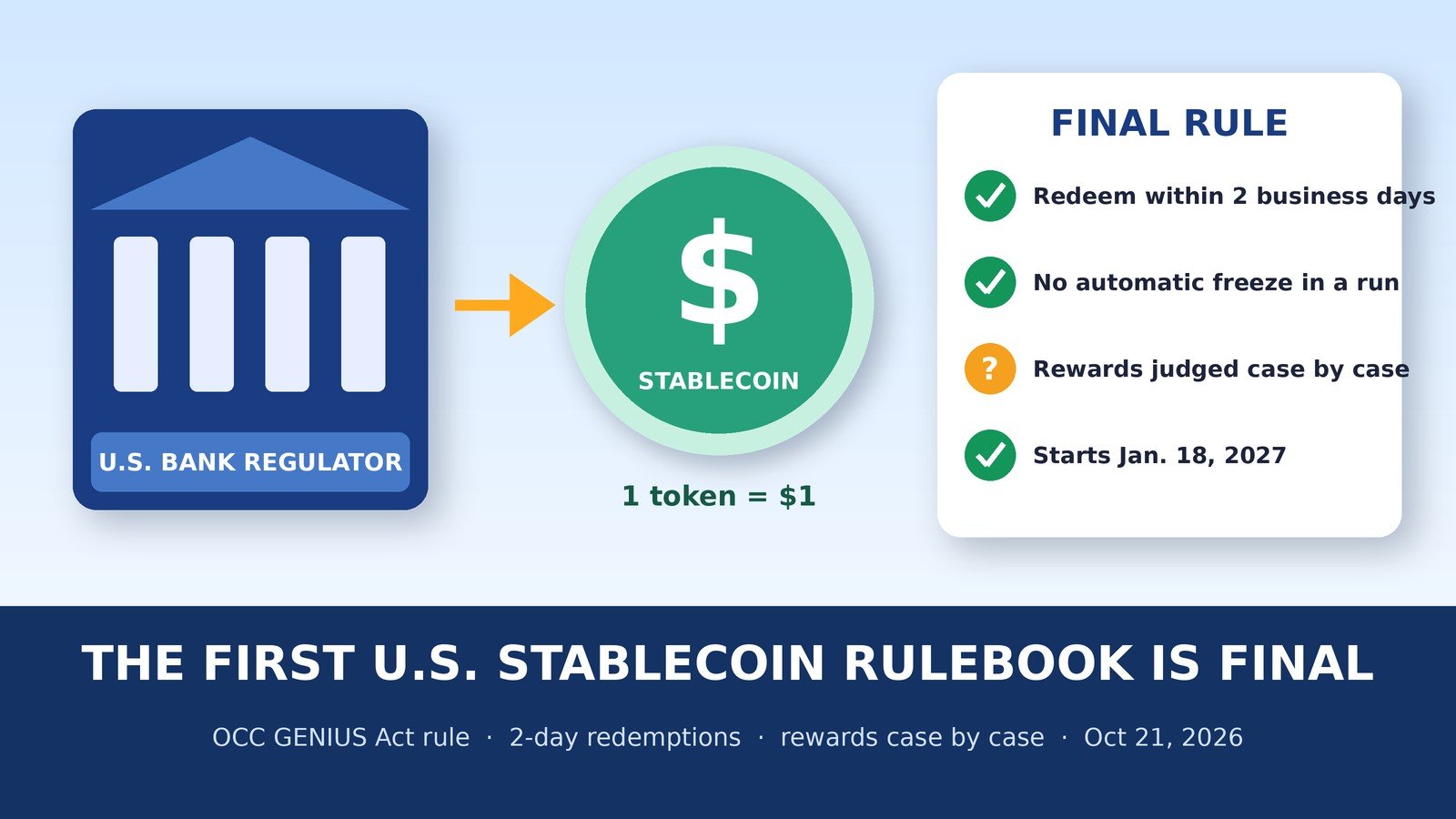
    The first U.S. rulebook for stablecoin issuers is final. On Wednesday, Oct. 21, the Office of the Comptroller of the Currency (OCC), which regulates national banks and federal trust banks, issued its final rule putting the GENIUS Act into practice. The rule and the law both take effect on Jan. 18, 2027. CoinDesk reported that the OCC is the first federal agency to finish its GENIUS Act rules. Other regulators are still writing theirs.

    The rule covers stablecoin issuers that fall under the OCC: subsidiaries of national banks and federal savings associations, federally chartered issuers, certain state-qualified nonbank issuers, and foreign issuers. It also covers some crypto custody done by OCC-supervised firms. Anti-money-laundering and sanctions rules are not in this package. The OCC said those will come in a separate rule written with the Treasury Department.

    What changed from the draft

    The OCC first proposed the rule on March 2, 2026, and received about 328 comments. The final version changes three things that matter to users.

    1. Stablecoin rewards will be judged case by case. The GENIUS Act bans issuers from paying interest or yield to holders “solely in connection with” holding, using or keeping a stablecoin. The draft would have presumed that certain payments through affiliates and related third parties broke that ban unless the issuer proved otherwise. The final rule drops that presumption. The OCC said it will “apply the language of the statute to the facts and circumstances” of each arrangement. It also declined to give a list of allowed or banned setups, declined a small-payments exemption, and said rewards programs that existed before the law “will be evaluated the same” as new ones. The OCC said it keeps its power to act against arrangements that try to evade the ban.

    2. No automatic redemption freeze. Issuers must pay out redemptions within two business days. The draft would have stretched that to seven calendar days automatically if holders asked to redeem more than 10% of a stablecoin’s supply in 24 hours. The OCC removed that, saying an automatic extension “could prove pro-cyclical and trigger or exacerbate runs.” Instead, an issuer that crosses the 10% line must notify the OCC within 24 hours and may ask for more time. The OCC said it expects such extensions to be “rare.”

    3. A smaller cash buffer. The draft required issuers to keep at least 10% of reserves as cash on demand, in bank deposits or at the Federal Reserve. The final rule lowers that to 5%, pointing to new stress-testing and liquidity planning requirements.

    What it means

    For banks, this is the operating manual for issuing a regulated dollar stablecoin under federal supervision. The OCC said it will announce separately when it starts taking applications. Under the law, firms with a pending application when the law takes effect can ask for a waiver of up to 12 months.

    For crypto users, the open question is rewards. Exchanges that pay customers for holding stablecoins get no safe harbor. Whether a given program passes will depend on how the OCC reads the word “solely,” one case at a time. CoinDesk noted the agency signaled that a reward paid “at least in part” for other reasons may fall outside the ban.

    The stakes are growing. Stablecoin transfers reached about $891 billion in the third quarter, according to a Coinbase and The Block study published this week.

    Treasury Secretary Scott Bessent called the GENIUS Act “a watershed moment in American finance.” Comptroller Jonathan Gould said the rule sets “strong standards for reserve backing, redemption, and risk management.”

    A practical note: nothing changes for stablecoin holders today. The rules apply from Jan. 18, 2027.

    Sources: Office of the Comptroller of the Currency (news release); OCC final rule; CoinDesk; The Block

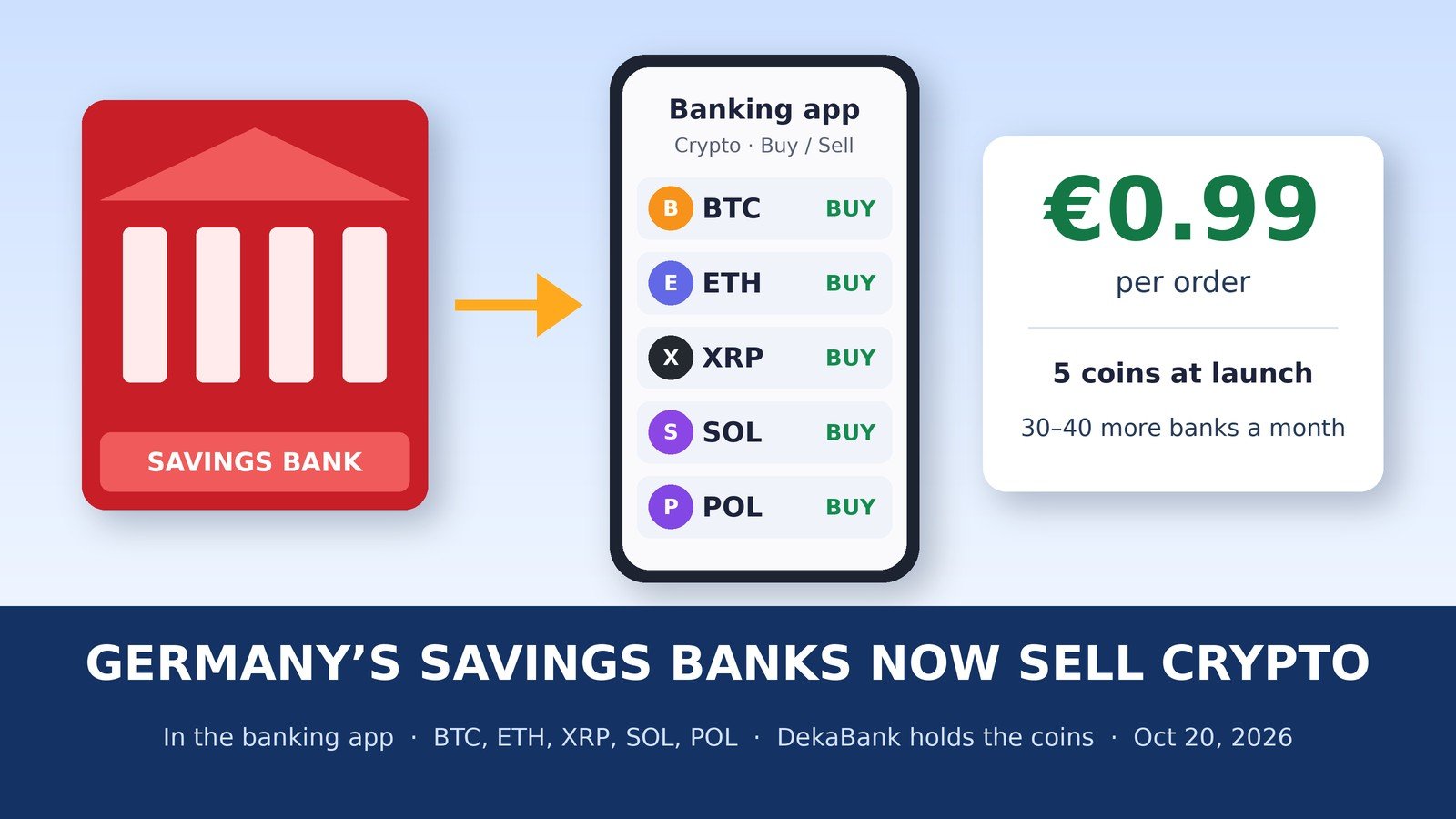
  • Germany’s Savings Banks Start Selling Crypto in Their App: Bitcoin, Ether, XRP, Solana and Polygon

    Germany’s Savings Banks Start Selling Crypto in Their App: Bitcoin, Ether, XRP, Solana and Polygon

    Germany’s savings banks, the Sparkassen, have started selling crypto inside their everyday banking app. Since Monday, Oct. 19, customers at the first participating banks can buy, sell and hold Bitcoin, Ether, XRP, Solana and Polygon in the app “Sparkasse,” through a service called “Krypto – powered by Deka.”

    The rollout is gradual. Five savings banks went first: Frankfurter Sparkasse, Taunus Sparkasse, Sparkasse Karlsruhe, Sparkasse Rottal-Inn and Niederrheinische Sparkasse RheinLippe, according to the German banking newsletter Platow. The savings banks association, the DSGV, told dpa that 30 to 40 more banks should join each month. There is no single nationwide start date. Each savings bank decides for itself when to switch the service on.

    How it works

    DekaBank, the securities house of the Sparkassen, runs the trading, holds the coins and handles customer support. Customers open a separate crypto account at DekaBank inside the app. A securities account is not required. Each order costs €0.99, DekaBank said in its announcement.

    The fee is not the whole price. DekaBank quotes a price based on a market reference price plus its own spread, and its published documents do not put a number on that spread, CryptoCompass reported after reviewing the bank’s price list.

    Two details matter for anyone used to crypto exchanges. First, the coins sit in a shared “omnibus” wallet, and DekaBank holds the private keys in trust for customers, according to its product page. Second, coins can only be sent out to wallet addresses of certain licensed crypto service providers. Sending them to any other address, such as a personal hardware wallet, is excluded.

    The banks are not pushing it. The offer is for customers who decide on their own: no advice and no broad marketing, the DSGV said. Customers are warned about sharp price swings and the risk of total loss, and crypto holdings are not covered by Germany’s statutory deposit insurance.

    Why it matters

    The Sparkassen-Finanzgruppe says it serves around 50 million customers. Platow reported that more than 200 of the roughly 340 savings banks are considering the offer. Joachim Schmalzl, an executive board member at the DSGV, told dpa the group wants a large share of the interested banks connected in the first half of 2027. He said customer demand and a “reliable European legal framework,” meaning the EU’s MiCA crypto rules, drove the decision.

    For years the savings banks stayed away from crypto as too risky, while app banks such as N26, Trade Republic and Revolut offered it. Germany’s cooperative Volksbanken recently started offering crypto, too. Now the Sparkassen are in.

    The coin list is worth noticing. Next to Bitcoin and Ether, the first five include XRP, Solana and Polygon. At about 8:18 a.m. ET Tuesday, XRP traded near $1.30, Solana near $104 and Ether near $2,383, each down roughly 1% to 2% over 24 hours, according to CoinGecko.

    A practical note: the service only shows up in the app once your own Sparkasse has switched it on. If you don’t see it yet, your bank hasn’t joined.

    Sources: DekaBank; Deka Krypto product page; dpa-AFX (via finanzen.net); Golem; Platow; CryptoCompass; DSGV; CoinGecko

  • France’s Stablecoin-Swap Tax Passed by One Vote. It Isn’t Law, and LCP Says Tuesday’s Budget Vote Will Slip

    France’s Stablecoin-Swap Tax Passed by One Vote. It Isn’t Law, and LCP Says Tuesday’s Budget Vote Will Slip

    France’s National Assembly voted on Friday, Oct. 16, to make swapping crypto into euro- or dollar-pegged stablecoins a taxable event starting Jan. 1, 2027. The margin was one vote, and the measure is still a long way from becoming law.

    Amendment I-3898 to the 2027 finance bill, tabled by Nicolas Sansu of the Democratic and Republican Left group, passed 38 to 37 with 25 abstentions, according to the Assembly’s record of public vote no. 8836. One hundred of the chamber’s 577 deputies took part.

    What the amendment does

    Under current French rules, trading one crypto-asset for another doesn’t trigger tax. The bill comes due when a holder sells for euros or spends. The amendment removes that deferral for swaps that end in “e-money tokens” as defined by the EU’s MiCA regulation, the category that covers single-currency stablecoins such as USDC and EURC. Those gains would fall under France’s existing flat tax on crypto gains. The amendment itself sets no rate; French outlets including Journal du Coin put that tax at 31.4%. The text also changes how gains are counted, using the cost of the specific assets sold rather than France’s current whole-portfolio formula.

    The government opposed it

    Public accounts minister David Amiel asked deputies to withdraw the amendment, telling them that “as things stand, implementing this measure would be too complex,” according to the official record of the sitting. He said stablecoins would first need a clear definition and the tax administration would need a way to trace reallocations inside a portfolio. The finance committee had adopted the measure, although its rapporteur général, Philippe Juvin, said on the floor that he personally considers the current deferral justified given crypto’s volatility.

    What happens next

    The timeline is less settled than several reports suggest. The Assembly’s official agenda, last set by its Conference of Presidents on Oct. 13, still lists a solemn vote on the revenue half of the budget for Tuesday afternoon. But LCP, the Assembly’s own broadcaster, reported Monday that 2,828 of the 3,396 amendments filed remain to be debated and that the vote can’t take place as planned. According to LCP, deputies will resume the revenue section after the social-security budget debate. LCP added that, with no majority in the chamber, the revenue section is more than likely to be rejected. Either way, the bill then goes to the Senate, which can strip the amendment, and a government using Article 49.3 can choose which amendments to keep.

    Hardwire’s Easton argued last week, before the floor vote, that it would tax people for using the very stablecoins Europe’s rules steer them toward.

    What it means for holders

    For holders in France, nothing changes before 2027, and the measure may not survive the process. The amendment names no specific tokens. Several French outlets say it would not reach USDT, which is not authorized under MiCA, but tax authorities have not issued guidance.

    This is a news report on proposed legislation, not tax advice.

    Sources: Assemblée nationale (vote record); Assemblée nationale (amendment I-3898); Assemblée nationale (transcript); LCP; Journal du Coin