Blog

  • OKX and ICE file to trade 63 tokenized U.S. stocks around the clock

    OKX and ICE file to trade 63 tokenized U.S. stocks around the clock

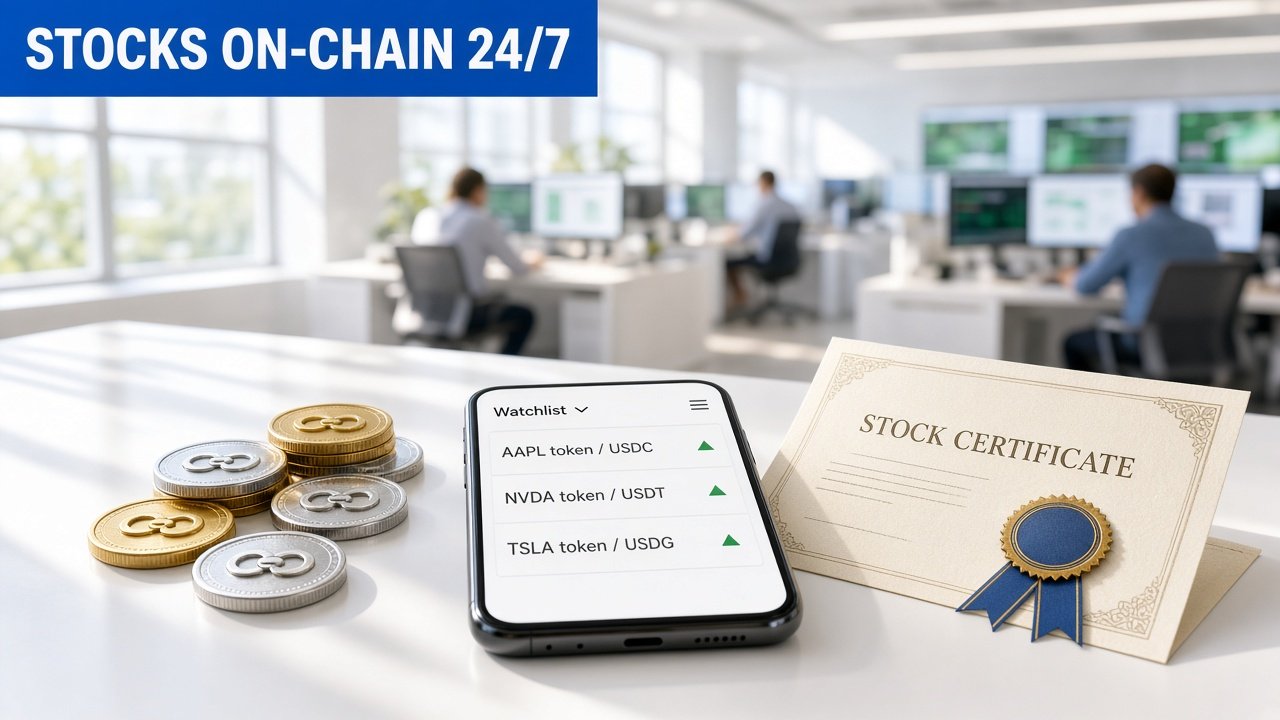
    OKXICE, the 50-50 joint venture between crypto exchange OKX and Intercontinental Exchange, the parent of the New York Stock Exchange, published a public notice dated Sunday, Oct. 4, saying it intends to run a tokenized stock venue under the SEC’s new tokenized-securities exemption. The plan is round-the-clock trading of tokenized versions of U.S.-listed shares, settled on a blockchain and priced against dollar stablecoins.

    The notice lists 63 stocks. They include Nvidia, Apple, Microsoft, Tesla, Amazon, JPMorgan Chase and Goldman Sachs, plus crypto-linked names such as Coinbase, Circle, Strategy, Robinhood, BitGo and Securitize. Each token would trade against one of three payment stablecoins: USDC, USDG or USDT. The venue says it will operate 24 hours a day, seven days a week.

    The rails are specific. Trades would run through Uniswap v4 liquidity pools on XLayer, OKX’s layer-2 network, with an OKXICE smart-contract add-on that checks every wallet. Only wallets holding a non-transferable “soulbound” token can trade or add liquidity. That token is issued after identity checks, anti-money-laundering checks and sanctions screening run by OKX’s U.S. entity. The venue does not run an order book, does not hold customer assets, does not lend and does not sell new shares.

    The trust question in any tokenized stock is simple: is there a real share behind the token? The notice says the tokens come from an unaffiliated third party, called only “the Tokenizer,” which holds the underlying shares one-for-one through an SEC-registered, FINRA-member broker-dealer. Tokens are minted only after the shares are bought and held. The notice says holders get the same rights as ordinary shareholders, including dividends, voting and a share of assets in a liquidation.

    There are guardrails, and the notice spells them out. Trading in a token stops whenever the underlying stock is halted on its main exchange. If trading in a token breaks the exemption’s volume limits a second time, the venue must pause it for three months. OKXICE keeps admin keys that can pause pools, upgrade contracts and remove wallets. The notice also warns that token prices are set by the pools, not by the stock market, and may differ from the real share price, especially outside regular trading hours or when liquidity is thin.

    Plain disclosure, worth reading twice: the venue is not registered with the SEC as an exchange, is not subject to Regulation NMS, and the SEC has not passed on the notice’s accuracy. Its use of the exemption remains subject to SEC oversight. That is how the exemption is built, not a red flag on its own.

    Companies get a say. Under the exemption, a venue must notify an issuer and give it 30 days to object. Cerebras Systems has already filed an objection, and its stock is not on the list. Ledger Insights reports the 30-day wait puts the earliest possible start in early November. The notice itself gives no launch date.

    OKXICE co-chair Andrew Cuomo called the filing “a landmark step toward a truly global, 24/7 Wall Street.” OKX CEO Star Xu said the future of markets is “real ownership, onchain,” and that “full shareholder rights are what make that possible.”

    What happened: an NYSE-linked venture filed a public notice to trade tokenized U.S. stocks on-chain. What has not happened: trading. The next marks are issuer objections and the end of the 30-day window.

    Sources: OKXICE public notice; Decrypt; Ledger Insights; The Block
  • Ripple’s $52 million XRP send has a sender and no name

    Ripple’s $52 million XRP send has a sender and no name

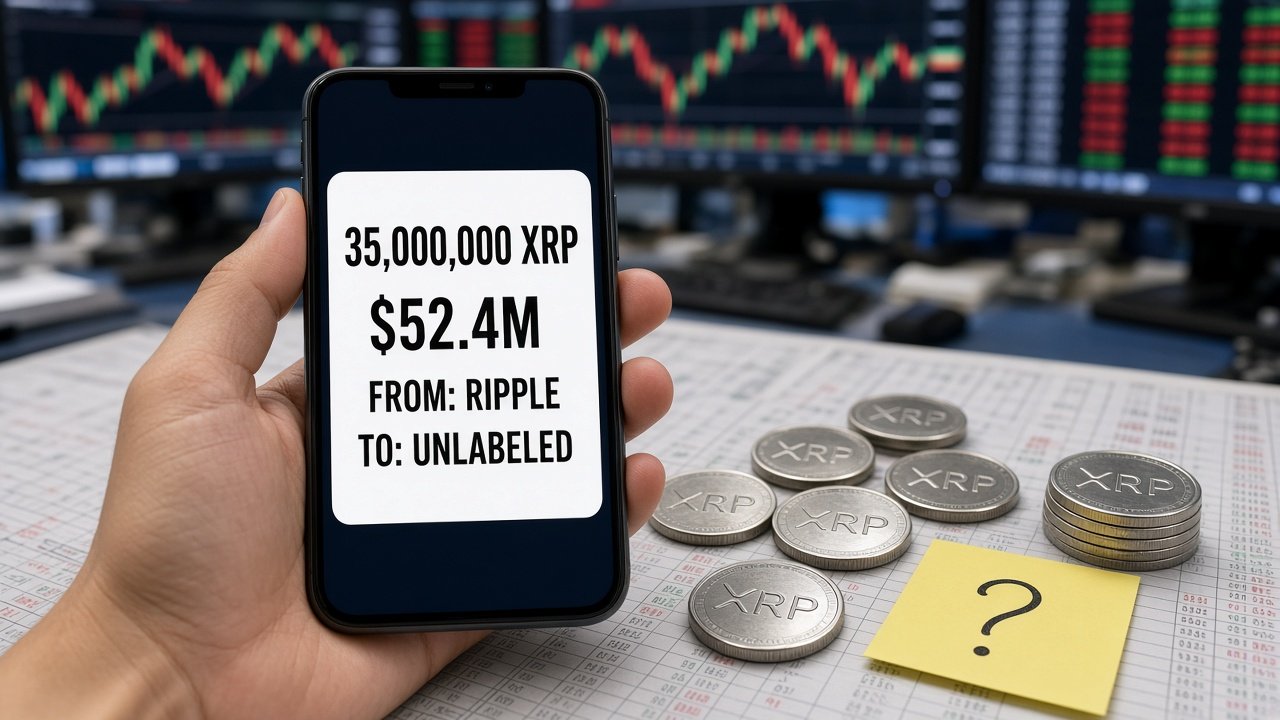
    Opinion, up front. Late Thursday, New York time, a wallet Whale Alert tags as Ripple paid 35,000,000 XRP to an address with no public name. The alert clocked it at 00:21 UTC on Oct. 2, which is 8:21 p.m. Thursday in New York, and printed the value at $52,425,783. Sender rJqiMb94hyz41SBTNr2AyPNW8AzELa8nE. Receiver raRVLN1i5QFF6w8cwV3RovtTkjFj3qyNRf. Hash 667DC2B9F7A5018609862354CEAC5DF7BEB0AE68E7A36C90F9A822DBFDA5A8F4. That payment is the fact. The rest of this piece is a read.

    The timeline going around welds that payment to the monthly escrow unlock, as if they were one event. They are not. Whale Alert does show a 300,000,000 XRP unlock at a Ripple-labeled account at 00:00 UTC on Oct. 1, worth about $446.7 million at its print. U.Today, citing four Whale Alert posts that morning, put the full scheduled release at 1 billion XRP in four slices: 400 million, 300 million, 200 million, and 100 million. This desk opened the 300 million slice and the later 35 million payment. It did not open a transaction for the other three slices.

    Here is the number this piece will not use as fact. A stack of recaps says Ripple locked 700 million XRP back the same day, 400 million plus 300 million, leaving a net 300 million. A Whale Alert “story” page carries that 700 million claim in the headline. The body underneath only says unused XRP is typically returned. U.Today’s own unlock story, filed Thursday morning UTC, said the return was still ahead and that the next day would show it. XRPSCAN would not load here. Until a relock transaction is in hand, “700 million went straight back” is a rumor with good company, not a figure Hardwire should print as ledger fact.

    Speculation, labeled as speculation. A $52 million send off a company-tagged wallet, a day and a half after a scheduled unlock, looks like treasury routing, not a market dump. On this ledger a destination tag usually means a shared deposit address at an exchange or a custodian. Secondary write-ups say this payment had one, and that the receiver forwarded 6.5 million XRP within a few hours. This desk could not confirm the tag or those forwards on an explorer. Do not trade them. The read that survives without them is simpler: the industry handed retail a billion-token headline, and the line item with a sender label and no receiver label is 35 million XRP.

    Both camps are selling a story the payment does not tell. Unlock-fear accounts need you to think supply hit the book. Absorption accounts need you to think an ETF or a treasury desk quietly took the other side. Neither has been shown. Crypto Economy reported about $4.07 million of U.S. spot XRP ETF inflows on Oct. 1, almost all of it one Franklin fund. That figure is not checked here against issuer filings, and even if it is right it is not the same size as $52 million. A nameless receive is not proof of a sale. It is proof that nobody put a name on it.

    What would settle it is boring, and that is the point. A Ripple note. A named receiving desk. Or the claimed forwards sitting on a public explorer with the tag visible. Until then the honest question is the short one: routine treasury move, or a sale nobody labeled?

    Sources: Whale Alert; Whale Alert; U.Today; Whale Alert; Crypto Economy

  • XRP Asia opens in Seoul. The bank panel is not a new rail.

    XRP Asia opens in Seoul. The bank panel is not a new rail.

    XRP Asia made its public debut Saturday at XRP Seoul 2026. XRPL Korea hosted the session at the Grand Hyatt in Yongsan, with Ripple as the official sponsor. Sabrina Tachdjian, president of XRP Asia, spoke with Tatsuya Kohrogi, a Ripple senior manager for ecosystem growth. Edaily’s on-site report ran Saturday afternoon, Korea time.

    Tachdjian described XRP Asia as a new organization with two jobs: support the communities that already exist, and support builders and startups. She said the aim is new communities across the Asia-Pacific, not only XRPL Korea and XRPL Japan. The tools she named were developer education, hackathons, help getting to market, microgrants, and early-stage investment. She also said she wants the European XRPL Commons model adapted for Asia.

    On payments, she said that from Ripple’s point of view RLUSD is an important priority, and that wider stablecoin use would open payment use cases in Asia and elsewhere. She drew a line Ripple’s own marketing often blurs: Ripple is heavily focused on institutions, and retail and person-to-person activity is still open ground. Asked for a three-year picture, she offered three tests: builders choosing the XRP Ledger first when they move or exchange value, products that find a market, and active communities in major cities. She said thousands of people showed up on a holiday.

    A published program listed Woori Bank, Kbank, and JB Bank for a separate panel on cross-border payments and tokenized deposits. TokenPost, writing Saturday, said that listing does not establish a deployment, a pilot, or a partnership. A later recap added Kakao Bank to the speaker list and said the organizer’s own language warned that participation is not a partnership. Edaily’s account of Tachdjian’s session announced no bank integration. Attendance, if it happened, is not a rail.

    The next dated corporate mark is not in Seoul. Evernorth and Armada Acquisition Corp. II said on Oct. 1 that Armada II shareholders approved their combination on Sept. 30. They expect about $300 million in gross cash proceeds, about 473 million XRP at closing, a close on Oct. 7, and Nasdaq trading as XRPN on Oct. 8. Those dates are still subject to remaining closing conditions. Investors named in the release include Ripple, SBI, Arrington Capital, Pantera, Kraken, and GSR.

    One same-day market note put XRP near $1.48, down about 3% over the prior day, while the Seoul sessions were underway. This desk did not pull a live tape Saturday night. Nothing in the Seoul record is a price call.

    Sources: Edaily; TokenPost; Analytics Insight; PR Newswire

  • Banks on a Seoul Stage Isn’t an XRP Ledger Deployment

    Banks on a Seoul Stage Isn’t an XRP Ledger Deployment

    Korea Blockchain Week’s XRP Seoul agenda for October 3 listed XRP Asia President Sabrina Tachdjian alongside Ripple’s Tatsuya Kohrogi. A separate panel put Woori Bank, Kbank, and JB Bank on the same stage to talk cross-border payments and tokenized deposits. The crowd read writes itself. The filing does not.

    TokenPost’s careful read of the program is the one that travels: the listing does not establish a commitment, pilot, or partnership. No XRP Ledger bank deployment was announced. Empty chairs on a conference stage are not plumbing. They are optics — warm light, nameplates, and a photo that outruns the contract.

    Hype framing sells “banks onstage = rails live.” That is conference theater dressed as institutional news. A panel title about tokenized deposits is not a go-live. It is a speaking slot. If your timeline needs a partnership press release, wait for one that names the ledger, the corridor, and the counterparty — not a KBW agenda line.

    Labeled speculation: Seoul stage time is attention capital, not settlement capital. Real XRPL institutional work — the kind Westen has already covered on Brazil CSD BR mirroring and similar rails stories — shows up in filings, operators, and live mirrors. Conference panels show up in camera angles. Confuse the two and you will buy the photo.

    XRP Asia itself was still early as of February reporting: no launch date, budget, or specific programs disclosed in the public record TokenPost cites. Ripple’s long-running ecosystem spend is real. That does not turn a Seoul panel into a Korean bank XRPL deployment. Stage ≠ switch.

    Keep the share-engine honest: applaud the conversation if you want. Do not mint a partnership from a speaker list. Optics vs plumbing — and only one of those clears a corridor.

    Sources: TokenPost

  • SEC Clears Listing Path for 3x Bitcoin and Ether ETPs; Trading Still Needs S-1

    SEC Clears Listing Path for 3x Bitcoin and Ether ETPs; Trading Still Needs S-1

    On October 2, 2026, the Securities and Exchange Commission approved Cboe BZX Exchange’s proposed rule change — Release No. 34-106577; File No. SR-CboeBZX-2026-065 — to list and trade six series of the VS Trust under BZX Rule 14.11(e)(4) (Commodity-Based Trust Shares): the 3x Gold, 3x Silver, 3x Bitcoin, 3x Ether, 3x Crude Oil, and 3x Natural Gas ETFs.

    Volatility Shares LLC sponsors the Trust. Each fund seeks daily investment results, before fees and expenses, equal to three times (3x) the daily performance of its reference commodity, measured through a specified portfolio of first- and second-month futures plus cash collateral. The products do not hold spot bitcoin or ether. Although each fund carries “ETF” in its name, the Commission’s order classifies them as Commodity-Based Trust Shares — exchange-traded products (ETPs), not 1940 Act investment companies.

    The rails signal is the category itself: bitcoin and ether sit in the same approval order as gold, silver, crude oil, and natural gas. Cboe filed the proposal on August 10, 2026; the Federal Register notice followed on August 19; approval came October 2 with no comments on the record.

    Listing clearance is not a trading green light. Shares cannot be offered or traded until the Trust’s Form S-1 registration statement under the Securities Act becomes effective. The order discloses no launch date. The VS Trust S-1 on EDGAR lists proposed tickers including BITH (3x Bitcoin), ETHK (3x Ether), GLDU, SLVK, OILY, and NATX.

    Product fact, not scare copy: these are daily-reset leveraged ETPs. Over periods longer than a day, path dependency means returns can diverge from a simple 3x of the reference commodity’s move. Existing broker-dealer and adviser standards of conduct still apply to recommendations of leveraged ETPs.

    What cleared on October 2 is the exchange listing path under Commodity-Based Trust Shares rules. What has not cleared is public trading. Until S-1 effectiveness, the clean read is rails permission — not a live product tape.

    Sources: SEC; Crypto Briefing; SEC

  • The ETF Door Just Voted Against Ether

    The ETF Door Just Voted Against Ether

    Thursday’s U.S. spot ETF tape split hard. Bitcoin products took in about $102.7 million. XRP funds added about $4.1 million. Ether funds lost about $55.4 million — a third straight outflow day, roughly $118 million over the streak. Solana funds shed about $5.9 million on a second consecutive red session. Flow figures via SoSoValue data as reported by Cointelegraph and market desks.

    Price did not recite the same memo. Into Friday morning, Bitcoin traded near the mid-$86,000s, Ether near $2,745, XRP near $1.54, and Solana near $122, with total crypto market cap around $2.95 trillion — CoinGecko tape cited across market updates. Ether can print green while its ETF door stays ajar the wrong way.

    Labeled speculation — whale / positioning read: treat the fund door as the institutional vote and the candle as the crowd’s mood. Three Ether outflow days after a strong Q3 haul is not “crypto dead.” It is selective. Allocators who wanted beta bought Bitcoin. A thinner XRP bid still showed up in the products. Ether and Solana products got the bill for the pause.

    Here’s the share-engine part they won’t put in the victory-lap threads: cumulative XRP ETF inflows sit near $1.8 billion while net assets sit near $1.7 billion — meaning the stack is worth less than the cash that went in, unlike the Ether and Solana products on a cumulative basis. Inflows are not the same as a mark-to-market win. And Ether rising slower than Bitcoin with ETH/BTC near 0.0318 is not “rotation into alts”; it’s the market refusing to crown a leader while the fund tape cools.

    Westen has the SEC custody rails story. Keep this desk honest: the overnight institutional tell was not a blanket bid — it was Bitcoin and a little XRP in, Ether and Solana out. Watch whether Ether and Solana funds flip back to inflows before you believe the next “altseason is back” headline.

    Sources: Bitcoin Insider; Cointelegraph; CoinGecko

  • SEC Proposes Crypto Custody Rules for Advisers and Regulated Funds

    SEC Proposes Crypto Custody Rules for Advisers and Regulated Funds

    On October 1, 2026, the U.S. Securities and Exchange Commission proposed Adviser and Regulated Fund Custody Rules; Crypto Custody Rules — Release Nos. IA-7023 and IC-36353, File No. S7-2026-35 — to address how registered investment advisers and regulated funds may custody crypto assets that are funds or securities (or, for funds, securities or similar investments).

    Chair Paul S. Atkins said the proposal aims to “provide a clear regulatory framework for the custody of crypto assets,” closing a gap where advisers and funds have been “guessing how to effect lawful custody” under rules written for traditional assets. The release is a proposal, not a final rule: comments are due 60 days after Federal Register publication.

    Two rails changes sit at the center. First, under limited conditions, an adviser could self-custody client crypto — including for regulated-fund accounts under a parallel fund rule — when it determines in writing, initially and quarterly, that no permitted custodian is available for that asset. Guardrails described in commissioner statements and the proposing release include safeguarding expertise and systems, cybersecurity controls, annual reviews, internal-control reports, and client account-statement or equivalent disclosure requirements. Commissioner Hester M. Peirce noted the proposal’s “self-custody” label means adviser custody of client assets, not retail wallet self-custody.

    Second, the proposal would allow eligible state-chartered trust companies to serve as permitted crypto custodians if the adviser or fund has a reasonable basis, after due inquiry, that the trust company is authorized by its state banking authority to provide crypto custody and maintains written policies reasonably designed to safeguard crypto and related cash — plus review of audited financials and internal-control reports, and segregation of client assets from the trust company’s proprietary assets.

    The package also modernizes long-standing Advisers Act and Investment Company Act custody provisions and would redesignate the Advisers Act custody rule as proposed rule 223-1, with related Form ADV and Form N-CEN disclosure updates. Atkins framed the custody proposal as one piece of a broader Commission crypto stack that has included staff tokenization guidance, a tokenized-securities taxonomy, Regulation Crypto Assets offering proposals, and an Innovation Exemption for certain tokenized NMS-stock trading.

    What it is not: a statute from Congress, and not an effective compliance path until the Commission adopts final rules after comment. Until then, the clean fact is that the Commission has put a public custody blueprint on the table — with self-custody and state-trust options as the headline institutional rails.

    Sources: SEC; SEC; SEC; SEC

  • Evernorth Flags Expected Oct. 7 Close, Nasdaq XRPN Trading Oct. 8

    Evernorth Flags Expected Oct. 7 Close, Nasdaq XRPN Trading Oct. 8

    Evernorth Holdings, Inc. and Armada Acquisition Corp. II (Nasdaq: XRPN) said in a company release this morning that the business combination is expected to close on October 7, 2026, with Class A common stock of the combined company expected to begin trading on Nasdaq under ticker XRPN on October 8, 2026 — subject to satisfaction or waiver of remaining closing conditions.

    The dated timeline follows Armada’s extraordinary general meeting on September 30, where shareholders approved the condition-precedent proposals for the combination. Armada’s Item 5.07 Form 8-K, filed October 1, records the vote: a quorum of 21,877,045 SPAC common shares (about 69% of shares entitled to vote); Business Combination Proposal 20,514,034 for, 1,362,081 against, 930 abstentions; Merger Proposal 20,514,597 for, 1,362,089 against, 359 abstentions; and Class B-only domestication approved unanimously, 7,880,000 for. Hardwire covered that tally earlier today. Shareholder approval is not closing, and closing is not automatic listing.

    Per the October 1 company PR (issued about 8:00 a.m. ET), the combination is expected to raise approximately $300 million in gross cash proceeds before transaction expenses — including about $225 million from related private placements, $30 million of incremental convertible note financing, and approximately $48 million of trust proceeds. Investors have also contributed XRP in kind. At closing, Evernorth is expected to hold approximately 473 million XRP if those contributions land as described. The release states that 100% of both advanced and delayed funders are participating. Named backers in the PR include Arrington Capital, SBI Group, Ripple, Pantera Capital, Kraken, and GSR, among others.

    After closing, the combined company would operate as Evernorth Holdings, Inc. Armada’s Class A ordinary shares already trade on Nasdaq as XRPN (units XRPNU; warrants XRPNW); the PR points to continued use of XRPN for the combined company’s Class A common stock once closing and listing steps clear. The Block’s same-day report (about 11:17 a.m. ET) restated the Oct. 7 close / Oct. 8 trading expectation and the ~$300 million cash and ~473 million XRP figures from the company materials.

    What still sits on the rails: remaining closing conditions in the Business Combination Agreement and related subscription and contribution agreements; whether private-placement and in-kind counterparties fund as committed; final trust cash after redemptions and expenses; and Nasdaq listing clearance for the combined company’s securities. Until a closing 8-K and listing notice land, Oct. 7 and Oct. 8 remain company-expected dates — not completed events.

    Key facts

    • EGM approvals: Sept. 30, 2026 (Item 5.07 8-K filed Oct. 1)
    • Expected close: Oct. 7, 2026 (company PR; subject to remaining conditions)
    • Expected Nasdaq Class A trading under XRPN: Oct. 8, 2026 (company PR)
    • Expected gross cash at close: ~$300M before expenses ($225M PIPE-related, $30M convertible note, ~$48M trust)
    • Expected XRP treasury at close: ~473M XRP (in-kind contributions included; contingent on close and funding)

    Sources: PR Newswire; The Block; SEC Form 8-K (Item 5.07); Hardwire morning vote piece.

  • They Cleared the Vote. The Listing Still Has Homework.

    They Cleared the Vote. The Listing Still Has Homework.

    Armada’s Item 5.07 is out. The Evernorth combination cleared the shareholder vote. Cue the victory-lap posts.

    Labeled speculation: celebrate the vote if you want — just don’t confuse the inspector’s tally with a listed XRP treasury company. Closing still sits in Q4 territory. Nasdaq listing clearance, contribution funding, and whatever cash left the trust after the September 28 redemption window still sit between “passed” and “trading as the combined co.” Same ticker letters on the SPAC today do not mean the post-close float is live.

    Here’s the part the share-engine accounts skip. Evernorth’s pitch is an actively managed XRP treasury — company materials have talked about roughly 473 million XRP expected at close, including Ripple-linked contributions. That stack is not a balance-sheet fact until closing conditions clear and the counterparties actually deliver. A $30 million convertible note is likewise conditioned on the combination closing. Vote yes ≠ tokens in the vault ≠ shares you can buy as XRPN-the-treasury-co.

    Whale-flow read, labeled as such: the people who needed the ballot to clear got what they needed. The people who redeemed got a different memo — cash out before the party. Until redemption totals and closing cash show up in primary disclosure, treat every “Nasdaq XRP treasury is here” headline as premature marketing dressed as a result.

    Westen has the vote math. Keep the celebration honest: the vote is real; the listing is still homework.

    Sources: SEC; PR Newswire

  • Armada Shareholders Approve Evernorth Combination; Closing and XRPN Listing Still Ahead

    Armada Shareholders Approve Evernorth Combination; Closing and XRPN Listing Still Ahead

    Armada Acquisition Corp. II’s Item 5.07 Form 8-K, filed October 1, confirms that shareholders approved the condition-precedent proposals for its business combination with Evernorth Holdings Inc. at the September 30, 2026 extraordinary general meeting.

    A quorum of 21,877,045 SPAC common shares — about 69% of shares entitled to vote — was represented. The Business Combination Proposal passed 20,514,034 for, 1,362,081 against, and 930 abstentions. The Merger Proposal passed 20,514,597 for, 1,362,089 against, and 359 abstentions. Only Class B holders voted on domestication; that proposal cleared unanimously, 7,880,000 for and none against. Non-binding advisory document proposals also passed. The adjournment proposal was not presented because enough votes were already on the table.

    Approval clears the shareholder-vote condition in the Business Combination Agreement among Armada, Evernorth (Pubco), Pathfinder Digital Assets LLC, merger subsidiaries, and Ripple Labs Inc. It does not close the deal. Armada’s September 17 8-K still pegs expected closing in the fourth quarter of 2026, subject to customary conditions — including Nasdaq listing clearance for Pubco’s Class A common stock and warrants after notice of issuance, and funding and contribution conditions under the subscription and contribution agreements.

    Ticker hygiene matters. Armada’s Class A ordinary shares already trade on Nasdaq as XRPN (units XRPNU; warrants XRPNW). The combined company is also expected to trade under XRPN once closing and listing conditions are satisfied. Shareholder approval is not the same event as closing, and closing is not a same-day debut of a new public float.

    Evernorth describes itself as a digital-asset treasury that intends to hold and actively manage XRP and allocate capital across XRP-linked infrastructure under public-company disclosure. Company materials have pointed to an expected treasury of at least about 473.3 million XRP at closing — a figure that remains contingent on close and on counterparties funding contributions as committed. A separate $30 million convertible senior PIK note facility at Evernorth is also conditioned on closing concurrently with the combination.

    Public shareholders could vote for the deal and still redeem; the redemption deadline was September 28. Final cash left in the trust for the combined company will depend on redemptions, expenses, and whether private-placement parties fund — numbers that typically land in later closing disclosures, not in the vote 8-K.

    What to watch next: closing announcements, any redemption and trust-cash updates, and Nasdaq listing notice for the combined company’s securities. Until those land, the clean fact is that the inspector’s tally is now on EDGAR — and the rails from vote to listed treasury company still have conditions left to clear.

    Sources: SEC; SEC; PR Newswire