Blog

  • A Whale Bought $55 Million of Ether. ETF Holders Sold for 10 Straight Days

    A Whale Bought $55 Million of Ether. ETF Holders Sold for 10 Straight Days

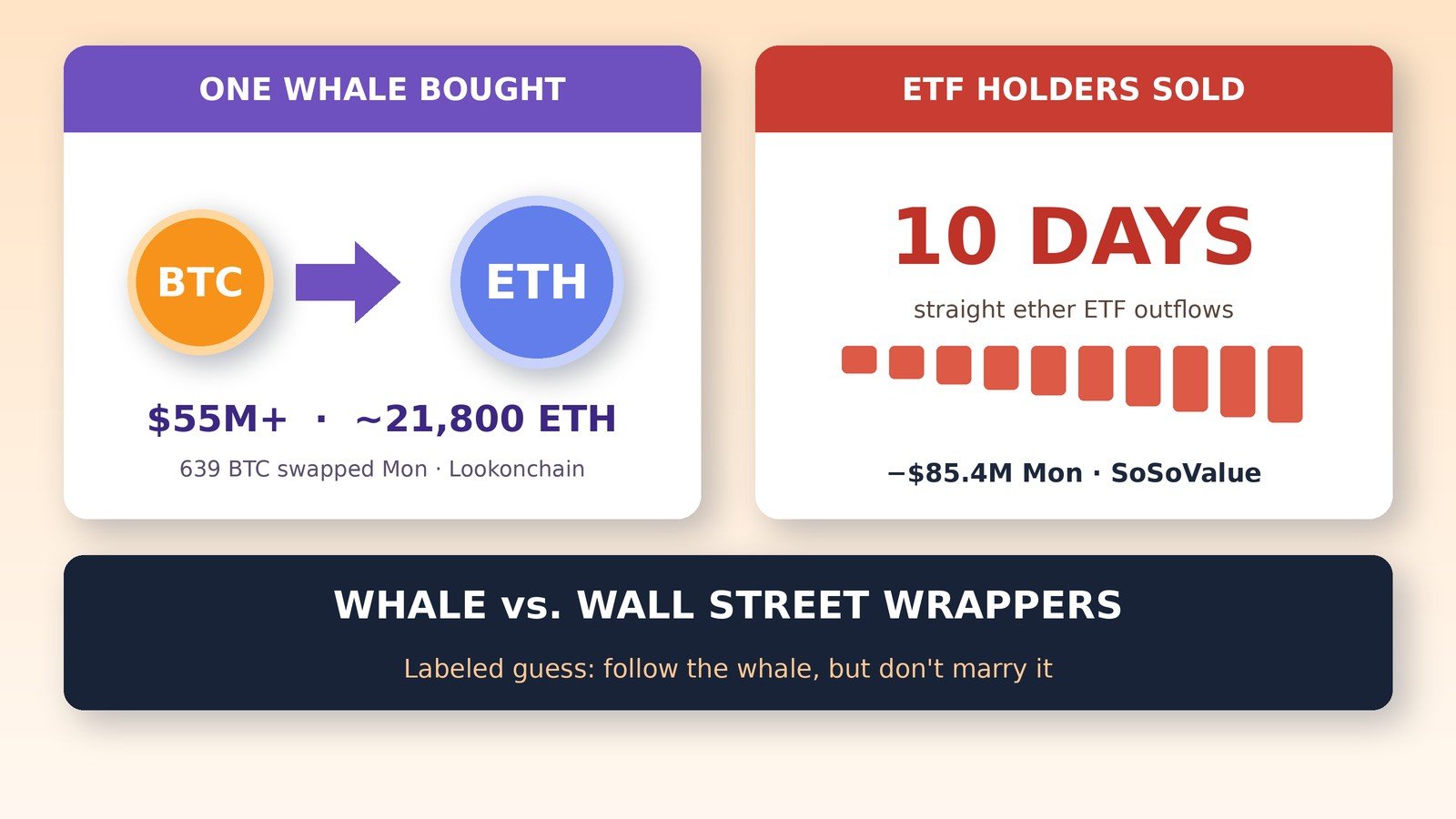
    Opinion. On Monday one whale went all in on ether. On the same day, ETF holders kept walking out the door for the tenth straight session. Somebody is wrong. Right now, the tape says it’s the whale.

    The whale’s trade

    Lookonchain flagged an unidentified wallet that sold 410.14 BTC, about $34.16 million, on Hyperliquid and then bought 14,341 ETH, about $36.14 million, on decentralized exchanges. Hours later the same wallet did it again: 229 BTC out, 7,469.8 ETH in, about $19.1 million each way. That’s more than $55 million moved from bitcoin into ether in one day, by one player. Lookonchain links it to an Arkham-tagged entity. Nobody has said who it is.

    Do the math on those fills and the whale paid roughly $2,520 to $2,560 per ether. By early Tuesday, ETH had slid to about $2,447, per KuCoin’s daily report, as a selloff in Korean chip stocks and more than $670 million in crypto liquidations hit the market. CoinDesk says ether has since bounced off five-day lows toward $2,500. Either way, the whale is starting underwater.

    The ETF crowd’s trade

    Now the other side. U.S. spot ether ETFs lost a net $85.4 million on Oct. 12, per SoSoValue data reported by TokenPost. That’s ten straight days of outflows. BlackRock’s ETHA alone shed $75.1 million. Lookonchain’s own weekly tally shows about 208,600 ETH, roughly $526 million, leaving the ether funds over seven days.

    So you’ve got one crypto-native trader buying $55 million of ether through Hyperliquid and Uniswap plumbing, and the Wall Street wrapper crowd selling more than that in a single afternoon.

    My read, labeled as a guess

    Here’s the speculation, and it’s only that. A wallet that rebalances this cleanly probably isn’t just guessing. It may hold a derivatives position we can’t see on-chain, or it may be betting that the ETF selling is close to done. On-chain trackers show the spot leg. They don’t show the whole book.

    And here’s the populist part. When the ETF tickers bleed, the headlines say “institutions are leaving ether.” But ETF flows only show fund holders pulling back. They don’t tell you what the people moving size on-chain are doing. My guess is the smart money that matters here isn’t the money with a ticker symbol.

    Still, one whale is not a season. If two or three more wallets make the same trade, and the ETF streak breaks, the story changes. Until then, “a whale bought ETH” is a fact. “Ether is about to rip” is a sales pitch. Follow the whale, but don’t marry it.

    This is opinion, not investment advice.

    Sources: Lookonchain; Lookonchain (second swap); Lookonchain (ETF flows); TokenPost; KuCoin; CoinDesk

  • Standard Chartered Starts Holding Ripple’s RLUSD in Dubai. The LMAX Collateral Link Isn’t Live Yet

    Standard Chartered Starts Holding Ripple’s RLUSD in Dubai. The LMAX Collateral Link Isn’t Live Yet

    Standard Chartered has started offering institutional custody of Ripple USD (RLUSD), Ripple’s dollar-pegged stablecoin issued on the XRP Ledger. The bank announced the service on Oct. 12 and is running it through its branch in the Dubai International Financial Centre, which the Dubai Financial Services Authority (DFSA) regulates.

    The second half of the announcement is not live yet. Standard Chartered, Ripple and LMAX Group say they are working to make RLUSD “eligible collateral for agreed LMAX Group products and solutions across trading and collateral management.” The releases from all three companies say those “agreed future capabilities remain subject to final documentation, successful testing, applicable laws and regulations, internal approvals and jurisdictional readiness.” None of them gave a launch date.

    What is live today

    What changes now is who holds the stablecoin. Eligible clients can keep RLUSD in a bank’s custody unit inside a DFSA-supervised branch, instead of with an exchange or a crypto-native custodian. The releases did not say which clients qualify, what the service costs, or how much RLUSD the bank holds.

    What is still a plan

    The planned piece is about how that custody would connect to trading. Under Standard Chartered’s “collateral mirroring” model, the value of eligible collateral would be mirrored to LMAX “without requiring the underlying RLUSD to be transferred directly to the trading venue,” the bank said. In plain terms, the bank would keep the tokens and the venue would accept their value as margin. The companies say this is meant to cut transfer-related operational risk and counterparty exposure. Neither the bank nor LMAX has published the legal or operational terms.

    “Institutional clients want to participate in digital asset markets without compromising on how their assets are safeguarded or how risk is managed,” said Waqar Chaudry, Standard Chartered’s global head of digital assets for securities services.

    Luke Dorney, LMAX Group’s head of custody for digital assets, said the venue had agreed “to adopt Standard Chartered’s collateral mirroring model.” Jack McDonald, Ripple’s senior vice president for stablecoins, said customers want “the efficiency of a regulated stablecoin without giving up the custody standards they already trust.”

    Several regulators, no single sign-off yet

    The custody sits under the DFSA in Dubai. LMAX’s businesses are licensed separately: according to the company, its FX exchange is regulated by the UK’s FCA and Singapore’s MAS, and LMAX Digital by Gibraltar’s GFSC. Which LMAX entity would accept RLUSD collateral, and under which approvals, has not been disclosed.

    The firms already have commercial ties. Ripple provided LMAX with $150 million in financing in January as part of plans to embed RLUSD in its infrastructure, CoinDesk reported. CoinDesk also reported last week that Standard Chartered plans to offer crypto and stablecoin custody to institutional clients in Singapore. That is a separate plan, and the Dubai launch says nothing about when it will start.

    The bottom line: a regulated bank is now holding RLUSD in Dubai. Using that RLUSD as collateral at LMAX is still a plan.

    Sources: Standard Chartered; Ripple; LMAX Group; CoinDesk

  • Whales Stacked, SPAC Holders Cashed Out: XRPN’s Day One Test

    Whales Stacked, SPAC Holders Cashed Out: XRPN’s Day One Test

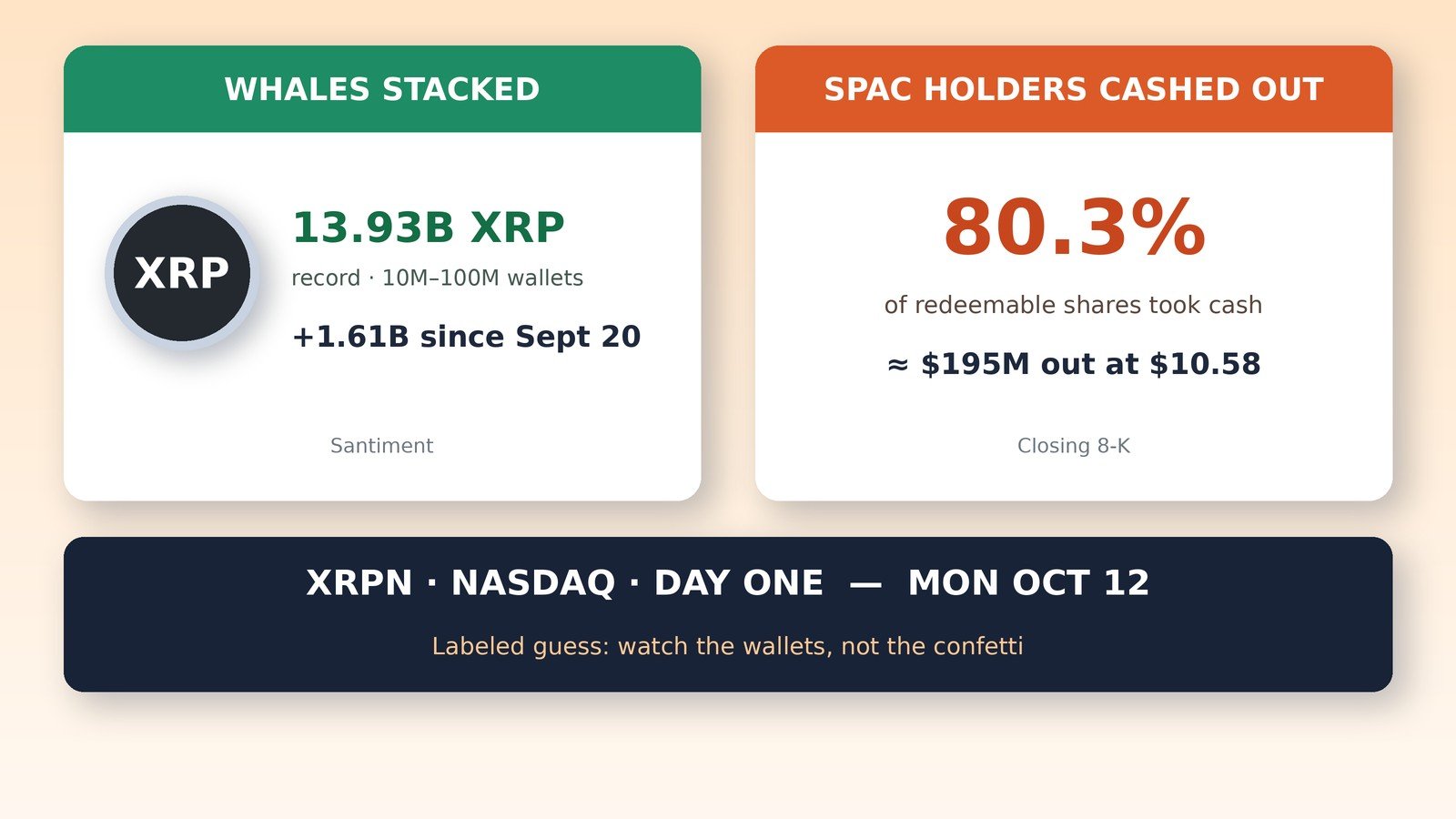
    Opinion. Today Evernorth’s XRPN and XRPNW start trading on Nasdaq. Wall Street finally gets an XRP treasury ticker. Before you cheer, look at who did what on the way in. The big wallets were buying. The SPAC crowd was cashing out.

    Two groups of “smart money.” Two opposite trades.

    The whales stacked

    Santiment data, as reported by The Crypto Basic, shows wallets holding 10 million to 100 million XRP added about 1.61 billion XRP from Sept. 20 into early October. That pushed the group to a record 13.93 billion XRP. A CryptoQuant contributor, per Bitcoin.com News, found 30-day whale withdrawals from Binance near 1.38 billion XRP, a seven-month high. Withdrawals alone don’t prove long-term holding, but coins leaving an exchange are not coins sitting on a sell button.

    The wrappers kept buying too. U.S. XRP ETFs added a net 7.9 million XRP in the week to Oct. 9, per XRP Insights, while spot bitcoin ETFs bled about $681 million, CoinDesk reported. XRP still lost about 7% on the week and sits near $1.40.

    The SPAC holders walked

    Now the other side. Evernorth’s closing filing shows holders of about 80.3% of Armada’s redeemable shares took roughly $10.58 a share, about $195 million in total, instead of riding into the new company. And the XRP filed at close adds up to about 389 million tokens, below the roughly 473 million Evernorth projected on Oct. 1.

    To be fair to Evernorth: redemptions are normal in SPAC deals, and a public company that files with the SEC is a cleaner way to hold XRP than a pile of promises. The skepticism here is aimed at the setup, not the people. Insiders and early money usually get the best seats. Retail usually gets the opening bell.

    My read, labeled as a guess

    Here is the speculation, and it is only that: some of that whale stacking looks like positioning ahead of exactly this week. The ticker opens today, and a closing-bell event is set for Oct. 14. If big wallets loaded up near the lows, a listing week full of headlines is a convenient time for someone to need buyers.

    My guess is the real tell won’t be today’s first print. It will be whether XRPN holds a premium to the XRP it owns once the party ends, and whether those whale balances keep climbing or start leaking back onto exchanges. Watch the wallets, not the confetti.

    This is opinion, not investment advice.

    Sources: Nasdaq Trader; SEC; The Crypto Basic; Bitcoin.com News; XRP Insights; CoinDesk

  • XRP Ledger Discloses Decade-Old Bug That Could Have Minted New XRP

    XRP Ledger Discloses Decade-Old Bug That Could Have Minted New XRP

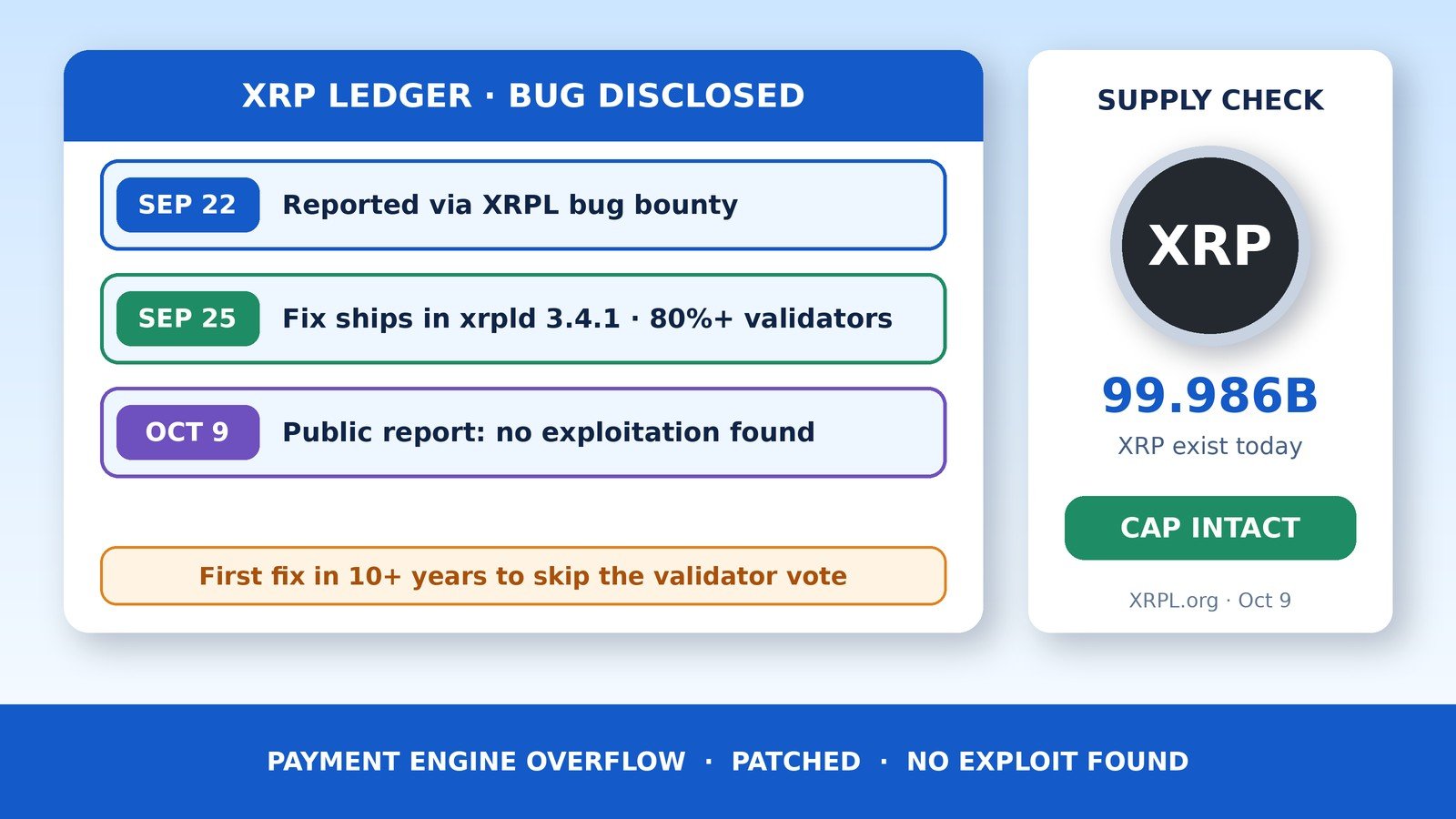
    The XRP Ledger’s core software carried a bug for roughly a decade that could have let an attacker create spendable XRP beyond the token’s fixed 100 billion supply, according to a vulnerability disclosure report published Oct. 9 on XRPL.org. The report says there is no evidence the flaw was exploited on any public network.

    What the bug did

    The problem sat in the ledger’s payment engine. When one payment consumed many offers from the built-in order book, the engine added up the XRP owed with 64-bit integer math and no overflow check. A large enough total wrapped around to a tiny number. Each offer owner was paid in full, while the buyer was charged only the wrapped amount.

    The ledger’s “no XRP created” safety check used the same arithmetic, so it missed the gap too. A separate per-account limit did not trip either, because the new XRP would have been spread across hundreds of accounts.

    It could not happen by accident, the report says. It took hundreds of offers priced in a way no real trader would use, then a payment built to consume them all at once. The cost to an attacker would have been a few hundred XRP in reserves plus fees.

    Who found it

    Researcher Cayden Liao and Veria AI reported the flaw through the XRPL bug bounty program on Sept. 22. RippleX reproduced it the same day and raised the severity to critical. Veria Labs says its proof of concept could have created about 18.4 trillion XRP in one transaction, and that it received the program’s maximum $250,000 bounty. Those are the firm’s own figures.

    The fix shipped in xrpld 3.4.1 on Sept. 25. More than 80% of default validators were running it that day, per the report. The supply check now uses a wider counter that cannot wrap.

    The governance question

    How it shipped is the bigger story for the network. Rule changes on the ledger normally go through amendments, which must hold more than 80% validator support for two weeks before switching on. This fix took effect on each server as soon as it upgraded. The report calls it the first deliberate exception in more than ten years.

    The report’s reasoning: the code is open source, so a normal amendment would have shown attackers where the bug was for weeks while it was still live on Mainnet. Validators received compiled software before the source code was public.

    That sequence drew criticism from Cyber Capital founder Justin Bons, who argued a public ledger briefly ran on closed code, ETHNews reported. The report says the call was made with the XRPL Foundation, RippleX and validators, and that skipping amendments stays reserved for the most severe bugs. The 3.4.1 source code has since been published.

    What it means now

    The same release carried a separate fix for the new Batch feature, which went live on Mainnet Oct. 9 through a normal amendment vote. Servers not running 3.4.1 or later are now amendment blocked. The report does not ask XRP holders to do anything.

    About 99.986 billion XRP exist today, slightly under 100 billion because fees are burned, CoinDesk reported, citing the foundation. XRP traded near $1.40 Monday morning, little changed on the day.

    This is reporting, not investment advice.

    Sources: XRPL.org, Veria Labs, CoinDesk, ETHNews, Kraken

  • Special Report: Ledger Confirms Reseller Device Implant; XRPN Debuts on Nasdaq Monday

    Special Report: Ledger Confirms Reseller Device Implant; XRPN Debuts on Nasdaq Monday

    Special Report. Two custody and market-rails stories for the week ahead.

    1. Ledger confirms a hardware implant in a reseller-sold device

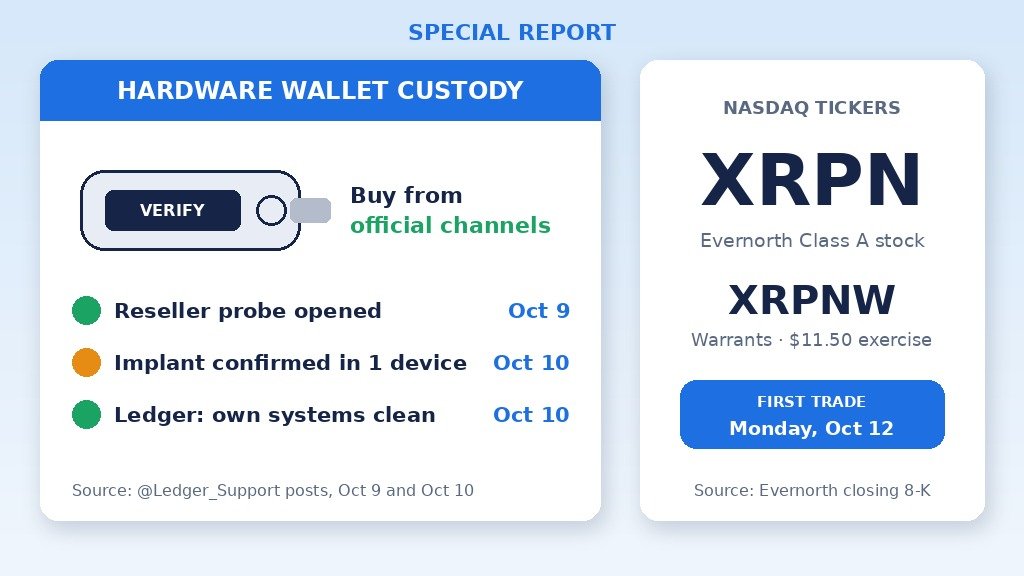
    Ledger said Saturday that one affected user’s device contained an unauthorized hardware implant. The update came from @Ledger_Support at 1:09 p.m. Eastern. Ledger said it is reaching out to impacted users as its investigation continues.

    The probe started Friday. In an Oct. 9 statement, Ledger said it was investigating reported losses among users in Southeast Asia who bought devices from CryptoBilis, a reseller. Ledger asked CryptoBilis to pause all sales and shipments of Ledger devices. News reports describe CryptoBilis as an authorized reseller in Indonesia, Malaysia and the Philippines.

    Ledger said it has no indication that its security infrastructure, systems or services have been compromised, per @Ledger_Support replies on Saturday. Ledger has confirmed one implanted device. It has not said how many devices were affected or how the implant got there.

    Loss figures are not from Ledger. On-chain researchers tanuki42 and Specter published thief addresses with losses above $86 million. Blockchain data firm Bitquery, in a tally verified Oct. 11, counts $93.2 million taken from 315 wallets across six chains, mostly USDT on TRON. Bitquery says Tether froze $10.0 million. Ledger has not confirmed any of these totals.

    Independent research adds context but not proof. Tibane Labs examined two Nano X units with suspected implants that could read the recovery words shown during setup, ForkLog reported. Those units were not shown to come from CryptoBilis.

    What Ledger advises. If you bought from CryptoBilis in the last 90 days and have not set up the device, do not set it up. If you already set it up, consider moving assets to a new Ledger signer with a new recovery phrase. Never share your 24 words with anyone, including people claiming to be Ledger.

    Basic custody hygiene.

    • Buy hardware wallets only from the maker’s official store or resellers it lists by name.
    • Run the device’s built-in authenticity check through the official Ledger Wallet app before loading funds.
    • Be wary of a device that arrives with a recovery phrase already printed or set up.
    • Generate your own seed on the device, and keep it offline.

    The key point is the supply chain. A hardware wallet is only as trusted as the path it took to your hands.

    2. XRPN debuts on Nasdaq Monday

    Evernorth’s closing 8-K, filed Oct. 9 at 4:25 p.m. Eastern, names Monday, Oct. 12 for Nasdaq trading. Class A shares trade as XRPN. Warrants trade as XRPNW. As of Sunday morning, Oct. 11, EDGAR shows no newer Evernorth filing.

    The filed facts:

    • The Armada merger closed Oct. 9.
    • About 80.3% of shares with redemption rights cashed out, about $195.39 million in total.
    • The XRP lots filed at closing add up to about 389 million XRP. Evernorth projected about 473 million on Oct. 1.
    • Each XRPNW warrant lets the holder buy one Class A share at $11.50.

    What to watch on day one. First prints for XRPN and XRPNW. Trading volume against a float thinned by heavy redemptions. Any first holdings update or press release from Evernorth. Any fresh SEC filing, such as a Form 4 or a resale prospectus.

    The trust angle holds. Evernorth’s XRP now sits inside a Nasdaq-listed company that reports to the SEC. Monday shows how the market prices that wrapper. Background: Westen’s Evernorth close piece.

    This is reporting, not investment advice. Hardwire Crypto makes no price calls.

  • Evernorth Closes Armada Merger; XRPN Approved for Nasdaq

    Evernorth Closes Armada Merger; XRPN Approved for Nasdaq

    Evernorth Holdings has closed its merger with Armada Acquisition Corp. II. A Form 8-K accepted at 4:25 p.m. ET on Friday says the business combination was consummated on October 9, 2026.

    That moves the deal from expected to done. Earlier this week, Evernorth said it expected to close on or about Oct. 9, citing an administrative delay. It closed on that date.

    The paper trail

    Friday’s filings came in order. At 9:16 a.m. ET, Evernorth filed a Form 8-A to register its Class A common stock and its warrants on the Nasdaq Stock Market. Each warrant lets the holder buy one share at $11.50.

    At 2:09 p.m. ET, Nasdaq filed its certification approving the listing. A prospectus supplement at 4:10 p.m. said the stock and warrants were approved for listing on the Nasdaq Global Market. The warrants will trade as XRPNW.

    The closing 8-K followed at 4:25 p.m. It also records one housekeeping step tied to the close. On Oct. 9, Evernorth took over Armada’s warrant agreement through an assignment and assumption agreement with Armada and the warrant agent, Continental Stock Transfer & Trust. The exercise period did not change.

    Redemptions and cash at close

    Armada shareholders redeemed heavily. Holders of 18,463,753 Class A shares, about 80.3% of the shares with redemption rights, cashed out at about $10.58 a share. The aggregate redemption amount was about $195.39 million.

    Against that outflow, Friday’s 8-K lists cash that came in with the close. Advance-funding subscribers put up about $214.05 million in cash (plus 600,000 XRP). Delayed-funding subscribers added $10.5 million in cash (plus 200,000 XRP).

    XRP that closed with the deal

    The same filing lists the large XRP moves tied to closing. Arrington XRP Capital Fund subscribed with about 211.3 million XRP. Ripple contributed about 126.8 million XRP under its contribution agreement. A Ripple-affiliated trust subscribed with 50 million XRP. Smaller subscriber XRP lots totaled another 800,000.

    Added together, those closing subscriptions and Ripple’s contribution come to about 389 million XRP. That is the filed package at close. It is not a later treasury report, and it is below the roughly 473 million XRP Evernorth had projected on Oct. 1.

    When XRPN trades

    The closing 8-K states that Pubco Class A common stock and Pubco warrants began trading on Nasdaq on October 12, 2026 under XRPN and XRPNW. That is Monday. An Oct. 6 8-K had said “on or about” that date. Friday’s closing filing names Oct. 12 without the hedge.

    As of the close, Evernorth reported 22,268,905 Class A shares, 32,211,992 Class C shares, and 11,739,645 warrants outstanding.

    For the XRP market, the point is the wrapper. Evernorth now holds its XRP inside a Nasdaq-listed company that files with the SEC. Investors will be able to track it through public reports, not just company posts.

  • The DCM Stampede: Licenses Before Rails, Press Releases Before Product

    The DCM Stampede: Licenses Before Rails, Press Releases Before Product

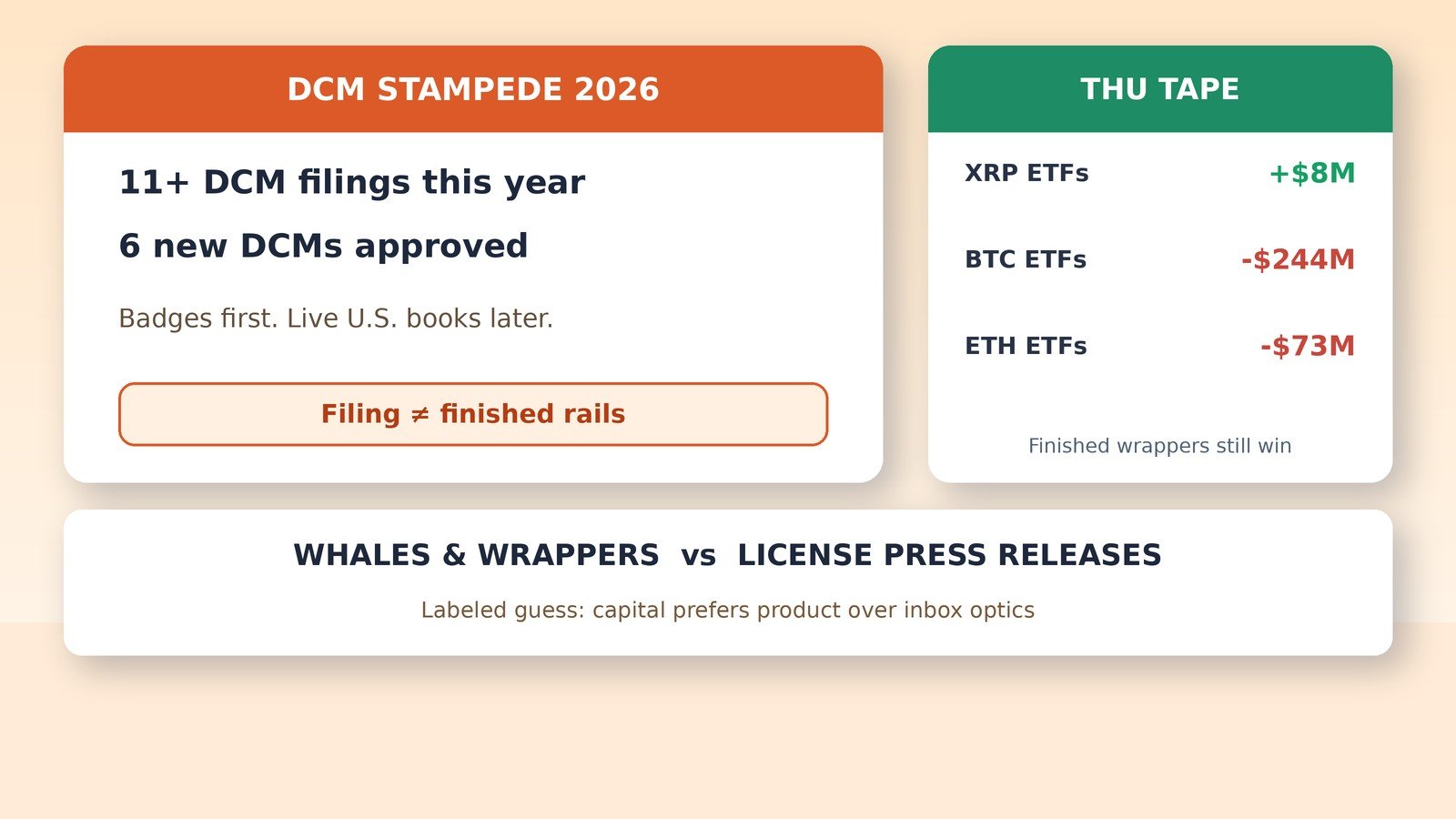
    Opinion. The CFTC inbox is having a moment. Blockchain.com told CNBC it filed for designated contract market and futures commission merchant licenses so it can chase U.S. event contracts and crypto derivatives. CNBC says it joins 11 other DCM filers this year, and the agency has already approved six new DCMs in 2026. That is a stampede for badges. It is not the same as finished U.S. rails.

    Everybody wants the DCM sticker before anybody finishes the product.

    Filings are cheap. Distribution is not.

    Finance Magnates checked the paperwork that actually shows up in public view. Blockchain.com Derivatives Inc. has had an FCM registration and NFA membership pending since Aug. 25. Still under review. Not authorized. The reported DCM application was not yet on the CFTC’s public list Friday, and there is no public rulebook, product list, or launch date. Press release first. Queue later.

    To be clear, I am not roasting Blockchain.com for filing. Filing the right forms is what serious shops do. The skepticism is aimed at the system: regulators get a parade of applications, markets get a parade of headlines, and retail gets the impression that U.S. prediction-market product is already on the shelf.

    Where the money actually went

    Look at Thursday’s tape for the contrast, used lightly because Friday already chewed on it. U.S. spot XRP ETFs took in about $8.17 million, all into Franklin’s XRPZ, while bitcoin ETFs lost about $244 million, ether about $73 million, and SOL about $3 million, per SoSoValue figures carried by CoinDesk and Benzinga. Same week, leveraged liquidations ran near $1.19 billion and XRP swept near $1.32 before rebounding toward $1.40. Whales and wrappers moved. License press releases did not clear those orders.

    Follow the cash, not the inbox. When institutions want exposure, they fund finished distribution. On Thursday that was an ETF wrapper, not a DCM application PDF.

    My read, labeled as a guess

    Here is the speculation, and it is only that: 2026’s prediction-market license stampede is partly regulatory theater and partly IPO optics. Blockchain.com confidentially filed for an IPO in May, with Bloomberg floating a roughly $4 billion to $6 billion valuation and about a $500 million raise. Dual DCM and FCM applications make a clean diligence slide. They do not mint a live U.S. event-contract book.

    My guess is capital still prefers finished wrappers over license press releases. DCM badges will matter when the public queue lists the name, when FCM clears, and when customers can actually trade under those rails. Until then, the stampede is noise around a CFTC inbox, and the tape still pays the shops that already shipped distribution.

    Sources: CNBC; Finance Magnates; CoinDesk

  • Blockchain.com Seeks CFTC DCM and FCM Licenses for U.S. Prediction Markets

    Blockchain.com Seeks CFTC DCM and FCM Licenses for U.S. Prediction Markets

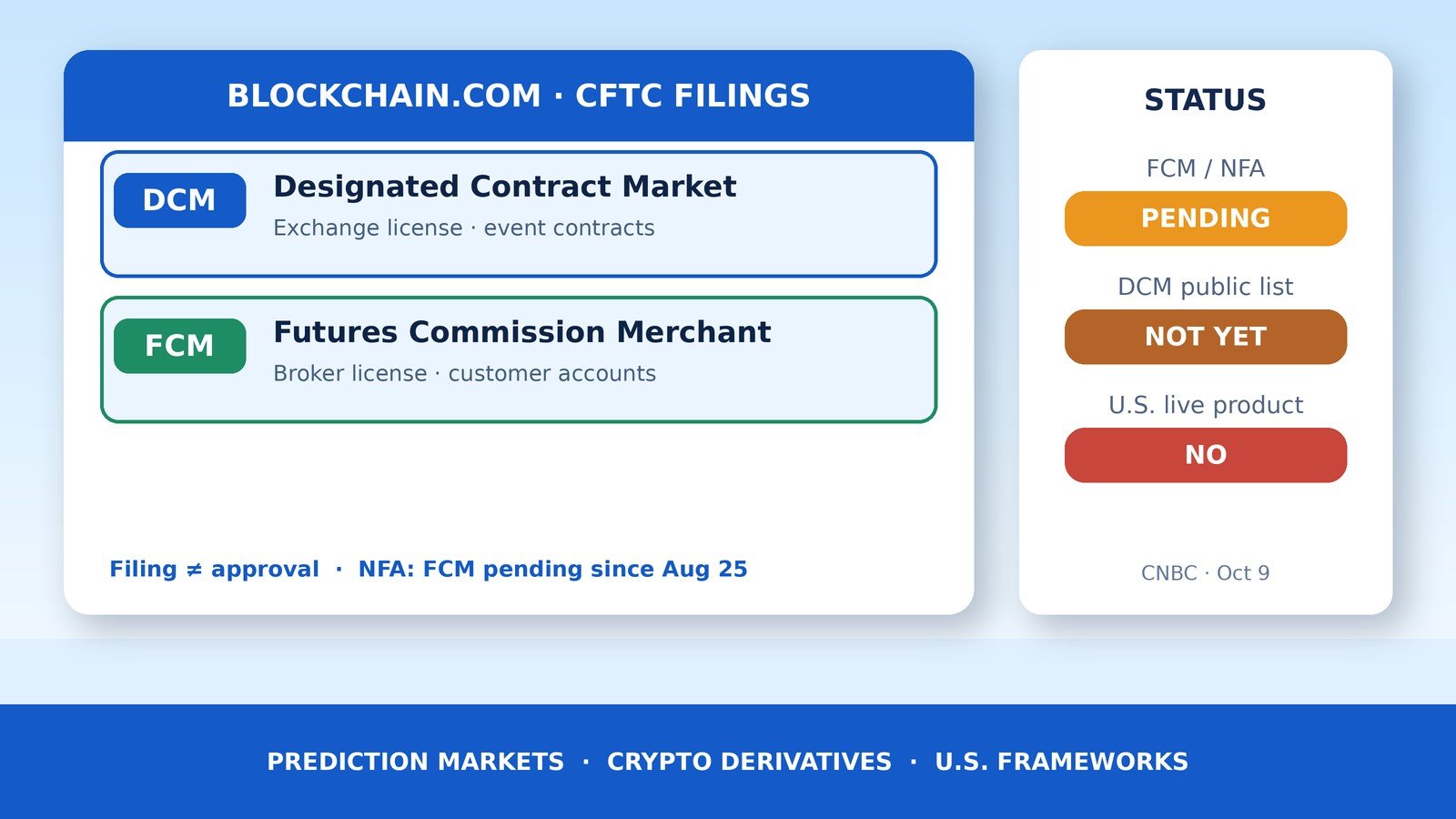
    Blockchain.com told CNBC on Friday that it has applied for Commodity Futures Trading Commission licenses to offer U.S. event contracts and cryptocurrency derivatives. The company is seeking designation as a designated contract market, the exchange license for futures and event contracts, and registration as a futures commission merchant, the broker classification that handles customer derivatives accounts.

    That is a filing story, not an approval story. The firm is not yet authorized to run those U.S. products under the licenses it says it seeks.

    What the company said

    CEO and co-founder Peter Smith told CNBC that users should be able to manage digital assets, trade derivatives, and take positions on real-world events in one place, without jumping between apps. He said the DCM and FCM applications build toward that future in the United States through the appropriate regulatory frameworks.

    Blockchain.com already offers prediction markets through a Polymarket partnership and perpetual futures powered by Hyperliquid to some international customers outside the United States, per CNBC. The dual filings would, if approved, move the firm from distributing partners’ products toward operating its own U.S. exchange and brokerage stack.

    What public records show so far

    Finance Magnates, citing National Futures Association records, reported that Blockchain.com Derivatives Inc. has had pending applications for FCM registration and NFA membership since Aug. 25. Those applications remain under review. The firm is not yet authorized to conduct FCM business.

    Finance Magnates also reported that the DCM application was not yet visible in public CFTC records as of Friday, and that no public filing disclosed products, market-access details, or a launch date. Treat the DCM claim as company-to-CNBC disclosure until it appears in the regulator’s public queue.

    The stampede context

    CNBC said Blockchain.com joins 11 other companies that have filed for DCM licenses this year. The CFTC has approved six new DCMs in 2026. More firms are chasing the prediction-market boom. Approvals and live U.S. product are still separate steps.

    Separately, Blockchain.com confidentially filed for an IPO with the Securities and Exchange Commission in May. Bloomberg previously reported ambitions around a roughly $4 billion to $6 billion valuation and about a $500 million raise. That is IPO optics context, not the lead of this filing.

    Rails and trust

    DCM plus FCM would be a model shift: from reseller of Polymarket and Hyperliquid rails to an in-house exchange-and-broker structure for eligible U.S. customers. Finance Magnates noted a similar path at Robinhood, which began by distributing external event contracts before moving toward its own market infrastructure. Blockchain.com has not disclosed whether it would build, buy, or outsource clearing.

    For Hardwire readers, the checklist is simple. Watch for the DCM name on the CFTC’s public applicants list. Watch whether the FCM application clears NFA review. Filing is not a license. A license is not a live U.S. product book.

    Sources: CNBC; Finance Magnates

  • Bank Rails Went Live. The Burn Lever Still Carries a Mint Risk.

    Bank Rails Went Live. The Burn Lever Still Carries a Mint Risk.

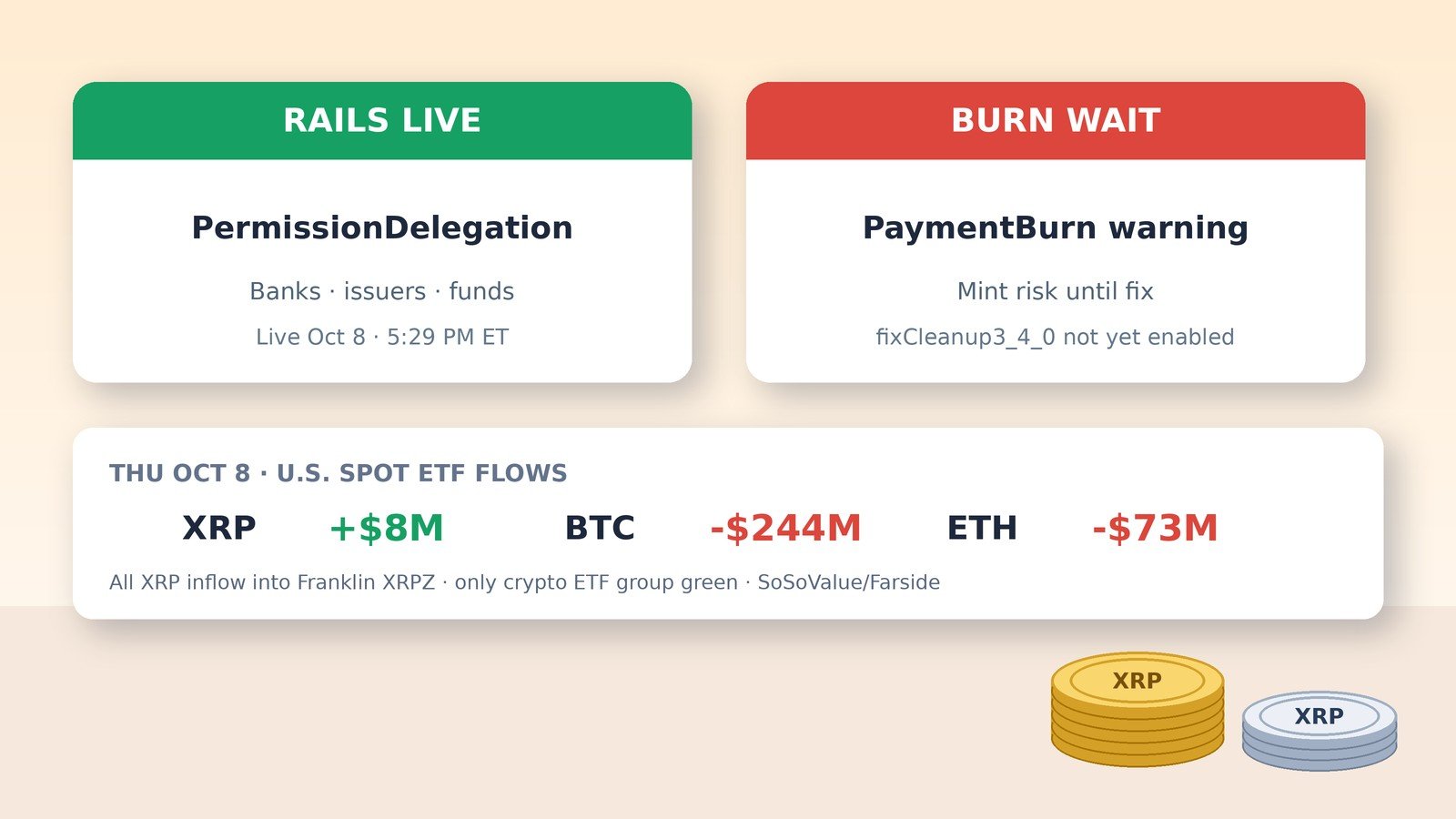
    Opinion. Thursday evening the XRP Ledger flipped on bank-style permission splits. Account owners can now hand payments to one helper, compliance to another, and keep the master keys offline. CoinDesk called it new controls for banks, stablecoins and tokenized funds. Then look at the tape that hit the same window: U.S. spot XRP ETFs were the only crypto ETF group in the green, taking in about $8 million, while bitcoin funds lost about $244 million and ether funds about $73 million, per SoSoValue data in CoinDesk’s live updates.

    Infrastructure PR on one side. Selective money on the other. Somebody is reading the fine print.

    Rails got a role map. Burning did not.

    PermissionDelegationV1_1 went live at ledger 107,524,865 on October 8, at 5:29 p.m. ET, per the ledger’s own record. That is real plumbing. Batch, the all-or-nothing bundling feature, is next in line Friday morning, if validator majorities hold. It is not live yet. A stablecoin desk can approve customers without parking the treasury key on the same laptop. Good.

    Here is the part the launch thread often skips. Official XRPL docs still say do not delegate PaymentBurn until fixCleanup3_4_0 activates. Before that fix, a helper with burn rights can, in some cases, mint issued tokens. The ledger logged a majority for that cleanup early Friday, but the roll calls disagree: 28 of 35 on XRPL Dashboard, 27 of 35 per CoinDesk, with 29 needed. Even if it holds, the earliest it could switch on is around Oct. 23. So the ledger sold “bank controls” while one of the burn levers still carries a mint risk. Rails are live. Rails are not finished.

    Who showed up with cash

    On Thursday’s ETF tape, all of that XRP inflow went into Franklin Templeton’s XRPZ, which added about 6 million XRP. The other four XRP funds saw zero flow. Bitcoin ETFs were deep red after Wednesday’s $485 million outflow. Ether and SOL funds bled too. That is not “crypto risk-on.” That is one fund family catching the only green print while the rest of the complex paid the liquidation bill from a roughly $1.19 billion leveraged washout.

    Follow the money, not the keynote. When institutions actually like a rail, they fund the wrapper that sits on top of it. On Thursday that wrapper was XRPZ, not a fresh round of “coming soon” bank pilots.

    My read, labeled as a guess

    Here is the speculation, and it is only that: the market is pricing finished distribution, not unfinished permission specs. Permission maps and offline master keys are what banks ask for in diligence decks. They are not the same as a named issuer running live customer approval on-ledger, and they are not the same as PaymentBurn being safe to hand to a helper. My guess is Franklin’s buyers were paying for ETF access and custody packaging, while the amendment headline bought attention that the burn warning still has to earn back.

    To be clear, turning on role-based delegation is the right direction. Separation of duties belongs on these ledgers. The populist question is simpler: if the ledger needs a cleanup amendment before one burn permission is safe, why does the launch copy sound like the bank branch already opened? Watch two things: when fixCleanup3_4_0 clears the two-week bar, and whether XRP ETF inflows keep showing up on days bitcoin funds are dumping.

    Sources: Farside Investors; XRPL.org Known Amendments; XRPL Dashboard; CoinDesk (PermissionDelegation); CoinDesk (ETF live updates); XRPL documentation

  • XRPL Batch Day: What Actually Turns On This Morning

    XRPL Batch Day: What Actually Turns On This Morning

    Permission Delegation is no longer a forecast on the XRP Ledger. The PermissionDelegationV1_1 amendment enabled on mainnet Thursday at 5:29 p.m. ET, in ledger 107,524,865. The ledger’s own EnableAmendment record shows it, and XRPL Dashboard and CoinDesk reported the same activation.

    Friday’s clock is Batch. It is not live yet.

    What is scheduled this morning

    Two Batch amendments reach the end of their two-week windows Friday, if validator majorities hold. The ledger’s Amendments record shows fixBatchV1_2 gained its majority on Sept. 25 at 10:12 a.m. ET, and BatchV1_1 at 10:46 a.m. ET the same day.

    That puts fixBatchV1_2’s projected activation at about 10:12 a.m. ET Friday. The switch itself happens in an EnableAmendment pseudo-transaction on a following flag ledger, expected around 10:29 a.m. BatchV1_1 follows: projected at about 10:46 a.m., with its enable transaction expected near 11:03 a.m.

    These are projections, not guaranteed times. An amendment needs more than 80% of trusted validators for two straight weeks. With 35 validators on the current list, that means at least 29 yes votes. If support drops to 28 or below, the majority is lost and the two-week clock restarts. That happened to Permission Delegation in September.

    The vote margins

    XRPL Dashboard’s roll call early Friday showed fixBatchV1_2 at 35 of 35 trusted validators. BatchV1_1 sat at 30 of 35, one vote above the 29 needed. Counts differ by tracker, so treat these as one source’s read.

    What Batch does

    BatchV1_1 adds the Batch transaction. One account can submit up to eight inner transactions together. They can be set as all-or-nothing groups, so a two-sided settlement either completes in full or not at all. The standard is XLS-56.

    BatchV1_1 replaces the original Batch amendment. That version was disabled in xrpld 3.1.1 after developers found a critical bug, per XRPL.org. fixBatchV1_2 is the companion fix. It shipped in xrpld 3.4.1, an emergency release for security-sensitive issues. Servers on older software risk becoming “amendment blocked,” unable to keep up with the ledger, once it turns on.

    The PaymentBurn caveat stays

    Permission Delegation’s warning is unchanged. Until fixCleanup3_4_0 is enabled, XRPL.org recommends not delegating the PaymentBurn permission. Before that fix, a delegate holding it can also mint new trust-line tokens or MPTs in certain cases. Other permissions are unaffected.

    The fix is not close to done. The ledger logged a majority for fixCleanup3_4_0 early Friday, about 5:34 a.m. ET. If that held for two weeks, the earliest activation would be around Oct. 23. But Friday morning roll calls had it at or below the line: 28 of 35 on XRPL Dashboard, and 27 of 35 in CoinDesk’s report. Treat PaymentBurn as off-limits for now.

    Evernorth: expected is not closed

    Separately, Evernorth’s Oct. 6 Form 8-K still points to a closing “on or about” Oct. 9 and Nasdaq trading as XRPN “on or about” Oct. 12. As of Friday morning, EDGAR showed no closing 8-K. Expected is not closed.

    What to check

    Batch day is a protocol event. It is about capability and operator risk, not price. Before treating either Batch amendment as live, look for its EnableAmendment transaction on the ledger after the morning windows, not just the countdown.

    Sources: XRPL.org Known Amendments; XRP Ledger Amendments object and ledger 107,524,865; XRPL Dashboard; CoinDesk; SEC EDGAR