Blog

  • Whales Are Hoarding XRP While Leveraged Longs Pay the Toll

    Whales Are Hoarding XRP While Leveraged Longs Pay the Toll

    Opinion. On paper, this was XRP’s best week of the fall. Paxos, the regulated back end behind crypto at some of the biggest apps in finance, switched on XRP for its partners. A top Korean brokerage, Meritz Securities, signed up to study Ripple’s custody tech. Evernorth’s XRP treasury company still expects to start trading on Nasdaq on Monday. And the price? XRP was near $1.40 on Thursday, down nearly 7% on the week, FXStreet reported.

    Good news, falling price. Somebody is getting played. So follow the whales.

    Where the big coins went

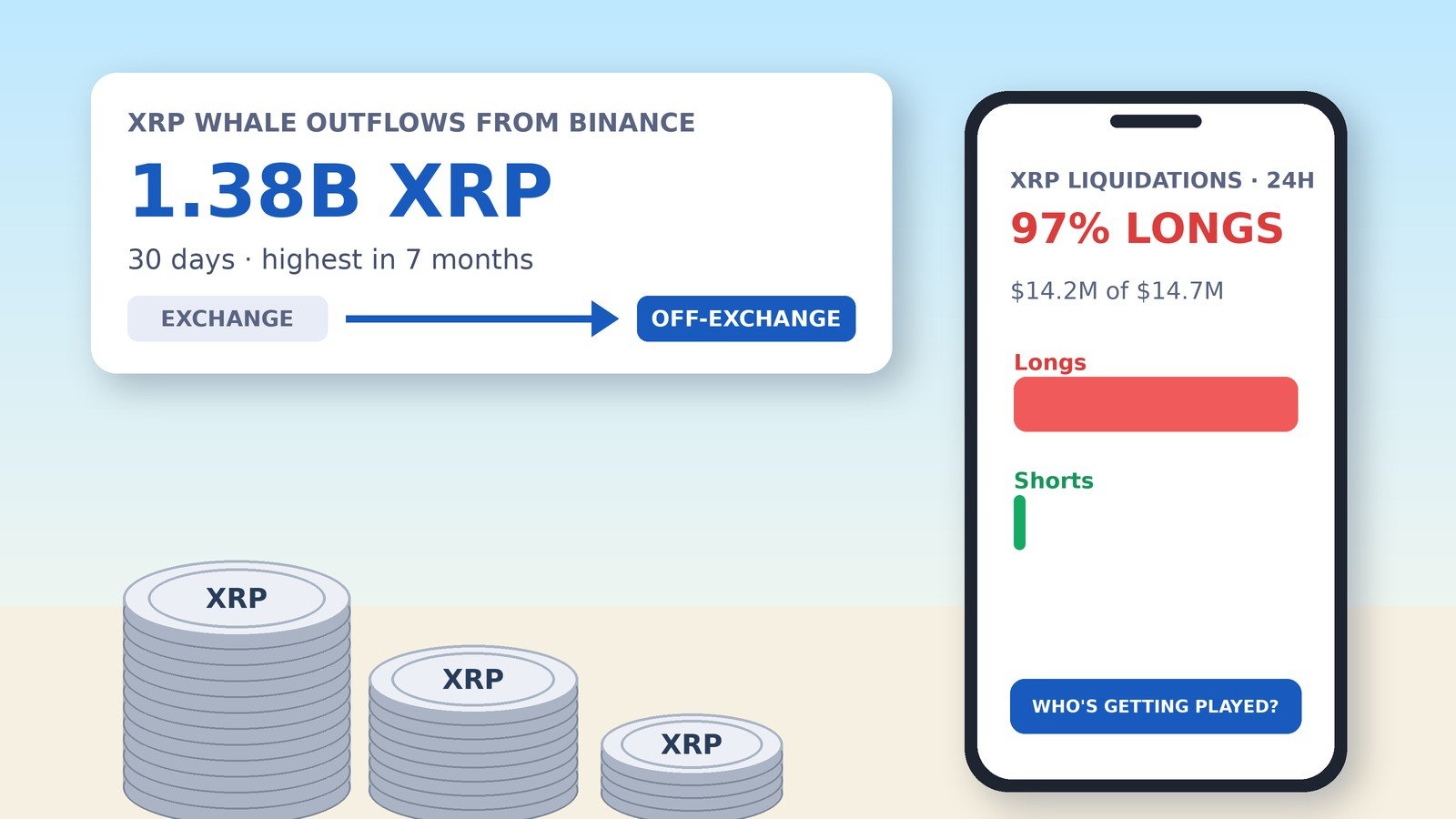
    Large holders have been pulling XRP off the biggest exchange. The 30-day sum of whale outflows from Binance hit 1.38 billion XRP, the highest in seven months, according to CryptoQuant data cited by CoinGape.

    Santiment’s wallet data points the same way. Wallets holding 10 million to 100 million XRP added about 1.61 billion tokens in the two weeks after September 20, reaching a record 13.93 billion XRP as of October 3, The Crypto Basic reported.

    Fair warning: coins leaving an exchange are not proof of buying. Big wallets can belong to custodians, funds or Ripple itself, and exchange flows run in both directions. But coins moved to storage are not sitting on an order book waiting to be sold, either.

    Who paid for the dip

    Now look at who got hurt. Over the past 24 hours XRP saw $14.69 million in liquidations, and $14.24 million of it, about 97%, was long positions, according to CoinGlass data reported by The Crypto Times. That is the leveraged crowd that bought the headlines.

    The fund crowd sat on its hands. U.S. spot XRP ETFs recorded exactly zero net flow on Wednesday, while bitcoin ETFs lost $487 million and ether ETFs $161 million, per SoSoValue data compiled by CoinGabbar. And Washington did not help. Fed minutes released Wednesday showed most officials expect another hike by year-end, with Treasury yields near their highest since 2002, CNBC reported. When cash pays again, leverage pays the bill.

    My read, labeled as a guess

    Here is the speculation, and it is only that: the whales are positioning for the day a household-name app actually turns on the Paxos pipe. They would rather fill their bags from margin calls this week than compete with brokerage customers later. Wall Street gets the plumbing first. Main Street gets the liquidation notice.

    To be clear, that is not a knock on Paxos. Building regulated rails, and saying so in public, is exactly what this market needs more of. The question is who gets to use those rails first, and at what price. Watch two things: which partner flips XRP on for its customers, and whether whale balances keep climbing if $1.40 breaks.

    Sources: Paxos on X; FXStreet; CoinGape; The Crypto Basic; The Crypto Times; CoinGabbar; CNBC
  • Paxos Adds XRP to the Brokerage Rails Used by PayPal, Venmo and Schwab

    Paxos Adds XRP to the Brokerage Rails Used by PayPal, Venmo and Schwab

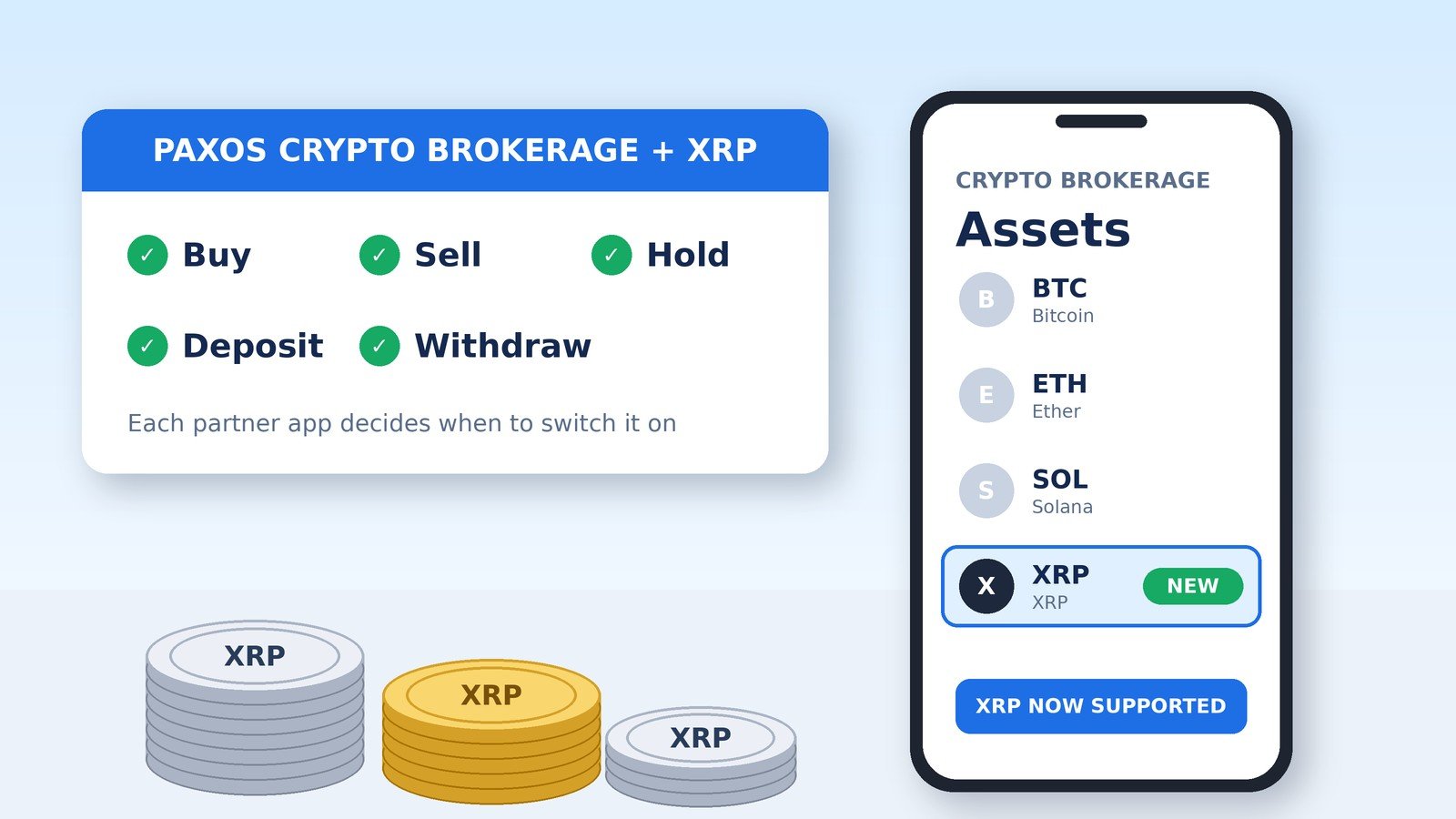
    Paxos has added XRP to Paxos Crypto Brokerage, the white-label trading and custody service it runs for banks, brokerages and payment apps. “Paxos Crypto Brokerage now supports $XRP,” the company posted on X on Wednesday morning. “Partners can now offer XRP through the same regulated platform trusted by some of the biggest names in finance.”

    The XRP Ledger Foundation, a non-profit that supports the network, filled in the client list. In its own post, it called Paxos Crypto Brokerage “the regulated back end used by PayPal, Venmo, Interactive Brokers, Charles Schwab, and Mercado Libre,” and said partners can offer XRP “for buy, sell, hold, deposit, and withdrawal.” Paxos replied: “The Paxos Crypto Brokerage lineup just got stronger.”

    What changed, and what didn’t

    What changed is the plumbing. A firm that already uses Paxos for crypto trading can now add XRP without building its own custody, liquidity connections or trade monitoring. Paxos says on its brokerage page that it “never trades against your clients,” benchmarks fills against independent price feeds, and puts every new asset through a review of “legal classification, liquidity, and regulatory history” before listing it. Paxos also says it is now federally chartered by the OCC and custodies assets on a fiduciary basis.

    What has not changed, yet, is what customers see. None of the named platforms has announced an XRP launch for its own users. Each partner picks its own lineup. Schwab is a useful example: Paxos handles trade execution and sub-custody for Schwab’s crypto service, while Charles Schwab Premier Bank holds customer assets, crypto.news reported. Schwab’s August expansion named Solana, Avalanche and Chainlink. XRP was not on that list.

    The addition fits a steady build-out. Paxos had more than doubled its brokerage list to 29 tokens by June and set a goal of covering much of the top 50 by year-end, Bitcoin.com News reported, citing head of brokerage product Asset Tarabayev.

    Korea gets a Ripple partner too

    The same day, South Korean brokerage Meritz Securities disclosed a strategic partnership with Ripple. The two will review how Ripple Custody and Ripple’s tokenization infrastructure could be used in Korea’s capital markets, The Herald Business reported. Meritz CEO Jang Won-jae and Ripple President Monica Long attended the signing at Meritz’s Yeouido headquarters, which took place on October 1, according to Seoul Economic Daily.

    Meritz says it will start inside current securities rules and widen the work in stages as Korea’s digital asset regime develops. It is studying spot crypto ETFs, fractional and tokenized securities, trading platforms and won-denominated stablecoins. No product or launch date has been announced. “We look forward to exploring how digital asset infrastructure can support the continued development of Korea’s capital markets,” said Fiona Murray, Ripple’s head of Asia-Pacific.

    The rails view

    Both moves are distribution, not demand. Paxos opens a regulated door that large consumer apps already walk through. Meritz puts Ripple’s custody stack in front of a top Korean brokerage before the rules are final. The trust markers to watch are concrete: a named partner switching XRP on for its own customers, and a first Meritz product with a filing or a date.

    The market did not wait for either. XRP traded near $1.40 on Thursday morning, down about 3% in 24 hours, per CoinGecko, after Wednesday’s Fed minutes showed most officials expect another rate hike by year-end, CNBC reported. U.S. spot XRP ETFs recorded zero net flow on Wednesday, while bitcoin ETFs lost $487 million, according to SoSoValue data compiled by CoinGabbar.

    Sources: Paxos on X; XRP Ledger Foundation on X; Paxos; crypto.news; Bitcoin.com News; The Herald Business; Seoul Economic Daily; CNBC; CoinGabbar

  • The Biggest Ether Whale Just Put a Ceiling on Its Own Bid

    The Biggest Ether Whale Just Put a Ceiling on Its Own Bid

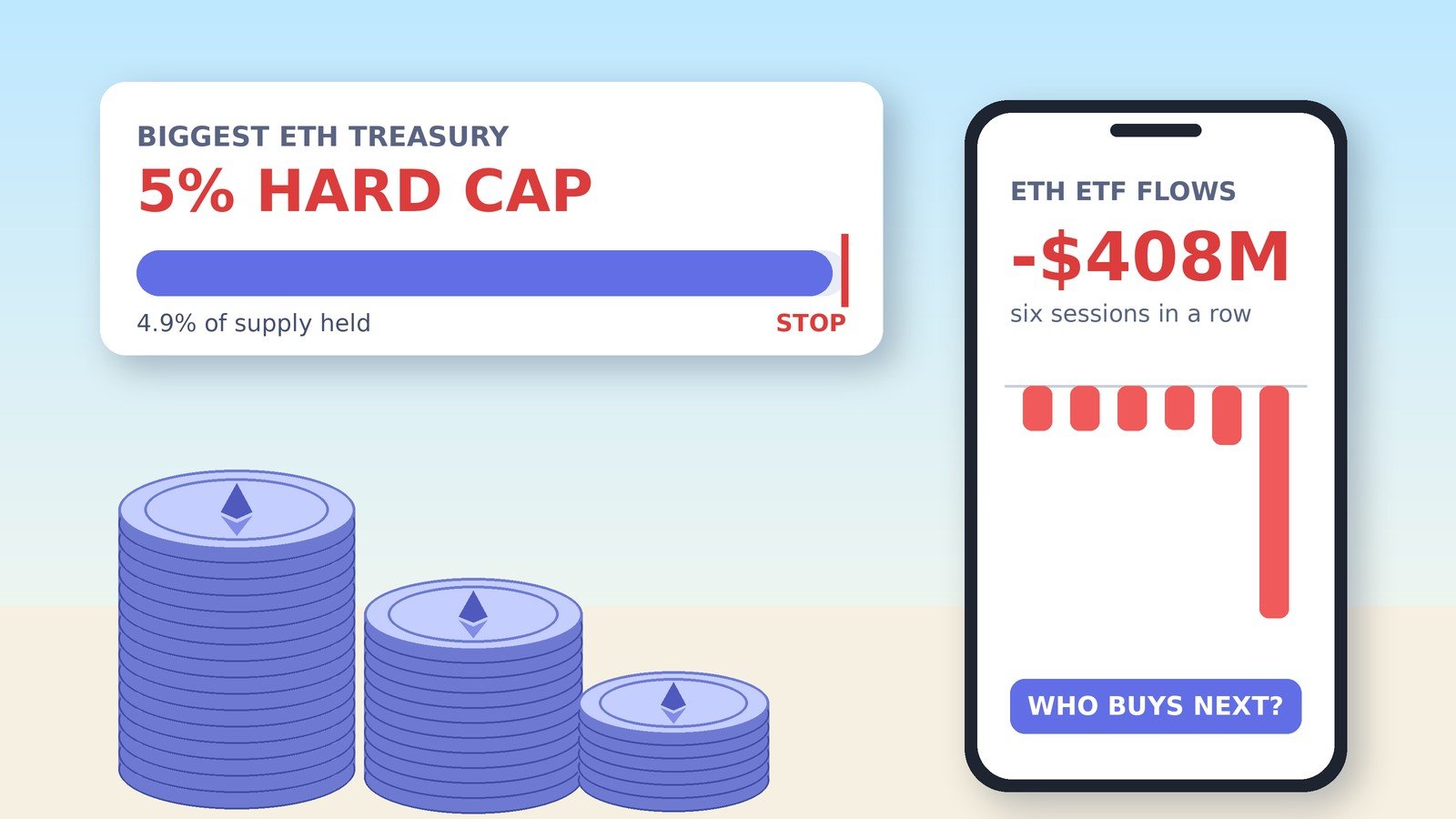
    Opinion. Yesterday this desk asked who picks up the ether bid when BitMine hits its target. On Wednesday, BitMine chairman Tom Lee answered half the question. Speaking at Token2049 in Singapore, he said the company will stop at 5% of ether’s supply. “That’s a hard cap. We’re not gonna be accumulating past 5%,” Lee said, according to Cointelegraph. “We’re not gonna own more than 5% of Ethereum.”

    That is a real change. Lee had left the door open to going past 5%, and as recently as an August interview with Bankless he said the company might revisit it in 2027, Cointelegraph noted. Now the target is a ceiling. Credit where due: BitMine announced its goal in public, reported its pile every week and is now telling the market exactly where it stops. Most whales never tell you anything.

    Do the math. BitMine’s October 5 update put its stack at 6,016,414 ETH, about 4.9% of a 122.1 million supply. Five percent is about 6.1 million. That leaves roughly 89,000 ETH by Hardwire’s count, or “about 100,000” in Lee’s round number. At Wednesday’s price near $2,616, that is somewhere around $230 million to $260 million of buying left. Then the biggest corporate bid in ether stops.

    Who else is selling

    Look at who was on the other side this week. U.S. spot ether ETFs lost $202 million on Tuesday, after about $51 million on Monday, and have now bled roughly $408 million over six straight sessions, Cointelegraph reported, citing SoSoValue. Bitcoin ETFs took in $119 million the same day. Money didn’t leave crypto. It left ether.

    The old money is cashing in too. On Monday, Lookonchain flagged a long-dormant early ether wallet sending 13,330 ETH, about $36.4 million, to Coinbase after six months of silence. Then came Wednesday morning’s flush. Ether fell below $2,600 at one point, The Crypto Times reported, with about $175 million in ETH liquidations. Across the market, more than $400 million in longs were wiped out in an hour, Bitcoin.com News reported, the same morning Lee told the room crypto is “2 days past the bottom.”

    Even Washington moved coins. Wallets linked to the U.S. government sent 833.6 BTC, about $71.6 million, toward Coinbase Prime deposit addresses on Tuesday, CoinDesk reported, citing Arkham. A transfer is not a sale, and no sale has been confirmed. But taxpayers are still learning what their own government does with seized bitcoin from a private blockchain-tracking firm, not from Washington. That should bother people on both sides of the aisle.

    The staking question

    Here’s the part the headline skips. BitMine’s update listed 5,067,309 ETH staked, and staking pays rewards in more ETH. Lee has said BitMine could sell staking-earned ETH to keep its share from rising above 5%, Cointelegraph reported. Speculation, labeled: if that’s the plan, the biggest ether buyer of the cycle could turn into a small, steady seller once it hits the cap. That’s not a scandal. It’s arithmetic. But it is the opposite of the “every week” headline that helped carry ether this year.

    Lee frames the cap as bullish. “We’re done stacking in front of a 25X move,” he said, and without new ETH buying BitMine doesn’t need to keep raising capital. That is a fair argument for BMNR shareholders. It is a different question for everyone holding ETH itself. Speculation, labeled: the whale just told you it’s leaving the buy side. Wall Street’s ETF money is already heading for the exit. Somebody has to replace both, and so far nobody has raised a hand.

    Hardwire’s read: thank BitMine for the clarity, then plan around it. Watch three things. Do the ETH ETF outflows stop? Does a new treasury buyer step up? And does BitMine’s first post-cap update show it selling staking rewards?

    Sources: Cointelegraph (BitMine hard cap); BitMine release (Oct 5); Cointelegraph (ETF flows); Lookonchain; The Crypto Times; Bitcoin.com News; CoinDesk

  • Evernorth Moves Expected Close to Oct. 9 and XRPN Nasdaq Debut to Oct. 12

    Evernorth Moves Expected Close to Oct. 9 and XRPN Nasdaq Debut to Oct. 12

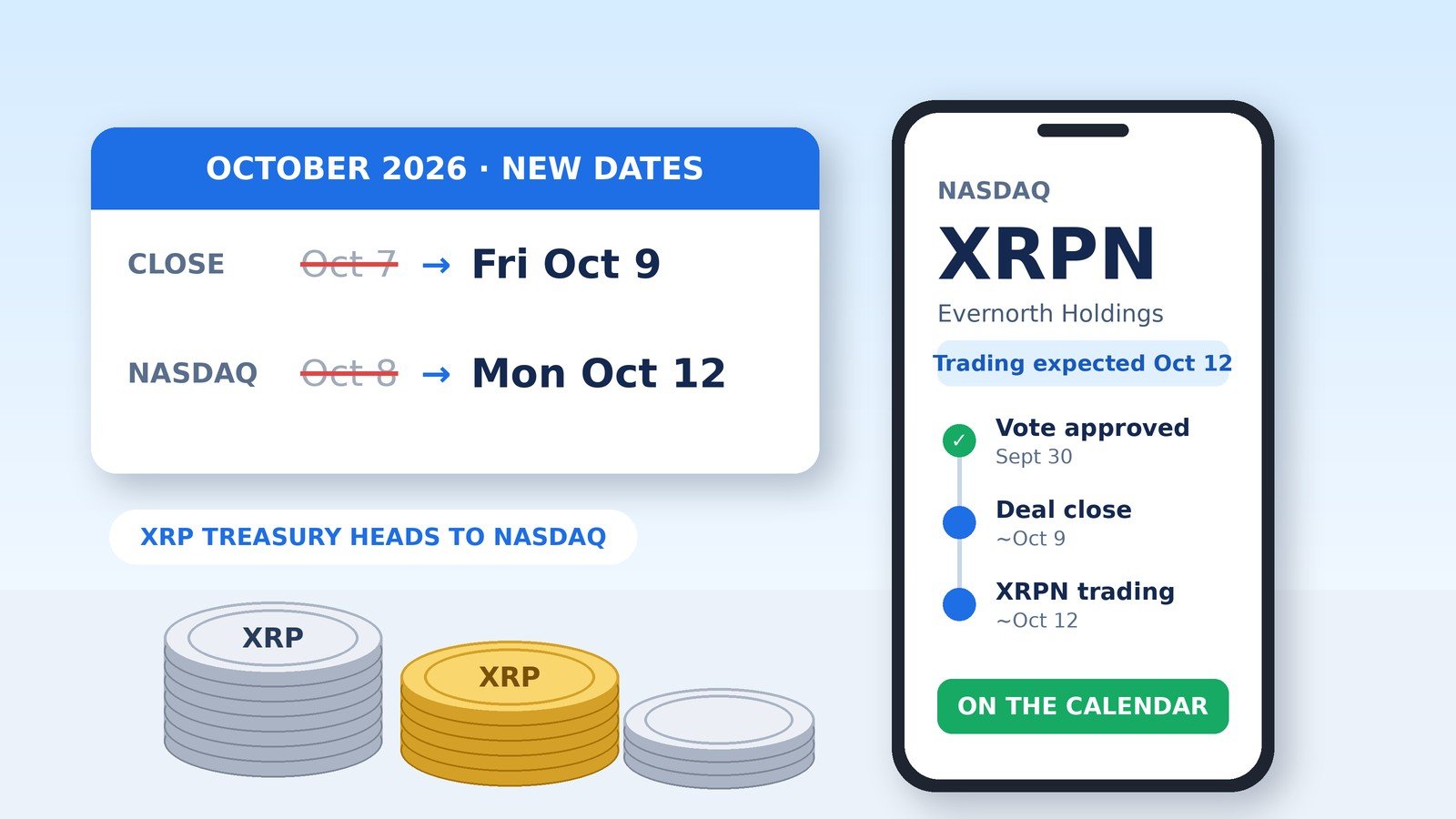
    Evernorth Holdings has pushed back its timeline by two days for the deal and four days for the stock. In a Form 8-K filed Tuesday, the company said its business combination with Armada Acquisition Corp. II is now expected to close “on or about October 9, 2026.” Its Class A common stock is expected to begin trading on Nasdaq under the ticker XRPN “on or about October 12, 2026.”

    The old plan, set out in the company’s October 1 release, was a close today, October 7, and first trading on Thursday, October 8.

    What the company said

    The filing gives one reason: “an administrative delay that is not expected to affect the closing.” It does not say what the delay is. Both new dates remain “subject to satisfaction of customary closing conditions.” CEO Asheesh Birla signed the report.

    Evernorth posted the same message on its verified X account: “we now expect to close on Friday, October 9th, with XRPN expected to start trading on Nasdaq on Monday, October 12th, in each case subject to customary closing conditions and Nasdaq listing requirements.” The X wording names Nasdaq listing requirements directly. The 8-K covers that ground in its risk language. An October 7 Rule 425 filing shows Evernorth also lodged its October 6 communications with the SEC.

    Nothing else in the deal terms has been publicly changed. Armada’s shareholders approved the combination on September 30. Per Armada’s vote 8-K, the Business Combination Proposal passed 20,514,034 to 1,362,081. The October 1 release projected about $300 million in gross cash proceeds before expenses and about 473 million XRP on the balance sheet at closing. Those remain projections until a closing filing confirms them.

    A warrant fix along the way

    One more piece of plumbing moved this week. On Monday, Armada amended its warrant agreement with Continental Stock Transfer & Trust. The warrants trade on Nasdaq as XRPNW and carry an $11.50 exercise price. The change makes the agreement match what Armada’s May 2025 IPO prospectus already promised: the warrants become exercisable on the later of the completed business combination or 12 months after the IPO closed. Evernorth announced the amendment the same day.

    That is a conforming change, not a new economic term. It lines up the contract with the disclosure investors were given, before the shares and warrants become claims on an XRP treasury company.

    The rails view

    For trust, the useful part is how the change was delivered. The new dates came first in an SEC filing signed by the CEO, matched in substance on the company’s own X account, and were labeled “on or about.” The company did not quietly let October 7 pass. It refiled.

    What still has to happen is the same list as last week: the closing conditions, funding from private placement and in-kind contributors, final trust cash after redemptions, and Nasdaq clearance for the combined company’s stock. Until a closing 8-K and a listing notice arrive, October 9 and October 12 are company-expected dates, not completed events.

    The market backdrop is soft. XRP traded near $1.47 on Wednesday morning during a broad, leverage-driven sell-off, FXStreet reported. U.S. spot XRP ETFs still took in a net $3.1 million on Tuesday, Cointelegraph reported, citing SoSoValue data. Hardwire will report the closing filing when it lands.

    Sources: Evernorth Form 8-K (Oct 6); Evernorth on X; Evernorth Rule 425 filing (Oct 7); Armada Form 8-K, warrant amendment; Evernorth release on warrant amendment; Armada Form 8-K, vote results; PR Newswire; Cointelegraph; FXStreet

  • Treasury Formally Drops Crypto Mixer and Self-Custody Wallet Reporting Proposals

    Treasury Formally Drops Crypto Mixer and Self-Custody Wallet Reporting Proposals

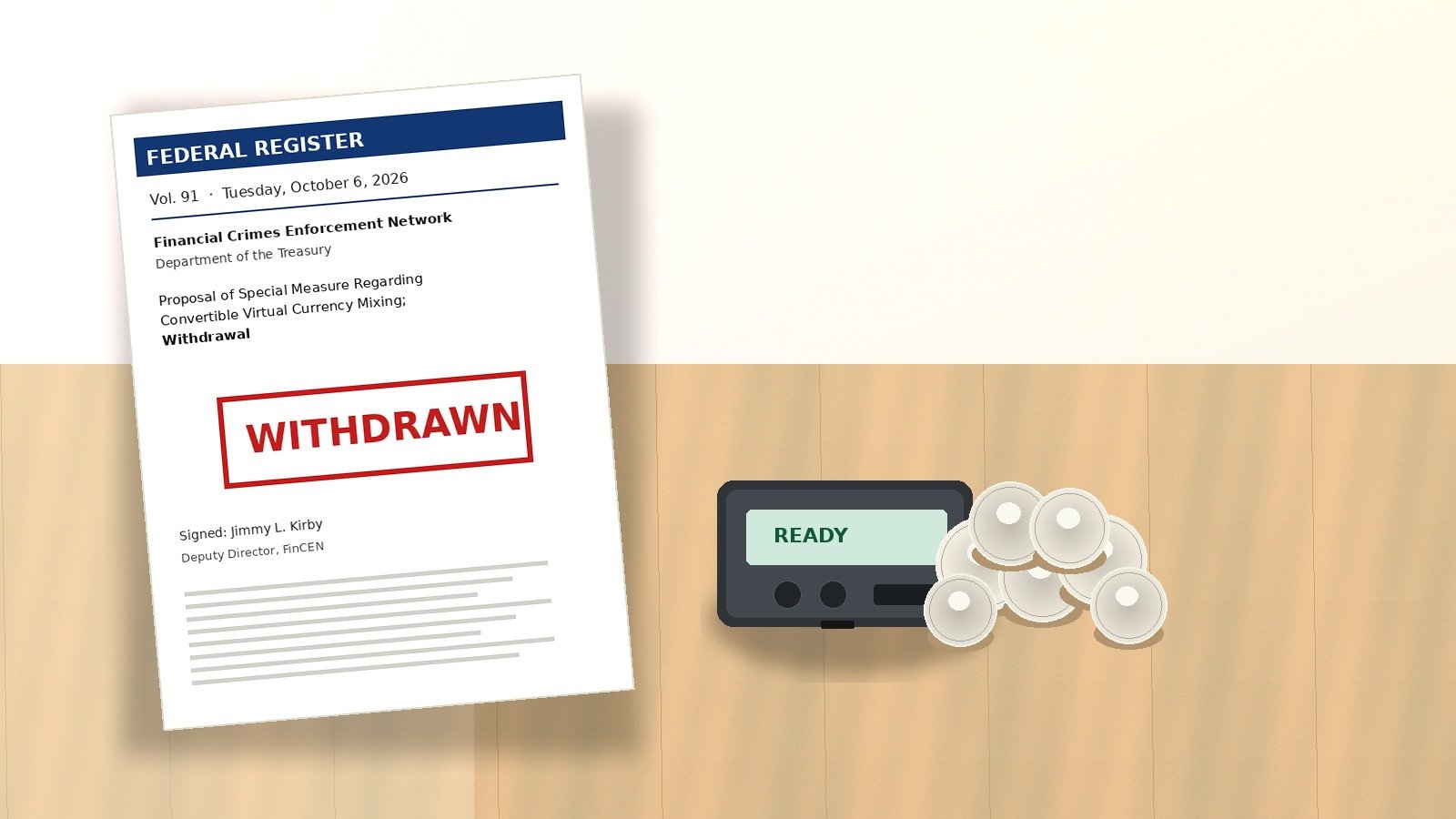
    The Treasury Department’s Financial Crimes Enforcement Network formally withdrew two long-pending crypto proposals on Tuesday. The proposals would have required banks and money services businesses to collect and report more data on transactions tied to foreign crypto mixers and self-custodied wallets.

    Both withdrawal notices were published in the Federal Register on Oct. 6 after going on public inspection Monday. Both are signed by FinCEN Deputy Director Jimmy L. Kirby.

    The first withdraws FinCEN’s October 2023 finding, made under Section 311 of the USA PATRIOT Act, that international crypto mixing is “a class of transactions of primary money laundering concern,” along with the proposed rule attached to it. That rule would have required covered institutions to report mixing-linked transactions with details including wallet addresses, transaction hashes and IP addresses.

    The second pulls a December 2020 proposal on “unhosted wallets.” It would have required banks and money services businesses to verify customers and keep records when a counterparty used a self-hosted wallet for transactions above $3,000, and to file reports above $10,000. “FinCEN will take no further action on this NPRM,” the notice says. Treasury’s regulatory agenda had already listed that proposal as withdrawn in 2024, Unchained reported; Tuesday’s notice makes it official.

    Both notices cite the July 2025 report of the President’s Working Group on Digital Asset Markets. The mixer notice quotes the report’s line that the administration “supports the ability of lawful users of digital assets to privately transact on a public blockchain.” It also says commenters warned the broad definition of mixing “could have a chilling effect on legitimate activity and place a large reporting burden on covered financial institutions.”

    What the notices don’t do matters as much. Neither proposal ever took effect, so current Bank Secrecy Act requirements stay as they are, and there is no new safe harbor for mixers. FinCEN said it “will continue to monitor activity involving CVC mixers” for illicit finance and “may take appropriate steps in the future.” Sanctions run on a separate track: on Oct. 2, Treasury’s Office of Foreign Assets Control designated a Hamas financing network that Treasury said moved money partly through crypto.

    Coin Center, the policy group that filed comments against both proposals, called the move “a significant victory for financial privacy,” Unchained reported, citing a post by Coin Center’s Jason Somensatto.

    For compliance teams, the practical change is smaller than the headlines suggest. A proposed reporting burden that had sat idle for years is now off the table, and the existing rulebook stays as written.

    Sources: Federal Register mixer withdrawal (2026-20429); Federal Register unhosted-wallet withdrawal (2026-20430); Treasury OFAC press release (Oct. 2); The Block; Unchained.

  • The Streak Is Intact. The Bid Is Shrinking.

    The Streak Is Intact. The Bid Is Shrinking.

    Opinion. BitMine Immersion Technologies said Monday it added 15,112 ETH last week, about $41 million at its $2,726 reference price. It now holds 6,016,414 ETH. That’s 4.9% of the 122.1 million supply, and the company says it’s 99% of the way to the “Alchemy of 5%” goal it set 15 months ago. The release leads with the streak: BitMine has bought ether every single week since June 30, 2025.

    The streak is real. So is the slowdown. Two weeks ago the weekly buy was 27,562 ETH. Last week it fell to 17,362, the smallest since mid-August, according to Unchained. This week it’s 15,112. Back in the spring, BitMine was buying more than 100,000 ETH in a week. To be fair to Tom Lee, he told Consensus in May that the pace would ease as the company closed in on 5%. Nobody hid the ball. But “we bought again” and “we’re still the bid” aren’t the same headline, and only one of them is getting printed.

    Do the math the press release doesn’t. Five percent of 122.1 million ETH is about 6.1 million. BitMine needs roughly 89,000 more, and at last week’s pace that’s about six weeks of buying. Then what? Either the biggest corporate ether buyer sets a new target, or one of the steadiest bids in this market shrinks to a maintenance trickle.

    Some other numbers in the release are worth a look. Cash and marketable securities fell to $643 million from $672 million a week earlier. The staked figure, 5,067,309 ETH, matches the count in every weekly update since at least mid-August, Unchained noted. So recent buys aren’t showing up as newly staked coins. Lee also highlighted the largest-ever crypto treasury equity buyback, 21 million shares this year. Speculation, labeled: a company that spends on its own stock while its ETH buys shrink may be choosing between propping up the share price and adding to its pile. That’s a legitimate capital choice, not a scandal. It just isn’t the story the streak tells.

    Strategy shows the same pattern with bitcoin. Its Monday 8-K reported 334 BTC for $28.7 million, down from 1,665 BTC the week before. That takes its stack to 848,000 BTC. In the same week, Michael Saylor said Strategy repurchased $176 million of its STRC preferred shares, about six times what it put into bitcoin. The orange chart still goes up and to the right. But more of the money is now going into managing the company’s own securities rather than buying bitcoin.

    Speculation, labeled: this looks less like whales losing faith and more like whales switching modes. One is finishing a target. The other is protecting the instruments that funded its buying. Either way, the steady corporate bid that helped carry this cycle is getting smaller, while the marketing keeps sounding the same. Lee keynotes Token2049 on Wednesday, and his October Chairman’s Message is titled “Crypto bull underway.” Maybe so. But a bull market needs a buyer at the margin, and the two loudest ones are buying less.

    Hardwire’s read: credit BitMine and Strategy for doing exactly what they said they’d do, in public, every week. Then watch the size, not the streak. If the next marginal buyer isn’t a treasury company, it has to be ETF flows, sovereigns or retail. Find out which before you trust the next “every week” headline.

    Sources: BitMine release (Oct 5); Decrypt; BitMine release (Sep 28); Unchained; The Block; Strategy 8-K

  • CFTC Opens a Federal Lane for Leveraged Retail Crypto, as an Option and Not a Mandate

    CFTC Opens a Federal Lane for Leveraged Retail Crypto, as an Option and Not a Mandate

    On Monday the Commodity Futures Trading Commission published an advance notice of proposed rulemaking (ANPRM). It lays out how the agency plans to regulate retail crypto trades made on a margined, leveraged or financed basis, and a new kind of federally registered venue to host them.

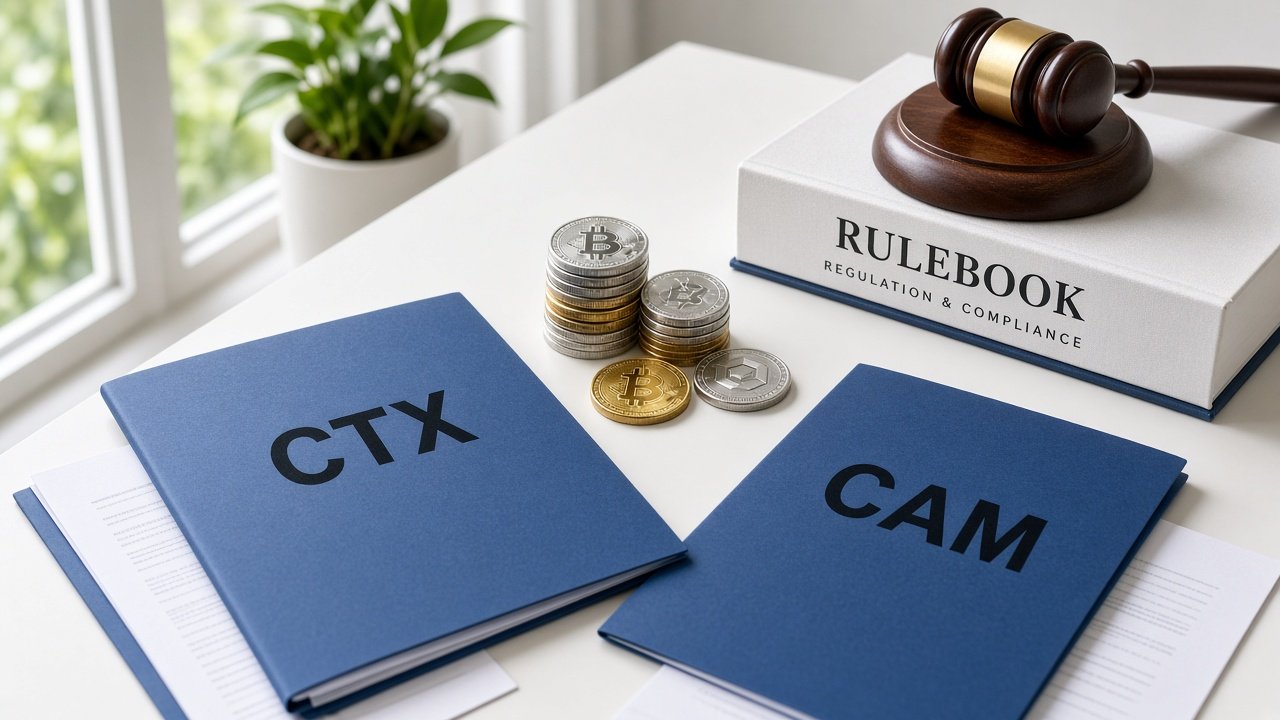
    The 108-page notice has two parts. Regulation Crypto Asset Transactions (Regulation CTX) would define and govern those retail trades, which the agency calls “CTXs,” under section 2(c)(2)(D) of the Commodity Exchange Act. Regulation Crypto Asset Markets (Regulation CAM) would create the “crypto asset market,” or CAM. A CAM is a sub-category of designated contract market (DCM) built only for CTXs.

    An ANPRM is not a proposed rule. The CFTC says it will use the comments “to inform potential future agency action, such as a rulemaking.” Comments are due 60 days after the notice is published in the Federal Register. The version posted Monday still has a placeholder for that date.

    Option, not mandate

    Chairman Michael Selig stressed that the framework is voluntary. “I want to underscore that this is a federal option for crypto asset exchanges,” he said in prepared remarks at Fordham Law’s Blockchain Regulatory Symposium. He compared it to the choice banks have between a state and a federal charter. “Only Congress has the authority to mandate that all crypto asset exchanges register with the Commission.”

    He made the same point in a Wall Street Journal op-ed posted on the CFTC’s website. Unlike the stalled Clarity Act, he wrote, the rules “wouldn’t require crypto assets to trade on CFTC-registered platforms. We don’t have the authority to impose such a requirement without congressional action.”

    Selig described the market as a three-rung ladder:

    1. Ordinary spot exchanges stay mostly under state money-transmission laws, with the CFTC policing fraud and manipulation.
    2. Exchanges that offer retail customers margin, leverage or financing must register with the CFTC. This is the rung Monday’s notice covers.
    3. Exchanges that list perpetuals and other derivatives already have to register.

    Existing DCMs could add CTXs under tailored rules. Firms that only want to offer CTXs could register as a full DCM or as a CAM.

    What the rails would look like

    According to Selig and the notice, CAMs would follow the statutory DCM core principles, with rules written for crypto. Before listing a token, an exchange might weigh how it was distributed and how concentrated holdings are, lock-ups and vesting, and any programmatic issuance or buybacks.

    Retail CTXs would go through futures commission merchants (FCMs). That brings customer-fund segregation, capital requirements and Bank Secrecy Act anti-money-laundering duties. Financing could come only from an FCM or from a qualified bank sponsored by an FCM.

    Selig said the framework “contemplates a ‘proof-of-reserves’ obligation” for exchanges that hold customer assets in omnibus accounts. At this stage, the notice itself asks for comment on proof-of-reserves practices rather than setting a requirement.

    The agency also gave a preliminary reading of the statute’s 28-day “actual delivery” exception. Delivering an asset to a user’s own non-custodial wallet within 28 days would generally qualify, which keeps those trades off-exchange.

    The plan builds on a joint CFTC-SEC interpretation from earlier this year. Selig’s speech says it named bitcoin, ether, XRP, XLM and SOL, among others, as examples of digital commodities.

    The limits

    The plan does not close the spot-market gap. CoinDesk noted that for unleveraged spot trading of assets like bitcoin and ether, the CFTC’s authority still stops at fraud and manipulation.

    How long the framework lasts is another open question. CoinDesk reported that Selig has been the CFTC’s only commissioner for nearly a year. He acknowledged the limits himself: “We haven’t solved every problem, nor can agency action substitute indefinitely for a statutory framework passed by Congress, but we must do what we can.”

    Sources: CFTC press release 9307-26; CFTC ANPRM on Regulation CTX and Regulation CAM; Chairman Selig’s Fordham remarks; Selig op-ed / statement; CoinDesk

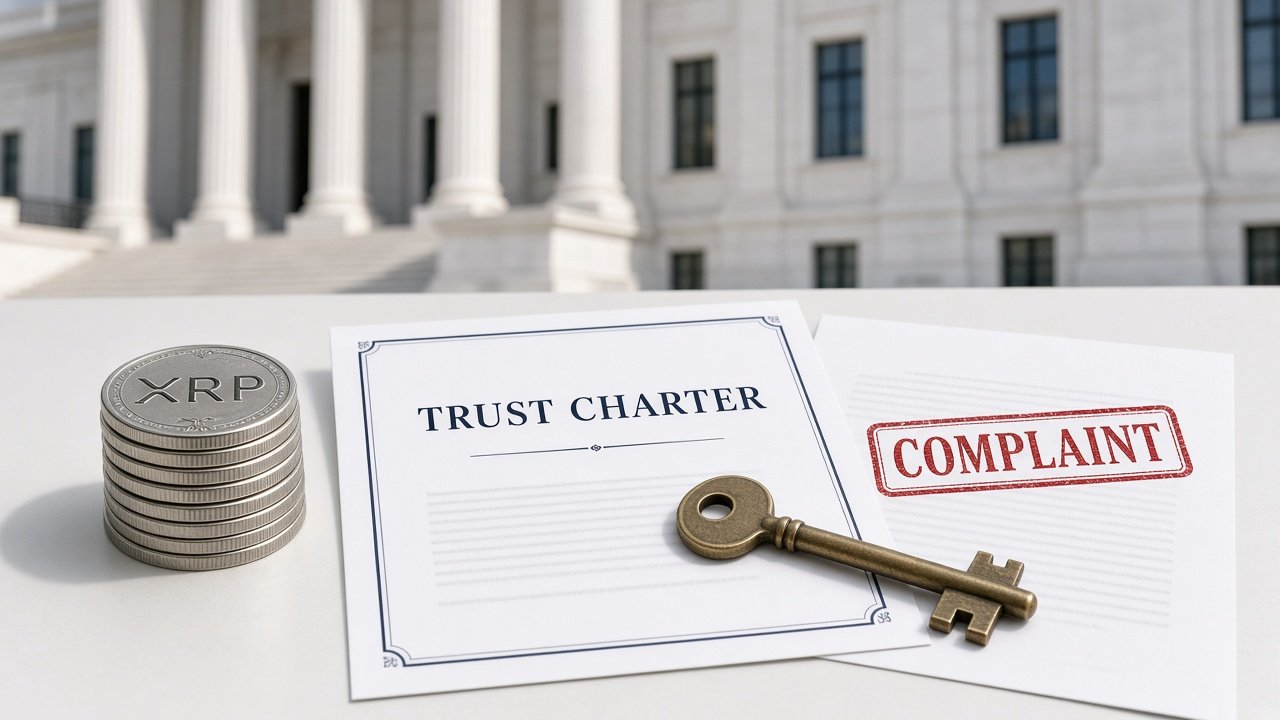
  • The Bank Lobby Found a Door It Didn’t Like. Now It Wants a Judge to Lock It.

    The Bank Lobby Found a Door It Didn’t Like. Now It Wants a Judge to Lock It.

    Opinion. On October 2, the Independent Community Bankers of America sued the Office of the Comptroller of the Currency in federal court in Washington. The suit asks a judge to throw out the OCC’s March 2 chartering rule and Interpretive Letter 1176, to cancel Protego’s conditional trust-bank approval, and to block the agency from using either document to approve any more charters. ICBA says the OCC has approved or conditionally approved 21 national trust banks under this administration, and that at least 13 of them are crypto companies.

    Read the press release and you get consumer protection and systemic risk. Read the complaint and you get something more honest. Paragraph after paragraph is about competition. Two anonymous member banks, each with less than $2.5 billion in assets, say they spend more than $1.5 million a year on compliance that crypto trust banks skip, and that they’ve already lost “hundreds of thousands of dollars” in business this year to firms with conditional OCC approval. That’s a real grievance. It’s also the oldest story in banking: whoever holds the license wants the next applicant held to a higher bar, or kept out.

    Give the bankers their due, because some of their points are strong. A national trust bank doesn’t carry FDIC insurance. It isn’t supervised like a bank holding company. And it can preempt a lot of state consumer law. The complaint also notes that the OCC hasn’t run an uninsured bank receivership in nearly a hundred years. If one of these new charters fails in a crypto crash, nobody has recently tested what happens next. Customers who see “national bank” on the door may assume protections that aren’t there. Those are fair questions, and the OCC’s two-page response to comments, as ICBA describes it, didn’t answer many of them.

    Here’s what they aren’t putting in the headline. The legal weapon is the major questions doctrine, the same conservative tool used to rein in agencies that claim sweeping powers Congress never granted. This time it’s pointed at a Trump-era OCC, and at an interpretive letter written by Jonathan Gould before he became Comptroller. ICBA also leans on the GENIUS Act, arguing that because Congress has now legislated on stablecoins, it meant to keep the bigger crypto-banking question for itself. Speculation, labeled: that line of argument would let incumbents treat every unfinished bill as a reason to freeze agency action in the meantime.

    Keep the scope straight, too. Ripple, Circle, and the other December 2025 conditional approvals aren’t named as targets for vacatur. Protego is the only charter the suit asks the court to cancel outright. Filing a complaint revokes nothing, and the OCC has declined to comment on the litigation. But the relief ICBA wants, an order stopping the OCC from using the rule or IL 1176 to approve future charters, would close the path for whoever comes next, however clean their books are.

    Hardwire’s read: be skeptical of the regulator that redefined a 1978 sentence into a national on-ramp, and be skeptical of the trade group that wants a judge to slam that ramp shut at the exact moment its members started losing customers. If crypto firms want bank-grade credibility, they should accept bank-grade scrutiny. If community banks want to keep their customers, they’ll need a better product, not just a better lawyer.

    Sources: ICBA complaint; ICBA release; CoinDesk; American Banker; OCC

  • Community banks sue OCC to shut the crypto trust-charter door

    Community banks sue OCC to shut the crypto trust-charter door

    The Independent Community Bankers of America sued the Office of the Comptroller of the Currency on Friday, Oct. 2, in the U.S. District Court for the District of Columbia. The trade group says the OCC has stretched its power to charter national trust banks far past what the National Bank Act allows, and that crypto firms have been the main beneficiaries.

    The case is brought under the Administrative Procedure Act. It targets two documents: the OCC’s final chartering rule, issued March 2, 2026, and Interpretive Letter 1176, the earlier letter the rule codifies. ICBA argues the OCC has no authority to charter banks that are neither depository nor fiduciary, that the rule is arbitrary and capricious because the agency did not meaningfully answer comments about its risks, and that the letter should have gone through public notice and comment in the first place.

    The relief asked for is specific. ICBA wants the court to vacate the rule and IL 1176, to vacate Protego’s conditional national trust-bank approval, and to bar the OCC from relying on either document to approve future charters. Protego is the only charter the complaint asks the court to cancel outright.

    The numbers in the filing frame the fight. According to the complaint, the OCC has approved, conditionally or otherwise, 21 national trust banks during the current administration, and at least 13 of them are crypto companies. ICBA says those firms get the credibility of a federal charter without the obligations community banks carry on capital, liquidity, supervision and FDIC insurance, and that the gap puts small banks at a competitive disadvantage. The complaint also warns that the OCC’s receivership framework for uninsured institutions is untested at the scale some crypto applicants propose.

    Scope matters here. The December 2025 conditional approvals, including Ripple National Trust Bank and Circle’s First National Digital Currency Bank, are not directly challenged in the suit. They could still be affected if a court threw out the rule and the letter behind the charter path, but the complaint does not ask the court to cancel them by name.

    A lawsuit is not a revocation. No existing charter or conditional approval has been revoked or paused. The OCC told reporters it does not comment on litigation. The next steps are procedural: the agency’s response to the complaint and any scheduling order from the court.

    The GENIUS Act sits in the background. The stablecoin law made a national trust charter more valuable, because it gives a federal route to become a qualified payment stablecoin issuer, while state-qualified issuers are capped at $10 billion in outstanding stablecoins. ICBA also points to the law in its argument, saying that by legislating on stablecoins, Congress kept the broader question of crypto banking for itself.

    What happened: the largest community-bank trade group asked a federal judge to shut the trust-charter path crypto firms have been using. What has not happened: any ruling, or any change to an existing charter.

    Sources: ICBA complaint; ICBA release; CoinDesk; American Banker; OCC

  • The biggest bitcoin whale sipped. The smaller one gulped.

    The biggest bitcoin whale sipped. The smaller one gulped.

    Follow the wallets, not the talking heads. This weekend the bitcoin tape ran up to just shy of $86,950, came within about $500 of its late-September high near $87,400, and then slipped back under $86,000. Second stall in a week. While the chart crowd argued about the line, the real whales filed their receipts Monday morning. The receipts say something interesting.

    Start with the biggest corporate whale in the water. Strategy’s 8-K says it bought 334 BTC from Oct. 1 through Oct. 4, for $28.7 million, at an average of about $85,839. That takes it to 848,000 BTC. Same filing: Strategy spent $73.7 million over those same days buying back its STRC preferred stock, and $176.3 million on STRC buybacks counting Sept. 28 to 30. The buying streak is alive. The cash just went to two places, coin and capital stack, and the coin got the smaller slice this week.

    Now the smaller whale. Strive CEO Matt Cole posted that Strive bought 2,000 BTC for $169 million, at an average cost of $84,422, taking it to 29,462 BTC. He said 61.5% of the money came from SATA, its preferred stock, and warrants brought in $56.7 million. Read that again: a company holding about 3.5% as much bitcoin as Strategy bought roughly six times as many coins this week. The little fish is swimming hard, and it is doing it in the open with a filing behind it.

    Then the ghosts. On-chain tracker Lookonchain flagged two early holders who bought 1,346 BTC about 13 years ago, at an average near $178, and just moved a tiny test amount, 0.0005 BTC, worth about $43. Their stack is worth about $115 million now. Labeled speculation: a $43 test is what you send when you want to be sure the keys still work before you move real size. It could also be an estate, a lawyer or simple curiosity. A test is not a sale. But when 13-year-old coins clear their throat near a multi-month high, the smart move is to watch, not to guess.

    Over in XRP, the big wallets are doing nothing at all, and that is the tell. Analyst Ali Martinez wrote Sunday that XRP whales have “remained relatively sidelined over the past week, with no significant change” in holdings, while the price coils near $1.50. The calendar is loaded: Evernorth says it expects to close its Armada deal on Oct. 7, with XRPN trading on Nasdaq on Oct. 8, subject to remaining closing conditions. Labeled speculation: big holders sitting flat into a dated event usually means they want to see the first prints before they commit. Quiet hands are not empty hands.

    The populist read here is simple. The man on the street is told the Fed, the jobs report and the chart pattern decide everything. Meanwhile, the people with real size are telling you exactly what they did, in 8-Ks and signed posts, every Monday. Weekend liquidations, per CoinDesk, were light at $62.7 million, and shorts made up 68% of them. That is not a crowd in panic. That is a crowd leaning the wrong way and paying a small bill for it.

    My positioning question for the week is not “will bitcoin break $87,000.” It is: who is buying at $84,000 to $86,000, with what money, and who is just testing their keys? This week the answer came with names and numbers attached. Watch the filings. They do not tweet in all caps.

    Sources: Strategy 8-K; Matt Cole on X; Bloomingbit; Lookonchain; Tron Weekly; PR Newswire; CoinDesk; CoinDesk