Blog

  • Three Banks, One Coin, Every Holder ID’d. Is This the CBDC Nobody Voted For?

    Three Banks, One Coin, Every Holder ID’d. Is This the CBDC Nobody Voted For?

    Opinion. The headline on the timeline said Japan’s three biggest banks just ran a “crypto stablecoin payment” test. Read the fine print and it sounds a lot less like crypto and a lot more like the banks.

    First, what’s real

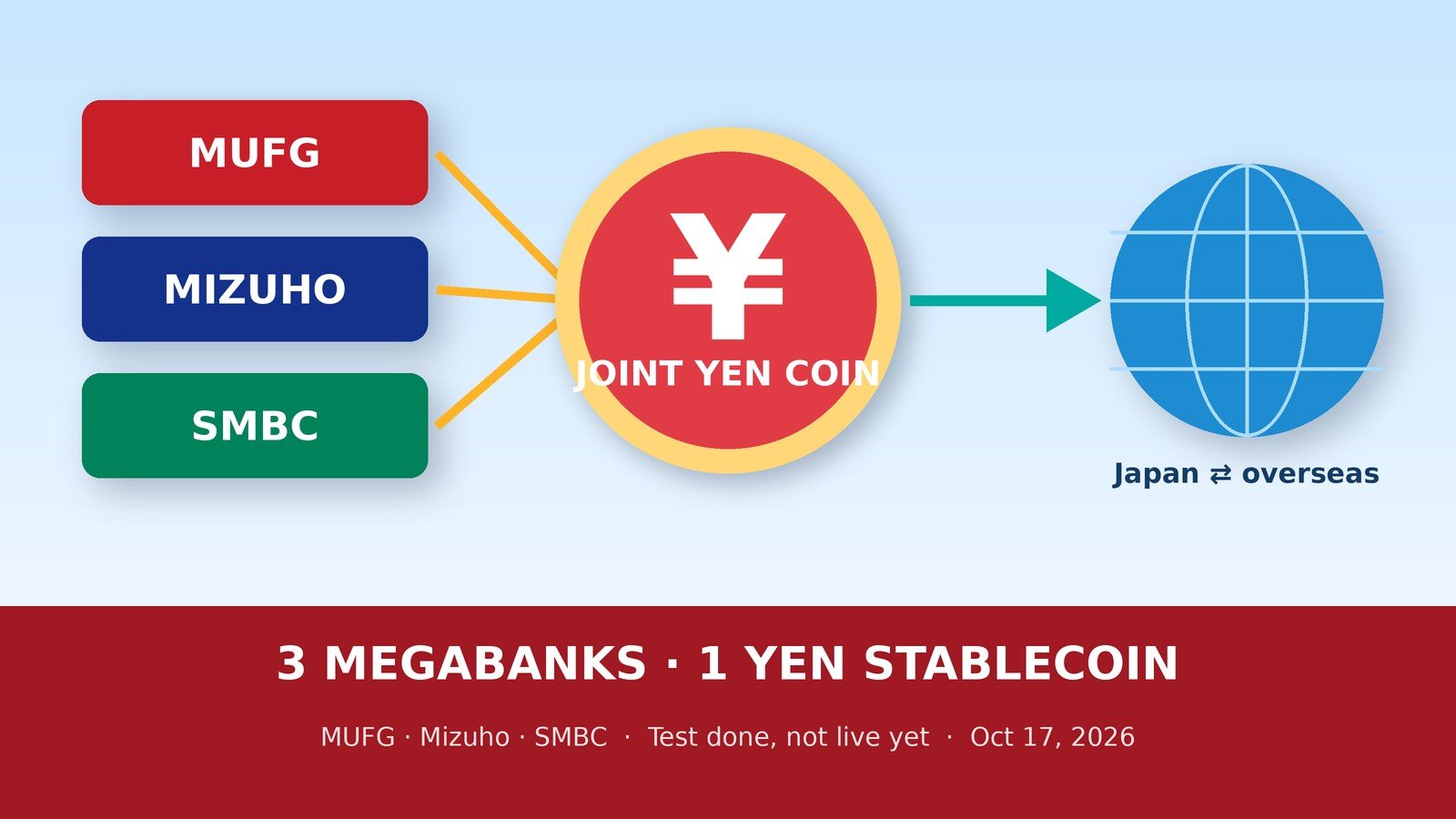
    MUFG, Mizuho and SMBC said on Oct. 16 that a jointly issued yen stablecoin worked in a one-week test in July. It moved money between Mitsubishi Corporation’s offices in Japan and overseas. The money behind it sits in bank deposits. A bank provided the blockchain. And the coin is designed to move only among people who have passed identity checks at the banks. The banks are aiming for live transactions in fiscal 2026, which ends in March 2027.

    That is a real step for bank payments. Westen’s desk has the straight write-up. Read that first.

    The part nobody put in the headline

    Think about what the design adds up to. Three giant banks issue one coin. Only ID-checked users can hold it. The banks run the platform it lives on. And there is no circulation cap, because they expect it to be used at scale.

    That is not the cypherpunk dream. Nobody is opting out of anything. It is digital money where the issuer knows who holds every coin, on rails the issuer controls.

    Speculation, labeled

    Speculation, labeled: my read is that this is how you get most of what a central bank digital currency would give the state, without anyone ever voting on a CBDC. You don’t need a government coin if the biggest banks, with a government regulator’s support, issue an ID-only coin and everyone’s payroll and invoices slowly move onto it.

    I’m not saying anyone in Tokyo is plotting a surveillance state. I’m saying the plumbing is the policy. Once money is programmable and every holder is known, the question of what that money can be stopped from doing gets answered by whoever writes the code and the rules, not by the person holding it.

    And it’s not just Japan. In the same week, a U.S. bank wired a dollar stablecoin into its core system and Visa moved stablecoin funding into production. Those are permissioned, compliance-first rails too. Plenty of people cheering “adoption” may be cheering the banks taking the stablecoin back.

    To be fair

    Identity checks exist for real reasons, like fraud and money laundering, and regulators expect them. A deposit-backed bank coin may well be safer for a company like Mitsubishi than an offshore token. And this was a test, with the design still open to change. But if you got into crypto to hold money nobody else controls, a bank-run, ID-only coin is a different product. Know which one you’re cheering for.

    This is opinion, not investment advice.

    Sources: MUFG Bank; Trade Finance Global; Watcher.Guru (X); Visa
  • Japan’s Three Megabanks Say Their Joint Yen Stablecoin Worked in a Test. Live Use Is Aimed for FY2026

    Japan’s Three Megabanks Say Their Joint Yen Stablecoin Worked in a Test. Live Use Is Aimed for FY2026

    Japan’s three largest banks say a jointly issued yen stablecoin worked in a test. MUFG Bank, Mizuho Bank and Sumitomo Mitsui Banking Corporation (SMBC) announced on Oct. 16 that they had issued, transferred and redeemed the coin in a proof-of-concept run from July 17 to July 23.

    The test used a cross-border payment scenario between Mitsubishi Corporation’s offices in Japan and overseas. Mitsubishi UFJ Trust and Banking acted as the agent trustee, and tech firm TISI built the wallet and blockchain connections. SMBC provided the blockchain platform used in the test, according to the banks.

    How the coin is built

    The coin was issued under Japan’s Payment Services Act as a trust-type stablecoin, with the three banks acting together as joint principal trustees. The money behind it sits in bank deposits. The banks said the design has no circulation cap, because they expect large-scale use.

    There is one big limit by design. The coin is meant to move only among users who have completed identity checks at the banks. That makes it a permissioned bank product, not an open token anyone can pick up on an exchange.

    The project ran with support from the Financial Services Agency’s FinTech PoC Hub, which approved the initiative in November 2025. The banks said the test also checked anti-money-laundering controls and how the operation works with several banks issuing one coin.

    What it is not yet

    This was a one-week test, not a launch. The banks did not disclose amounts moved in the test. They said the design “may be subject to change” and that they will keep working through issues with regulators in Japan and abroad before real-world use.

    The timeline points to the near term. In the same release, the banks pointed back to a June 10 announcement about launching live transactions of the three-bank coin in fiscal 2026. Japan’s fiscal 2026 ends in March 2027.

    The news landed the same week that Visa moved stablecoin prefunding for Visa Direct into commercial use and a U.S. bank, Cross River, added Ripple’s RLUSD to its core banking platform. The common thread: banks and payment networks are building stablecoin rails inside regulated systems, not around them.

    Sources: MUFG Bank; SMBC; Mizuho; Trade Finance Global; Visa

  • They Wired a Stablecoin Into a Bank Core. Then the Timeline Sold You X Money

    They Wired a Stablecoin Into a Bank Core. Then the Timeline Sold You X Money

    Opinion. Yesterday a New Jersey bank put Ripple’s dollar stablecoin into its core operating system. By morning, half the timeline was selling you a story about Elon Musk’s payments app. Those are not the same announcement.

    First, what’s real

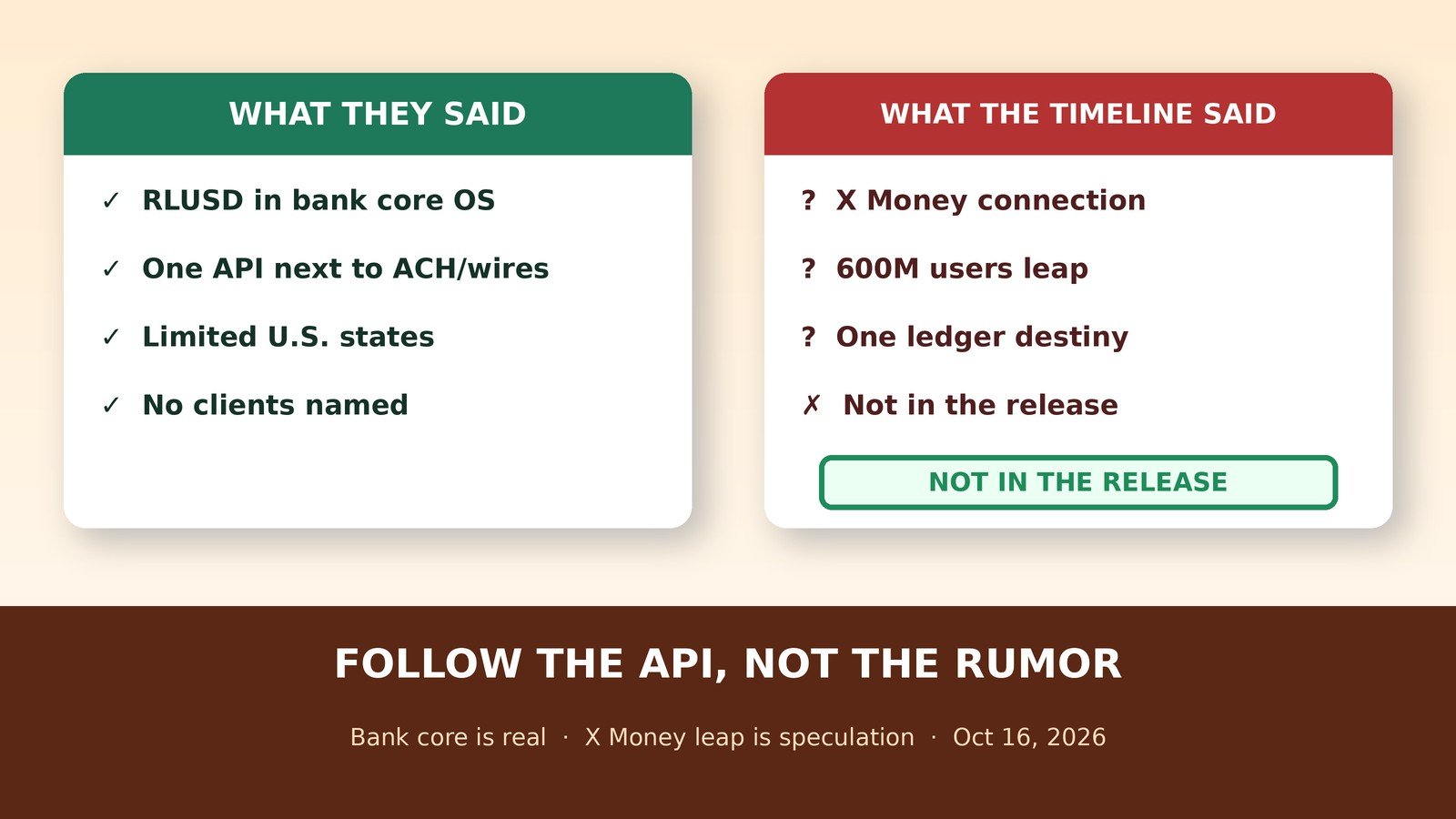
    Cross River Bank said on Oct. 15 it is integrating RLUSD, Ripple’s U.S. dollar-backed stablecoin, into its proprietary Core Operating System, with support for transactions on the XRP Ledger. Eligible fintechs get the rail through one API, next to ACH, wires and real-time payments. The bank says it is live only in limited U.S. states. No client names. No volumes. No nationwide launch.

    Ripple amplified the same deal on X. Cross River amplified it too. Neither company said a word about X Money, Musk, or a 600-million-user rocket.

    What is true, separately: Cross River has been publicly described as providing banking infrastructure for X Money, the payments product tied to the X platform. That relationship is about fiat banking rails. It is not, on the public record, an RLUSD or XRP Ledger deal for X Money. CryptoRank and others have already noted the leap: confirmed bank + Ripple partnership, unconfirmed anything about X Money.

    The pattern

    Watch the sequence. Congress still hasn’t handed the market a finished digital-asset rulebook. Agencies fill gaps with notices and exemptions. And the actual plumbing keeps getting wired into places most retail holders never see: a bank’s core OS, a brokerage settlement plan in Europe, institutional custody in Dubai.

    Then the attention economy does what it always does. It takes a dry bank press release and turns it into a meme about destiny. One bank becomes “the bank of X Money.” One API becomes “one ledger for 600 million users.” None of that was in the release.

    Speculation, labeled

    Speculation, labeled: this is how the new rails get built while you’re busy arguing about price targets. Quiet integration into regulated banking infrastructure. Loud secondary story that sounds like a consumer moonshot. My guess: the people writing the bank contracts are not the people drafting the viral threads, and the gap between those two groups is the product.

    I’m not saying X Money will never touch a stablecoin. I’m saying nobody with a signature on this deal has said it will. Treating an unconfirmed retail fantasy as the headline is how you miss the real story: a regulated U.S. bank is putting a dollar stablecoin next to ACH inside the software fintechs already use. That is already a big deal. You don’t need to invent a bigger one.

    And here’s the populist read, also labeled as my take: when the timeline sells you the fantasy version, it keeps you staring at the celebrity product while the settlement layer moves into the bank OS. Follow the API, not the rumor.

    To be fair

    Cross River really is an X Money banking partner in other reporting. Ripple really is pushing RLUSD into institutional rails this week. People are allowed to connect dots. They’re just not allowed to pretend the dots were in the press release. Westen’s desk has the factual write-up of what Cross River actually announced. Read that first. Then decide whether the timeline earned its leap.

    This is opinion, not investment advice.

    Sources: Cross River; Ripple; Cross River (X); CryptoRank

  • Cross River Puts Ripple’s RLUSD on Its Core Banking Platform for 24/7 Settlement

    Cross River Puts Ripple’s RLUSD on Its Core Banking Platform for 24/7 Settlement

    Cross River Bank is integrating Ripple USD (RLUSD), Ripple’s U.S. dollar-backed stablecoin, into its proprietary Core Operating System, with support for transactions on the XRP Ledger.

    The Fort Lee, N.J.-based bank, a New Jersey state-chartered FDIC member, announced the partnership on Oct. 15. RLUSD becomes an additional payment rail on Cross River’s platform, next to ACH transfers, wire transfers and real-time payments. Eligible fintech customers can reach it through a single API without standing up their own blockchain systems, the bank said.

    What the bank says it unlocks

    Adam Goller, Cross River’s head of fintech banking, said the bank is expanding on stablecoin capabilities already in development. The setup is meant to let fintechs convert between U.S. dollars and RLUSD, settle cross-border payments and treasury moves around the clock, and keep those rails on the same banking platform as traditional payment options.

    Markus Infanger, senior vice president for RippleX at Ripple, said Cross River is bringing RLUSD and the XRP Ledger’s settlement into a regulated banking platform so fintechs can move money in real time across borders without running a parallel system.

    The two companies also pitched the work as a settlement option for payment networks, giving issuers and acquirers more flexibility to settle intraday. The release cites typical XRP Ledger settlement of about three to five seconds, fees of a fraction of a cent, and more than $1.3 trillion settled on the ledger to date. Those are company figures and have not been independently verified.

    What’s narrow — and what this is not

    Availability is narrow. Cross River’s release states that services are currently only available in limited U.S. states. It did not name those states or give a timeline for a wider rollout.

    What this is not: a custody product, a retail deposit product, or a sign that every Cross River client can use RLUSD today. The release describes payment and settlement access for fintechs and payment networks through the bank’s existing core. Separately this week, DriveWealth said it plans to use RLUSD on the XRP Ledger for brokerage settlement starting in Europe, with no launch date, and Standard Chartered said institutional RLUSD custody is live at its Dubai branch. Those are different arrangements.

    The release did not name any fintech or payment network that is using the RLUSD rail yet.

    Sources: Cross River; Business Wire; Ripple

  • France Wants to Tax You for Using the Stablecoins Europe Told You to Use

    France Wants to Tax You for Using the Stablecoins Europe Told You to Use

    Opinion. For years, Brussels told Europeans the same thing: use the regulated stablecoins. The licensed ones, the supervised ones, the ones that report to the tax man. Now a group of French lawmakers wants to charge you 31.4% for doing exactly that.

    First, what’s real

    On Oct. 7, the National Assembly’s finance committee adopted an amendment from Nicolas Sansu of the left-wing GDR group. It would end the tax pause on swapping crypto into e-money tokens, MiCA’s name for stablecoins pegged to one currency, like USDC. Starting Jan. 1, 2027, that swap would trigger France’s 31.4% flat tax on gains. Today, crypto-to-crypto swaps in France aren’t taxed until you cash out to euros or spend.

    Two days later, the committee rejected the whole revenue half of the budget, 31 to 3. Under French budget rules, the floor debate restarts from the government’s text, which doesn’t include the amendment. It is not law.

    But it isn’t dead either. On Oct. 10, Sansu refiled the same text for the full Assembly as amendment I-3898. It’s on the list to be debated. The vote on the revenue half of the budget is set for Tuesday, Oct. 20.

    Taxing the lane they built

    Do the simple math. Lock in a €40,000 gain by moving into a regulated stablecoin, and at 31.4% you’d owe €12,560, even though not a single euro reached your bank account.

    The amendment’s own explanation calls the current rule a “hole in the legislation” and says taxing the swap is just “a simple application of tax law that already exists” (our translation). Maybe. But look at the timing. On Oct. 8, the EU’s markets regulator, ESMA, told licensed crypto firms to stop offering services in stablecoins that don’t comply with MiCA, and gave supervisors three months to clean up what’s left. And on Wednesday, the European Banking Authority named USDC the EU’s first “significant” e-money token, putting its reserves under EU-level watch.

    So Europe is herding people into the regulated stablecoins, and Paris is drafting a toll at the door. Francois Volpoet, Chainalysis’s regional sales director for France, told CoinDesk the measure could push people toward DeFi, peer-to-peer trades and exchanges outside international tax reporting. He also noted it targets MiCA-compliant stablecoins and may leave other tokens outside its scope. Tax the compliant lane, and you shouldn’t be surprised when traffic moves to the dirt road.

    Speculation, labeled

    Speculation, labeled: this looks less like stablecoin policy and more like a treasury hunting for any gain it can call “realized.” The same committee also backed a rule making people declare self-custody wallets holding €100,000 or more, and an exit tax on large crypto holdings when people move abroad. Put it together and the message to French holders reads like this: stay, report everything, pay early, or pay on the way out.

    And here’s my guess about who actually pays. The whales, the funds and the big desks have lawyers, offshore entities and the option to move. The regular saver on a French app doesn’t. A tax like this doesn’t stop big money from moving. It just makes sure the little guy is the one who sends the check. That’s my read, not a fact. But it’s worth watching who lines up behind this on Oct. 20.

    One more thing nobody should wave away: Chainalysis counted 30 violent attacks on crypto holders in France in the first half of this year, according to CoinDesk. A government list of everyone with €100,000 in a wallet is a list somebody will want to steal.

    To be fair

    There’s pushback on the record. Deputy Daniel Grenon filed the opposite amendment for the floor, I-3738, which would keep swaps into e-money tokens tax-free. His stated reason: taxing them would hit French holders directly and make platforms based in France less attractive. The committee also voted to let investors carry crypto losses forward for 10 years. And French budgets don’t always survive the floor. Last year, the Assembly voted down the revenue half of the budget outright.

    So watch Oct. 20. If the swap tax gets back in and survives, Europe will have built a regulated stablecoin market and then charged people for using it. If it dies, credit the deputies who noticed that you don’t bring money onshore by taxing it at the door.

    This is opinion, not investment or tax advice.

    Sources: Assemblée nationale (amendment I-3898); Assemblée nationale (amendment I-CF1826); Assemblée nationale (amendment I-3738); CoinDesk; ESMA; European Banking Authority; NosParlementaires; Cryptoast

  • EU Names USDC Its First ‘Significant’ Stablecoin. Oversight of Its Reserves Moves to the EBA Nov. 12

    EU Names USDC Its First ‘Significant’ Stablecoin. Oversight of Its Reserves Moves to the EBA Nov. 12

    The European Banking Authority has classified USDC, the dollar stablecoin issued in the EU by Circle Internet Financial Europe SAS, as a “significant” e-money token under the bloc’s Markets in Crypto-Assets rules, known as MiCA.

    It is the first token to get that label. In its Oct. 14 announcement, the Paris-based authority said 45 e-money tokens have been notified in the EU under MiCA, and USDC is the first of them to be classified as significant. E-money tokens are stablecoins that track a single official currency.

    Who watches what

    The label splits supervision in two. From Nov. 12, direct oversight of USDC’s own funds, reserve of assets, liquidity requirements, and recovery and redemption plans moves from France’s Autorité de Contrôle Prudentiel et de Résolution (ACPR) to the EBA. The ACPR keeps areas including governance, qualifying holdings, fit-and-proper checks, outsourcing and conflicts of interest. The two authorities said they will work together on the handover.

    In plain terms: the parts of the token that decide whether a holder gets a dollar back, the reserves and the plan for paying people out, now sit with an EU-level supervisor instead of a single national one.

    USDC is issued in the United States by a separate company, Circle Internet Financial, LLC. To cover that cross-border setup, the EBA said it has signed a memorandum of understanding with the New York State Department of Financial Services on cooperation and information sharing.

    What the EBA did not say

    The EBA did not say which of MiCA’s significance tests USDC met. The rules look at measures such as the number of holders, the value of tokens issued, and the number and value of transactions, and a 2024 Commission regulation sets out how they are counted. The EBA reviews each classification every year. Under MiCA, an issuer of a significant e-money token also faces extra requirements, mainly on liquidity and own funds, which the EBA will supervise.

    USDC has about $73 billion in circulation worldwide, according to The Block’s data. Circle had not published a statement on the classification as of Thursday morning.

    A busy week for EU stablecoin rules

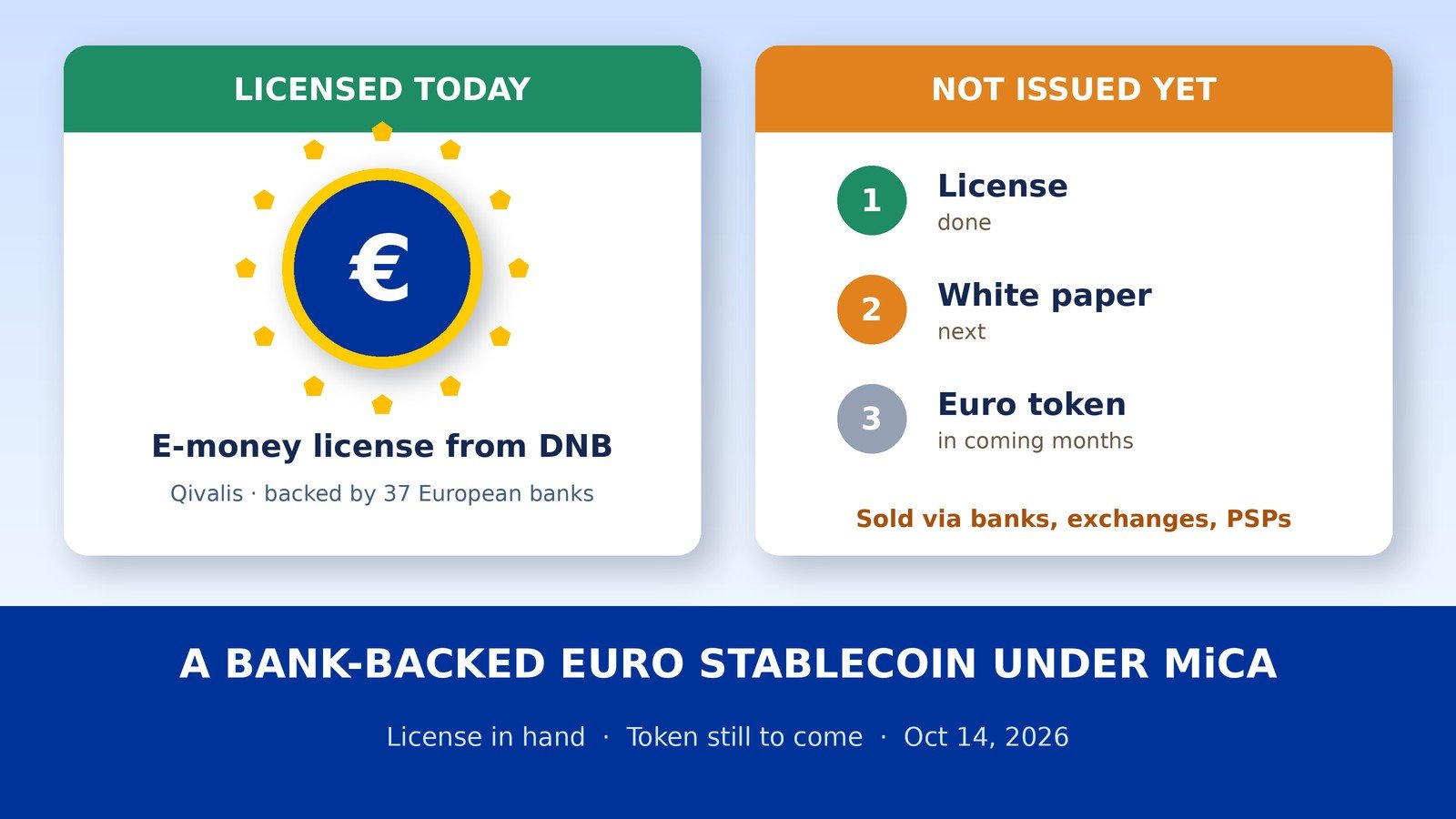
    The decision caps a week of moves by EU regulators. On Oct. 8, the European Securities and Markets Authority said crypto firms licensed under MiCA should stop offering services involving stablecoins that do not comply with MiCA, and asked national supervisors to have existing exposures cleaned up within three months. On Wednesday, as Hardwire reported, Qivalis, a euro stablecoin company backed by 37 European banks, received its e-money license from the Dutch central bank. That token has not launched.

    The bottom line: the EU’s biggest regulated dollar stablecoin now gets a second, EU-level supervisor for its reserves and redemption plans, starting Nov. 12.

    Sources: European Banking Authority; European Securities and Markets Authority; The Block; Cointelegraph; Hardwire Crypto

  • Evernorth Hires Ex-Coinbase Asset Management Co-CIO to Run XRP Treasury, Corrects Closing Share Count

    Evernorth Hires Ex-Coinbase Asset Management Co-CIO to Run XRP Treasury, Corrects Closing Share Count

    Evernorth Holdings Inc. has hired Hugo Jeandesboz as chief investment officer to lead its XRP treasury strategy, the company said in an Oct. 12 press release that it filed with the SEC on Tuesday.

    Jeandesboz joins from Coinbase Asset Management, where he was co-chief investment officer and led the firm’s Solutions investment strategies. According to the release, he was previously Coinbase’s lead derivatives trader, traded interest rate derivatives at HSBC in New York, and started his career at Société Générale. He reports to founder and Chief Executive Officer Asheesh Birla.

    The release says the role covers “treasury allocation, liquidity management and the active management of Evernorth’s own XRP holdings,” and makes him the company’s senior contact for trading counterparties and custodians. The filing does not disclose his compensation or a separate start date. The release says he “has joined.”

    The same Form 8-K corrects the company’s post-closing report. At the Oct. 9 closing of its merger with Armada Acquisition Corp. II, Evernorth issued 1,078,613 Class A shares to investors with delayed-funding subscription agreements, “not 663,510 shares as was indicated” in that earlier filing, “due to a clerical error,” the 8-K says. Those shares were priced at $10.00 each against the subscription amount, whether paid in cash or XRP. The correction also changes several other figures. Class A shares outstanding at closing are now 23,638,882, and Class C shares are 31,392,746. Former SPAC public shareholders held 20.5% of the Class A stock.

    XRPN closed Tuesday at $16.48, down 2.54% on its second day of trading as Evernorth, according to StockAnalysis. It traded between $15.70 and $17.86 on about 1.27 million shares.

    Company leadership is scheduled to ring the Nasdaq closing bell on Wednesday, Evernorth said in its Oct. 9 announcement.

    Sources: SEC Form 8-K; Evernorth press release (Ex. 99.1); StockAnalysis

  • Ledger Pulls Wallets From Shelves in Seven Asian Markets as Tampering Probe Widens

    Ledger Pulls Wallets From Shelves in Seven Asian Markets as Tampering Probe Widens

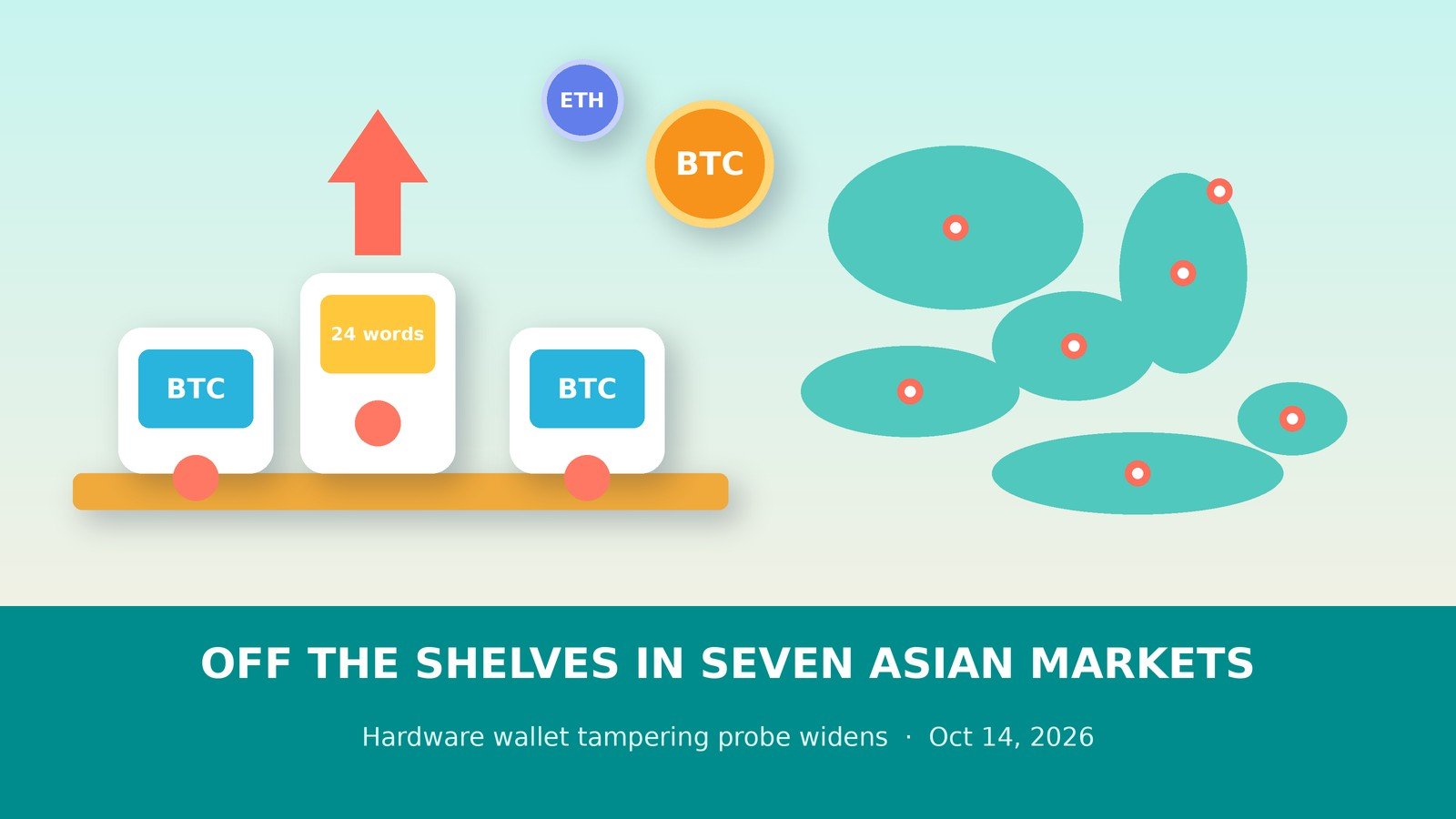
    Ledger has asked resellers and distributors in six Southeast Asian countries and Hong Kong to stop selling its hardware wallets and take them off shelves. The move widens a sales halt that began last week with a single reseller.

    In an update posted on X on Tuesday evening, the Paris-based company named Indonesia, Singapore, Thailand, the Philippines, Vietnam, Malaysia and Hong Kong. “The investigation is ongoing to determine who tampered with these devices and where in the distribution chain it happened,” Ledger said. The request builds on Ledger’s Oct. 9 call for CryptoBilis, a reseller in the region, to pause all sales and shipments.

    Earlier Tuesday, Ledger’s Donjon security team described how the tampering works. An added component sits inside the device’s case and reads the screen. When the wallet shows its 24-word recovery phrase during setup, the implant decodes the words and sends them out over a mobile network using a built-in eSIM. Ledger said the implant does not modify the Secure Element, the chip that guards private keys, or the device’s operating system, and does not alter transactions or signatures. The company said it has no indication that its own systems or its direct sales channel were compromised.

    Ledger says the confirmed losses so far are confined to Southeast Asia. “We have not verified a drain linked to a device bought elsewhere,” it said. In replies to users on Wednesday, the company said confirmed losses involve devices sold “through a limited number of resellers,” without naming them.

    Ledger has not confirmed a loss total or a victim count, and says figures circulating online come from third parties. Blockchain analytics firm Bitquery counts $102.0 million taken from 324 wallets across six blockchains, up from early estimates near $86 million. Bitquery says Tether froze $10.0 million in USDT and that about $84 million could still be traced on-chain as of Tuesday morning.

    The worry has reached store shelves elsewhere. In Singapore, The Straits Times reported that a tampered device had been sold at Metapod in Changi Airport and that another was reportedly bought at a Challenger outlet. In Europe, MediaMarktSaturn has pulled Ledger products after a customer in Germany reported an implant. Ledger said no funds were lost in that case. Rival Trezor said Tuesday it is cutting its own reseller network as a precaution, adding that “there is not a single piece of evidence” its devices have been compromised.

    Ledger’s advice has not changed. CryptoBilis buyers should not set up unused devices, and anyone already using one should move funds to a new device with a new recovery phrase. People who lost funds should contact law enforcement before opening the device.

    Sources: Ledger; Bitquery; The Straits Times; Cointelegraph; The Block

  • Wells Fargo Says Stablecoins Have No Clear U.S. Use. It’s Building One Anyway

    Wells Fargo Says Stablecoins Have No Clear U.S. Use. It’s Building One Anyway

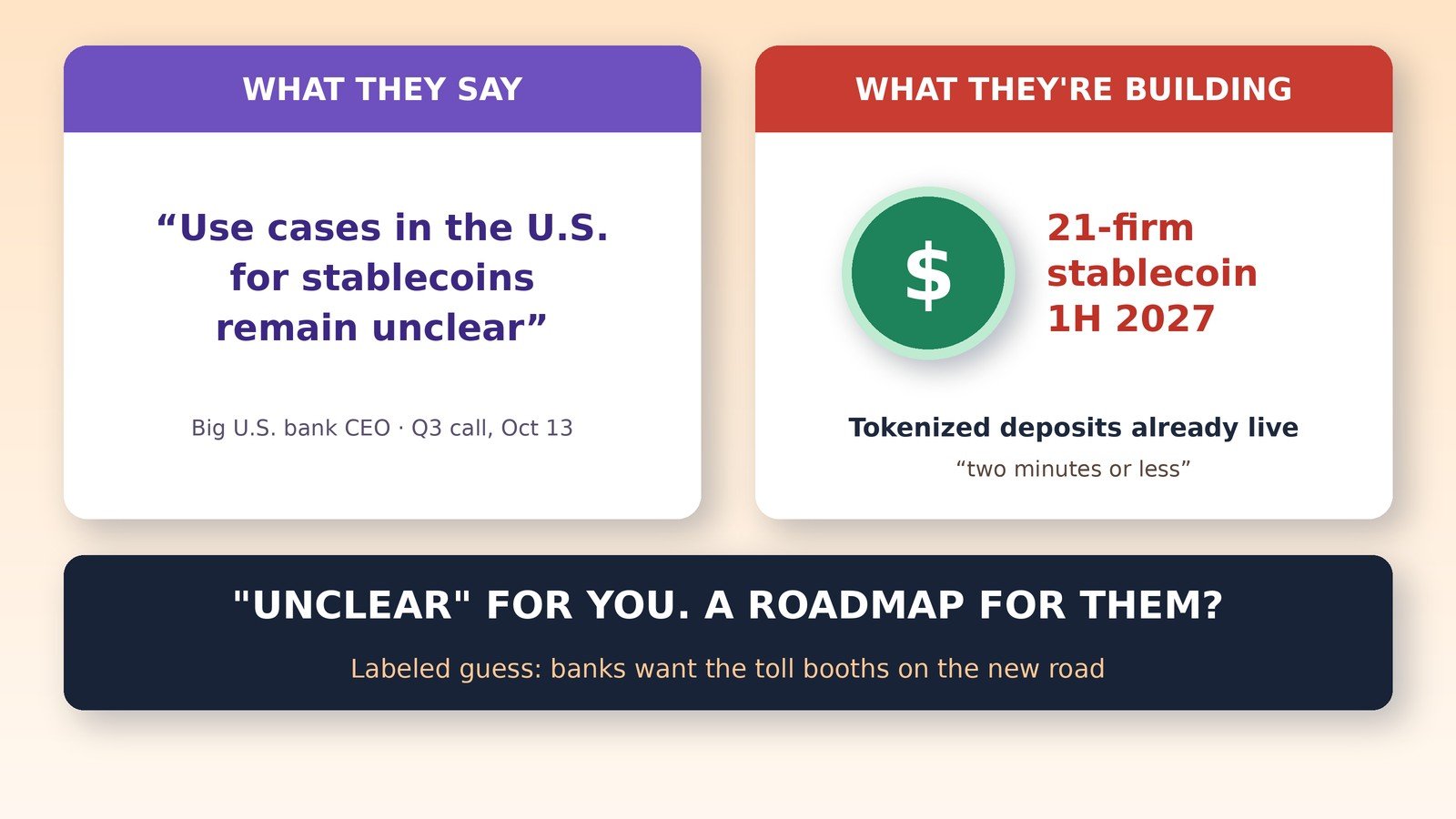
    Opinion. On Tuesday, the CEO of one of America’s biggest banks told Wall Street analysts that stablecoins don’t have a clear use in this country. In the very next breath, he told them his bank is building one. Both things can be true. But it’s worth asking who that first sentence is for.

    What Wells Fargo actually said

    Here’s Charlie Scharf on the bank’s third-quarter call: “Use cases in the U.S. for stablecoins remain unclear, but we’re building solutions to be prepared as opportunities potentially unfold.” Then: Wells Fargo, “along with 20 other international financial institutions,” is setting up a new company “to issue stablecoins beginning in the first half of 2027,” for wholesale, institutional and retail customers.

    And it isn’t just talk. Scharf said the bank launched tokenized deposits on its own blockchain last month for corporate and commercial clients. His CFO, Mike Santomassimo, said it’s “in production,” at “small volume so far,” and payments land “in two minutes or less” instead of a day or two.

    Meanwhile, across the Atlantic, Qivalis, a euro stablecoin company backed by 37 European banks, just got its license from the Dutch central bank on Wednesday.

    Read the fine print

    Look at how Scharf pitched the tokenized deposits: clients will move money around the clock “without changing how they bank with us.” That’s the tell. A tokenized deposit is still a bank deposit. The money stays on the bank’s books, and the bank keeps earning on it.

    An open stablecoin from an outside issuer is a different animal. Money that leaves a checking account for a token is money the bank no longer holds. So when a big bank says the use case is “unclear,” I hear a bank that isn’t in a hurry for you to find one before it does.

    My read, labeled as a guess

    Here’s the speculation, and it’s only that. I think the big banks figured out that they can’t stop stablecoins, so they’re doing the next best thing: build their own, on their own timeline, and make sure the toll booths on the new road have familiar logos on them. “Unclear” is a handy word when you’d like the upstarts to slow down while you catch up.

    To be fair, there’s a boring explanation too. Banks answer to regulators, and nobody wants to oversell a product that doesn’t exist yet. Wells Fargo’s dollar token is still a 2027 plan, and the company that would issue it is still being set up.

    But for regular people, the question isn’t whether banks get into stablecoins. They clearly are. It’s whether you end up with real choice, or just your same bank in a new costume. Watch who gets to issue, who gets to hold, and who gets paid for it.

    This is opinion, not investment advice.

    Sources: Wells Fargo Q3 2026 earnings call; crypto.news; Qivalis; CoinDesk

  • Euro Stablecoin Backed by 37 European Banks Gets Dutch E-Money License. The Token Isn’t Out Yet

    Euro Stablecoin Backed by 37 European Banks Gets Dutch E-Money License. The Token Isn’t Out Yet

    Qivalis, the Amsterdam company backed by 37 European banks to issue a euro stablecoin, said on Oct. 14 that the Dutch central bank, De Nederlandsche Bank (DNB), has authorised it as an electronic money institution. That puts the company under DNB’s ongoing supervision and makes it eligible to issue euro-denominated electronic money tokens, the regulated form of stablecoin under the EU’s Markets in Crypto-Assets rules, known as MiCA.

    The token itself is not out yet. Qivalis says issuance is planned “within the next months” and will still be subject to MiCA’s requirements, including publication of a white paper. It did not give a date.

    What the license does

    Under MiCA, an e-money token is pegged to a single official currency and must be issued by a licensed bank or e-money institution. Holders have a legal claim on the issuer and can redeem at face value at any time, CoinDesk noted. The tokens cannot pay interest.

    Qivalis called the authorisation “a decisive regulatory condition” for issuing its token. “Europe’s currency deserves Europe’s rules – on-chain,” said Jan-Oliver Sell, the company’s chief executive. “We believe Europe should have a euro-denominated on-chain settlement asset issued under European law and subject to European regulatory standards.”

    Who it is for

    Qivalis will not sell directly to the public. It plans what it calls a B2B2X model, distributing the token through banks, exchanges, payment providers and market infrastructure firms. The backers span 15 countries and include BBVA, BNP Paribas, ING and DZ Bank, according to CoinDesk, which also reported that Fireblocks was picked to provide the digital asset infrastructure. The supervisory board is chaired by Sir Howard Davies, a former chairman of NatWest Group and of the UK’s old Financial Services Authority.

    What Qivalis has not said yet: which member banks will use the token first, how much money they expect to move with it, and which blockchains it will run on.

    The U.S. banks are on a slower clock

    The license lands a day after Wells Fargo’s third-quarter call. Chief executive Charlie Scharf said there that Wells Fargo and 20 other international financial institutions are setting up a company to issue stablecoins “beginning in the first half of 2027.” He also said the bank launched tokenized deposits on its own blockchain platform last month for corporate and commercial clients. Chief financial officer Mike Santomassimo said that service is “in production,” at “small volume so far,” with payments reaching the beneficiary “in two minutes or less.”

    The bottom line: a 37-bank euro stablecoin now has its license in hand. The token, its white paper and its first users are still to come.

    Sources: Qivalis; CoinDesk; Wells Fargo Q3 2026 earnings call; crypto.news